07.14.2014 | 2:27 pm
A Note from Fatty: Enormous thanks to everyone who signed up for the 2014 100 Miles of Nowhere Thursday and Friday. The event is now sold out. Huzzah! And again: Huzzah!
A Note from Fatty About Today’s Post: This is part 10 of my 2014 Rockwell Relay Race Report. As a refresher (or if you haven’t read it yet), part 9 is here. Or if you need to, you can go to back to the beginning.
There are certain realities of endurance racing that you simply cannot avoid. One of them is that, at some point, it’s going to stop being fun. No, that doesn’t mean the fun won’t come back. But if it weren’t hard and painful and both mentally and physically brutalizing, it wouldn’t be cycling. It would be baseball.
Ha ha! Just kidding, baseball fans! Baseball is definitely an endurance sport, at least it sure feels like one whenever I try to watch it!
But back to the Rockwell Relay.
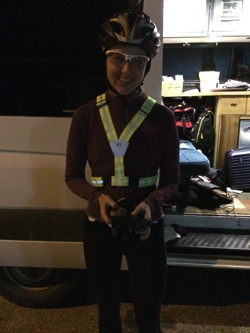
It’s Always Nearly the Darkest Just Before It’s Actually the Darkest
Every year, there comes a point where I stop thinking about how exciting it is and how much fun I’m having and how awesome my friends and wife are, and start thinking instead about how tired I am and how much I want this race to be over.
Without exception, that moment comes sometime during leg 8 — the fourth racer’s second turn. It starts during the coldest part of the night—three or four in the morning—so the racer heading out is starting right at the precise time she (it’s always been a “she” for our team) would never otherwise start a bike ride.
And in short, it just feels wrong to get on the bike then. And yet, Heather always takes the fourth racer place. Every single time (i.e., all four times we’ve done this race).
And somehow, she doesn’t just dial it in, either. The segment starts with a long climb, and Heather passes racer after racer. Like she’s fresh. Like she isn’t freezing. Like it isn’t four in the morning.
This Looks Like a Fine Pillow
As Heather started riding, I climbed into the back and changed into warm, comfortable clothes. Smartwool tights. Sweatpants. A nice stocking cap and a down coat. I have the wonderful just-raced endorphin buzz going on, supplemented by Red Bull and yet another slice of pizza.
As I eat, I look at the amount of pizza we have left. It’s a lot. Like, maybe three times as much as we need. “We need to bring a lot less food next year,” I think to myself.
I think that thought every year.
Then The Hammer makes a request: even though it’s still my “recovery hour,” she needs me to help. She isn’t feeling well at all. And her eyes aren’t great for night driving anyway (something you might not know about The Hammer: minus her contacts, she’s darned close to blind).
That’s fine, I say, and it really is. My heart is still pumping fast after my leg of the race, so I’m plenty awake. I feel good. Further, I know The Hammer wouldn’t ask if she was OK.
So I take over driving, leapfrogging Heather every mile or so. Ringing the cowbell, yelling in the gloaming. It feels strange. Like we’re waking someone up.
Heather catches another female racer and they start working together. Strangely, the other woman is wearing shorts, and a lightweight long-sleeve jersey.
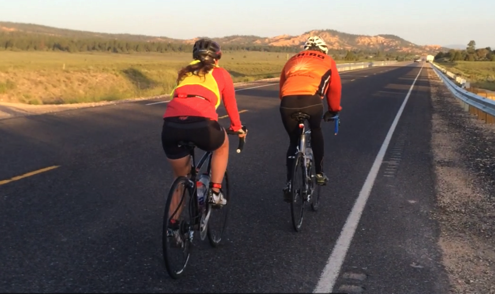 Heather, on the other hand, is wearing roughly twenty times that much clothing, and is still cold. “Why are you dressed so light?” Heather asks the other racer.
“It’s all I brought,” the woman replies. Which wins the “most outrageously crazy thing I heard the whole entire race” award. It gets cold in these mountains. Everyone knows that. The first year, it snowed in these mountains. How could she not have brought something warmer to wear?
I guess I’ll never know.
In between leapfrogs past Heather, I start to warm up. And my heart rate drops. I get sllleeeepy.
I lean my forehead against the steering wheel. Just for a moment, mind you.
Then my next moment of consciousness is when Kenny is tapping me on the crown of my head. “Let’s go,” he says.
And that sets a pattern. I drive for a couple minutes, we cheer Heather on as we go by, I pull over, rest my head against the steering wheel, and instantly drop off until Kenny—who gets out of the van to cheer Heather on—climbs back in and wakes me.
These five-minute naps, done maybe three or four times, get me through the early hours. Give me enough rest to keep plugging away.
Welcome Back, Sun
And then, as Heather still rode, the sun comes. And when that happens, it’s magic. Somehow, even though you haven’t slept (we all know that nodding off with your head resting against a steering wheel doesn’t count), something happens to you. You wake back up. You get a renewed sense of hope. You feel a surge of energy.
You know that you’re going to cross the finish line before that sun goes down again. And that soon, it’s going to get warmer.
A lot warmer.
Maybe too much warmer.
But right at this moment, “warmer” sounds—and feels–really good.
Heather’s gotten us through the roughest leg of the race. Nobody has passed her. Kenny takes off in the early morning sunlight:
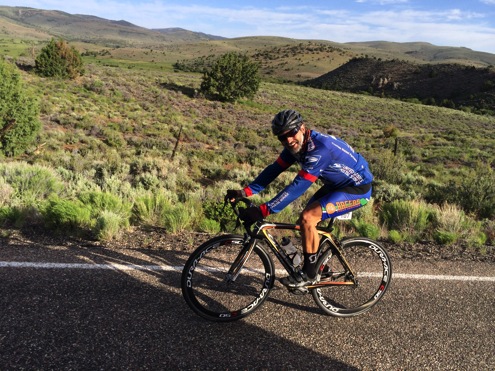
The final set of four turns for our team has begun, and Heather has definitely earned what seems like, at the moment, the ultimate luxury:
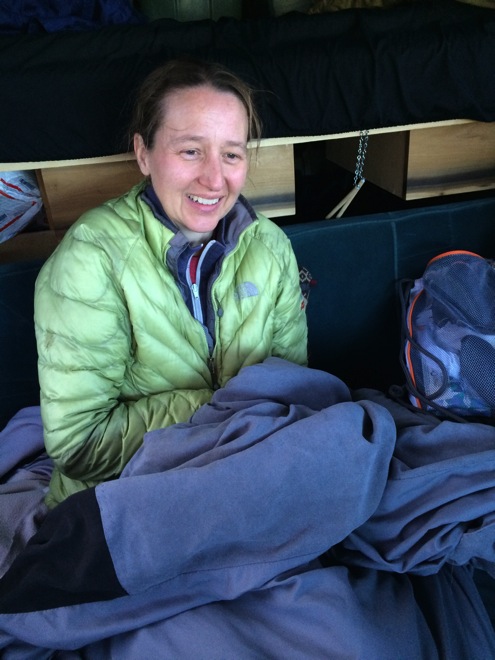
Two shirts, two jackets, a coat, and a blanket. With the van’s heater going full blast.
Hey, she’s earned it.
And that’s where we’ll pick up in the next—quite likely penultimate—installment of this story.
Comments (13)
07.9.2014 | 4:54 am

I am incredibly excited to announce that registration for the 2014 100 Miles of Nowhere opens tomorrow.
Specifically, it opens at Thursday, July 10, at 11:00 AM, EDT. (I.e., 11am EDT / 9am MDT / 8am PDT).
There are a few things that will be different this year. For example:
1. It’s directly benefitting Camp Kesem, a nationwide series of camps put on for kids who have parents who have (or have had) cancer. The idea of Camp Kesem is simple and beautiful: kids who have parents with cancer have missed out on a lot of the fun and silliness that kids ought to have; Camp Kesem helps get them caught up on that fun and silliness. I can tell you that my own twins love this camp more than any other thing they do every summer.
2. It’s in Autumn instead of late Spring. With everything going on in my life, this was the earliest I could make this happen. Many of you seemed to agree Autumn works better anyway.
3. Instead of a 100 Miles of Nowhere T-Shirt, there’s a 100 Miles of Nowhere JERSEY. Here’s the front (but you’ll have to wait ’til tomorrow to see the back, which is my favorite part):
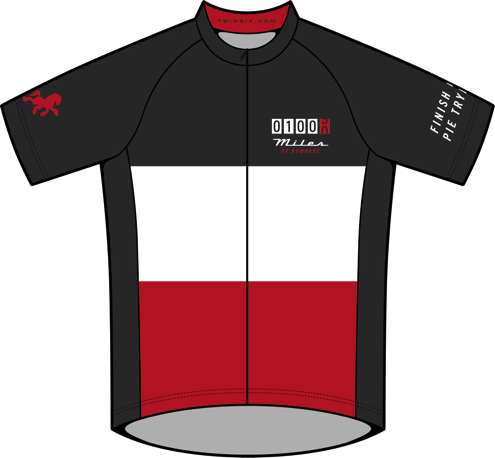
Yes, the sleeve says, “Finish or Pie Trying.” And instead of yet another orange/black/white or pink/black/white jersey, we’re — for the first time ever — adding red to the palette. The reason is simple: it looks awesome.
Why a jersey? Because I get asked about the 100 Miles of Nowhere all the time when I’m wearing the t-shirt, but I want people on bikes to know about this awesome thing we do.
You should also know that this is the ONLY FatCyclist.com jersey there will be this year.
Of course, many of the things about the 100 Miles of Nowhere will be the same. For example:
- It will be capped at 500 people.
- The swag box will be awesome. I know I said I’d do a lower-key swag box this year, but when it came right down to it, I couldn’t help myself. Sponsors have been extra-generous, and you’re going to be stoked with what you get. More on that tomorrow.
- I will want your stories and photos. The thing that makes 100 Miles of Nowhere incredible is that we get to share how we did this ridiculous event. Once you’ve done it — whether on October 18, before, or after — write it up and email it to me. Include lots of photos. Make it fun. I will post as many of these 100 Miles of Nowhere race reports as I can.
This sells out every year, and lately it sells out on the same day registration opens. So you may want to be ready to register as close to the registration opening time as possible.
And today, I’d love to have you post in the comments section what your 100 Mile of Nowhere plan is (unless it’s so crazy you want to keep it top secret, in which case, post that too), to inspire other race participants.
PS: The Hammer and I haven’t decided yet on our course, but I’ve been thinking about the theme of “fastest” this year. Like, what if we found a nice lonely, flat, short course with right turns only, then took turns pulling each other while riding our Shivs and aero helmets? Could we do a sub-five-hour 100 Miles of Nowhere (breaks included)? It’s an interesting question!
Comments (92)
06.30.2014 | 2:01 pm
A Note from Fatty: My review of Phil Gaimon’s Pro Cycling on $10 a Day: From Fat Kid to Euro Pro is below. Be sure to read it, because it’s so insightful and enlightening that you will be unable to refrain from openly weeping.
And be sure to sign up for, mark your calendar for, and otherwise make sure you attend the live Q&A with Phil Gaimon on Tuesday, 12:00noon EDT / 11:00AM CDT / 10:00AM MDT / 9:00AM PDT. You can watch it below, but I really recommend you go to the Spreecast site to watch it, so you comment, ask questions, talk amongst yourselves, and whatnot. This is going to be a pretty fantastic opportunity to talk with one of the most down-to-earth pros you’ll ever meet; don’t miss it.
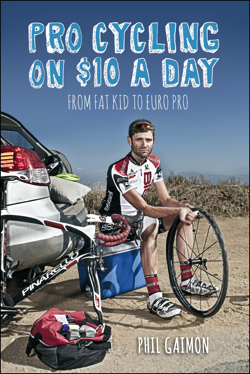 Review: Pro Cycling on $10 a Day, by Phil Gaimon
In general, I skip prefaces and introductions and forewords and dedications at the beginnings of books. And in general, I would recommend you do the same.
But for Phil Gaimon’s Pro Cycling on $10 a Day: From Fat Kid to Euro Pro, reading the preface is absolutely essential. It’s where Gaimon describes how some kids ask him for advice on how to rise through the ranks to become a pro cyclist.
Gaimon thinks about it, considering ways he could craft his response:
I’d sit them down for a lecture. I would start by explaining how hard it’s going to be, how many hears of solitude and poverty they’ll have to push through, and how many opportunities and relationships they’ll have to sacrifice. Only after the young riders grasped the downside would I feel comfortable explaining the beauty of the sport, what I’ve taken away from it, and why I wouldn’t trade it for anything.
And that is exactly what this book does. Using frequent aphoristic headings — as if they were guidance for the aspiring pro (“Get everything in writing,” “You can say no,” “Being right doesn’t always mean you win,” “Bacon is your friend”) — Gaimon tells his story, starting all the way back when he was a teenager, riding his way through college, and subsisting on way sub-minimum wage as a pro-in-sarcasm-quotes cyclist.
It’s a good story, and Gaimon tells it with a strong, personal (and personable) voice. He’s usually funny, frequently vulgar, sometimes naive, occasionally angry and accusatory, and once in a while he’s even serious and touching.
In other words, Gaimon comes across as a mostly-normal young man, who just happens to be an experienced writer (he’s written for both Bicycling and Velo magazines) with considerable ability, a lot of personal drive and ambition, and no small amount of personal discipline.
OK, so maybe he isn’t that normal.
My short-version assessment is that Pro Cycling on $10 A Day gives you an incredibly realistic and entertaining feel for what goes on in the minor leagues of pro cycling. It’s also the best—by far—of the current crop of cycling autobiographies.
It’s fun, it’s insightful, it’s surprising, and it’s well-worth reading.
So with that said, now let’s dig into what I like—and don’t like—about this book.
Detailed Storytelling
The single thing I liked the best about Gaimon’s writing is that he tells a great racing story—he talks about what he’s thinking and what he’s doing before the race, the moves and strategies during the race, and even what he wishes he would have done differently after the race. Early in the book, he gives an example of how he was bullied into doing more than his share of pulling:
I took a hard pull and flicked my elbow, asking Jonny for help.
“Fuck you! You pull us back there!” he replied. I kept pulling and didn’t say a word, but Jonny kept a consent barrage of insults coming, lashing me like a whip.”
And then,, after the stage:
I sat reluctantly beside Jonny Sundt, afraid to make eye contact after our interaction early in the race, but he was fine….It was a tactic, and it earned him a free ride across to the break.
A few things happen here. First, Gaimon pulls us not just into the action of the race, but into the personalities, strategies, and conversations of the race.
The second thing is Gaimon lets us take the verbal beating right alongside him. We don’t know why Sundt is attacking him until after the race is over…just as Gaimon didn’t.
Finally, we find ourselves wondering, after the fact, how we would have reacted to this kind of “barrage of insults.” Personally, I think I would have caved, and maybe not come back for more. And I started understanding—much more than I had before—that the toughness required of pro athletes is more than physical, more than mental. There’s an emotional toughness that’s required, and it’s a pretty critical component.
Gaimon doesn’t do the kind of navel gazing I just did, though. He just tells the race stories — both what’s happening around him and what’s going on in his head — with enough detail that, after a while, you get a much more clear picture of the inside of an elite-level race than you’ll ever get by watching on TV.
Fat Kid, But Not For Long
Pro Cycling on $10 A Day doesn’t have this kind of detail everywhere.
It seems strange to me that it has the subtitle, “From Fat Kid to Euro Pro,” and that the back cover text leads off with the “fat kid” angle, too (“Plump, lumpy, slumped on the couch and going nowhere fast at age 16…”). That kind of emphasis promises a central theme or plot point in the book.
As a guy who constantly fights to keep the weight off, I was interested.
The thing is, though, the book itself only barely mentions this “fat kid” phase. Indeed, a scant two pages is devoted to this transition, and is behind us before the middle of page 5.
In a book full of detail, it’s a pretty weak delivery of what the cover promises.
Mentors and Villains
Pro Racing on $10 A Day isn’t a thick book — just under 300 pages, plus the front matter and the glossary. However, thanks to the itinerant lifestyle and numerous races of a young, hyper-under-employed pro (Gaimon’s not kidding about the “$10 A Day” thing), Gaimon moves in and out of peoples’ lives with incredible frequency, to the point that my head was spinning with all the names, trying to remember from one page to the next who they were and whether I needed to remember them.
Which, come to think of it, is probably what Gaimon was doing, as well.
As the book progresses, however, there are certain people who emerge as standout characters—people who have strongly affected Gaimon’s life.
Jeremy Powers, more than anyone else, seems to be a mentor, as well as the person perhaps most responsible for helping Gaimon turn a corner in taking his career seriously, on investing in himself. Looking at the sparse food and almost non-heated status in Gaimon’s house, Powers tells Gaimon:
“How can you be fast when you have to wear a jacket in your own house?” he asked. “You can sit here and half-ass this thing, and you’l always make $20,000 a year, or you could do it right, invest in yourself, and make 10 times that. You know you have the talent, so stop being scared!
Over and over (63 mentions by name, according to my handy Kindle version of this book), Powers emerges as almost a North Star for Gaimon.
Gaimon’s admiration for / friendship with / loyalty to Powers comes through as a very touching thing. It also made me want to read Jeremy Powers’ autobiography; he comes across as a very centered, focused, and insightful person.
But where Gaimon has boundless admiration for Powers, he has nothing but scorn for Chad Thompson, who at the time was the “the boss” of the Kenda pro team, which Frankie Andreu directed and Gaimon rode for. Gaimon relentlessly ridicules Thompson and his apparently unbroken string of bad decisions, to the point where it starts feeling a little bit lopsided. I found myself wondering, “I wonder what the other side to this story is?”
And Shades of Grey
Gaimon starts his career — and the book — out brash, with a lot of youthful bluster. I don’t know how he manages it, but in a lot of cases he writes with more nuance and understanding as the book progresses; this mirrors his own growing experience. Early on, for example, he apologizes to the reader for not taking advantage of an opportunity to punch Lance Armstrong in the testicle.
Later, he relates how he trashes Tom Danielson for not knowing that he had made an agreement with Levi Leipheimer that he was going to go across to a breakaway. Still brash, but no longer straight-up juvenile.
Then, toward the end of the book, he’s training with the same Tom Danielson, and admiring his work ethic and dedication to training.
Eventually, he concludes, as he tries to resolve his disdain of doping with his friendship of those who have doped:
…You have to look at a person’s full body of work before you judge him. Frankie Andreu doped and I couldn’t have asked for a better friend or mentor. Jonathan Vaughters doped, and then brought cycling back from the edge of a cliff. Tom hadn’t made up for his doping yet, but I’d seen him pull over to help a stranger change a flat tire, and I could tell that he was just another normal guy who did something wrong.
It’s a well-put statement of someone who has strong convictions, which are beginning to be tempered by a complicated world.
Gaimon’s book ends essentially as he’s being brought into the big league. He’s still brash, he’s still himself. But he’s growing, and he’s interesting.
Phil Gaimon is a good writer, and it feels like he’s on the path to getting better. His story is compelling, honest, and funny.
I strongly recommend Pro Cycling on $10 a Day: From Fat Kid to Euro Pro.
Comments (18)
06.30.2014 | 9:26 am
A Note from Fatty: I know it’s unusual for me to post twice in a day, but I needed to today. I just posted my review of Phil Gaimon’s Pro Cycling on $10 a Day: From Fat Kid to Euro Pro today. OK? Meanwhile, I just have to talk about this bike. Have to.
About two years ago I was talking with the founder of Ibis, Chuck Ibis (known in real life as Scot Nicol). I was telling him that I missed having an Ibis for mountain biking, but that I’m a hardtail guy. A 29er guy. And, increasingly frequently, a singlespeed guy.
“We’re working on something for you,” he said, conspiratorially. “A bike you’re going to love. You’ll be able to set it up as a geared 29er hardtail. Or as a singlespeed, just as easily. Or even with a Gates carbon belt drivetrain. It’s going to be so light, it’s going to be so versatile. It’s going to be your new favorite mountain bike. It could be your only mountain bike.”
“I want one,” I said. “How soon?”
“Stay in touch,” Chuck said. “We want to get it perfect.”
And I have. Relentlessly. For two years I have texted Chuck at least once or twice a month. “Got a picture for me? Got a date? When can I have this bike?”
“We’re still working on it,” Chuck said, over and over. And over.
And then, a couple weeks ago, he sent a couple pictures. “Show these to nobody.”
Here’s what he sent me:
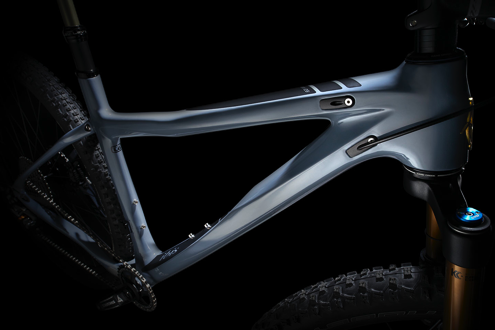
And this:
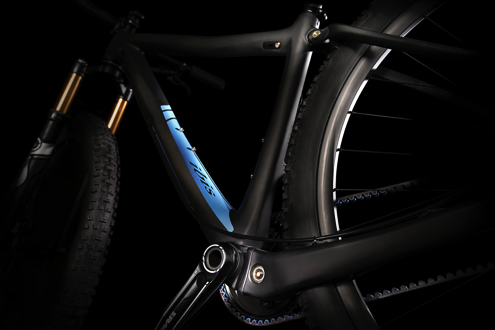
“MUST. HAVE. NOW,” I texted him.
“It’s on its way to the US right now,” he told me. “Then some quality control checks. Then you can have one.”
“It’s called the Tranny 29?”
“Yep.”
I confessed to being slightly disappointed by this. I had lobbied to have the bike named “Clyde,” my middle name (and also one of the Pac Man ghosts).
But this is a minor thing. A thing I can live with. And also, I can have decals made for mine.
Meet My (Your) New Bike
Over the weekend, Chuck told me they were going to be announcing the Tranny 29 today. Like, now. And that this is what it looks like set up as a single:
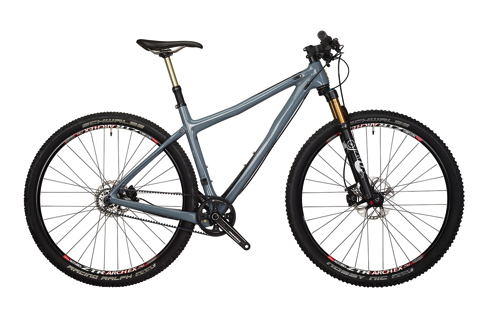
Or geared:
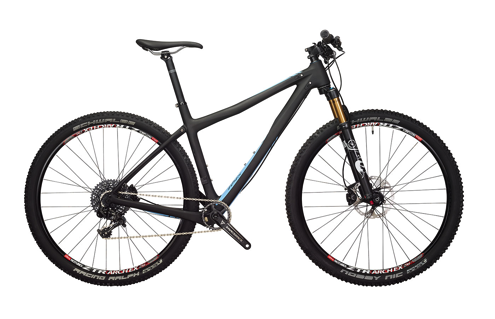
Chuck also pointed out that Jefe Branham had actually — the day before the planned Tranny 29 release — just won the Tour Divide on a Tranny 29. And that they had made a video just before Jefe had started the race. Here:
The Part That Excites Me
The Tranny 29 is a good-looking bike. And it’s an Ibis, so you know for sure it’s going to ride beautifully.
Those are things to be excited about, sure.
But it’s the rear triangle that makes all the difference to me. Its clever design makes it so you can break down and transport the bike a lot more easily than most mountain bikes.
And (for me, more importantly) it also solves a problem most singlespeeders have — or have had — for pretty much ever: chain tension.
See, when you don’t have a rear derailleur to tension your bike chain, you’ve got to do it some other way. For other bikes, this happens either at the bottom bracket, or at the dropout.
If you go with the dropout method, it means moving the rear wheel back to give it tension, which means adjusting the brakes and centering the wheel…and, at some point, probably having your wheel slip in the dropout.
Or if your bike has an eccentric bottom bracket, it means rotating the bottom bracket shell to give the chain tension. And I have never ever seen a bike using this method that doesn’t start creaking horribly at some point.
So I’m excited about the Ibis solution. You see that bolt down there by the crank?
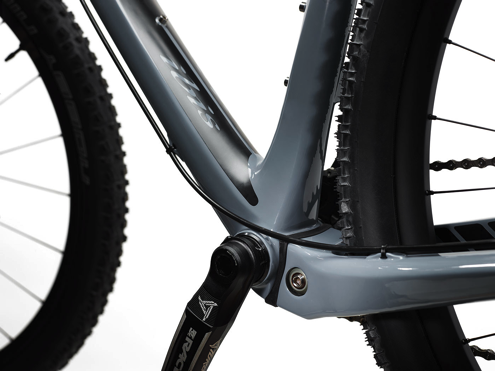
That’s called the “slot machine.” You loosen that bolt and one more at the top of the seat stay, lengthen the chainstay to tension the chain, and tighten it down. Easy.
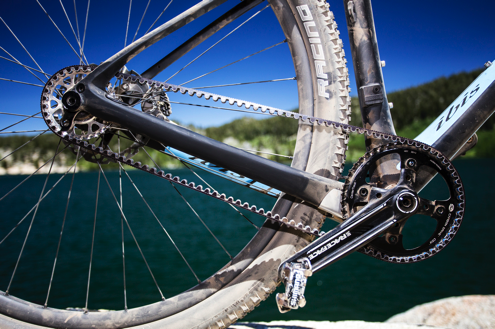
Meanwhile, the wheel, its centered-ness and its position relative to the brake calipers remain rock-solid and unchanged, thanks to the 142mm Maxle rear axle.
My Plans Have Changed
Would it surprise you to know that I have a Tranny 29 on order? No? Oh, you know me so well.
And would it surprise you to know that I have a SRAM XX1 drivetrain on order, too? Which means I’ll be able to change this bike from a geared to a singlespeed ridiculously easily? Like, almost on a whim?
No?
Well, would it surprise you to know that I also have a Gates Carbon Belt Drive setup on order, too, since—by virtue of the ability to remove the rear triangle—this bike is beltable?
OK, I bet that was a little bit of a surprise.
And how about this: I’m changing my Leadville Trail 100 registration. Where I was going to go geared this year, I think it’s time—based of course on whether I love this bike as much as Chuck thinks I will—for me to singlespeed this course on the bike I’ve been wishing for for about two years.
Excited? Yeah, I guess you could say I’m excited.
PS: Count on a real-time as-it’s-built post in the near future.
Comments (28)
06.27.2014 | 10:51 am
Here’s something I’m surprised to be finding out about myself: I like reviewing stuff, as long as it’s really interesting. Like, if I really love something and find myself thinking about why I’m drawn to it. Or if I really hate something and wonder how it ever came to see the light of day. Or if I’m just confused by something and wonder what I’m missing — or if perhaps the creator of that something just didn’t think things through.
For things like bikes and helmets and power meters, I may not be (ha!) qualified to do good reviews. Hey, I don’t even really work on my own bikes.
But for things like books, well, I do write. And I read a lot. And I like stories about people who ride bikes.
So you might be seeing more reviews here. And I’m going to be honest. Which may come across as a little tough sometimes. But I’m also going to be fair, and try to maintain my core philosophy (be kind).
Read — And Then Meet — Phil Gaimon (Garmin-Sharp)
This Monday, I’m going to be reviewing Phil Gaimon’s Pro Cycling on $10 a Day: From Fat Kid to Euro Pro.
And then, Tuesday — 12:00noon EDT / 11:00AM CDT / 10:00AM MDT / 9:00AM PDT — we’re going to have a live video chat with Phil on Spreecast. I have a bunch of questions for him, but would like you to use the comments question today to start asking your own.
Plus, be sure to attend the Spreecast; I’ll be sure to let as many of you as possible ask Phil your questions yourself.
I want to point out that — as I did with my review of Hincapie / Hummer’s book — I extended the opportunity to Gaimon to have a chance to respond to my review and answer questions, but have not shown him the review itself.
Unlike with the Hincapie / Hummer books, Gaimon accepted, in spite of the fact that he doesn’t know what will be in the review, nor its tone. So kudos to him for that.
Check back Monday for the review and info on watching / participating in the Spreecast.
Have a good weekend and ride lots.
Comments (15)
« Previous Page — « Previous Entries Next Entries » — Next Page »
