
I Shall Run No More Forever

10.14.2005 | 3:39 pm

Every year about this time, I start thinking: maybe I should start running again. After all, cross-training is good for you, right? Plus my buddy John and I have a tradition of signing up for the Death Valley Marathon each year (I did a writeup on this race back in 2003, posted below as a surprise bonus for people who feel they deserve to be punished), so I ought to start training for it, right?

No.

I’m not going to run.

Ever again.

This is why.


Guilty Relief

Last January, my training for the Death Valley Marathon went especially badly. I was the heaviest I had ever been in my life (around 192 pounds), due to steroids and holiday overindulgence, not to mention some pretty half-hearted training. I was planning to do the marathon with John, but had no expectations of doing much running. I was a very solid back-of-the-pack bet.

So when John called me from the hospital — five days before the race — saying he was going to have to bail on the race, due to the fact that he had had a heart attack that day, I had three reactions:

  • Relief that he was OK.
  • Concern that since John had a heart attack, I was probably at risk, too – he and I are very similar in the way we train, eat, and live.
  • Joy that I now had an ironclad excuse for not doing the race. Not as ironclad as John’s, but close enough.

I have not run since. Man, that sport could kill you.


Irrefutable Logic

I actually understand why runners run. They run for a lot of the same reasons cyclists ride: It’s a good workout. You can do it right out your front door. You get to be outside and see a little bit of the world. When you do it right, you get that endorphin rush and feel great.

Sadly, these reasons are not sufficient. Here is what is wrong with running:

  • It pounds the crud out of you. As you bike and get in better shape, you hurt less and less. That’s because your muscles are getting stronger and you’re not slamming all your weight and force into your joints several times per second. This cannot be said of running. Runners spend all this time stretching and warming up and cooling down, but they all wind up hobbling around with screwed-up joints anyway. Basically, I’m willing to endure muscle soreness because I know that’s part of the process of building fitness. Joint soreness is just the path to more joint soreness.
  • Lack of variety. When I get tired of road biking, I mountain bike. Or I get out the fixie. Or try cyclocross. With running, you get to do what to mix it up? Run really fast instead of at your normal pace? Run on trails instead of road? Maybe skip or hop? Or run backwards? When I bike, I never use an MP3 player, because there’s so much going on, my mind stays plenty busy. When I run, on the other hand, I need an MP3 player desperately. Because otherwise the tedium is Just. Too. Much. Here’s a thought: If an essential part of your exercise gear is a gadget that helps you keep your mind off that exercise, maybe it’s time to switch sports.
  • Lack of cool gear. OK, I admit this is a throwaway point, but if you’re a gear geek like me, you know what I’m talking about. With biking, there’s new frames and components and clothes and helmets and measuring apparatus! With running, there’s shoes (oh yes, lots and lots of shoes) and shorts and … socks? Maybe special running underwear? Headbands?
  • It injures you without giving you a cool scar, nor a story to tell. Both runners and cyclists get injured while doing their thing. That’s just a given. For cyclists, every injury has an accompanying story that can be treasured, tweaked, and told for decades to come. I admit that there have been times when, even as I writhed in pain, a little part of me was working on the description of how bad I hurt. Runners, on the other hand, get to talk about how they were jogging along when — spung! — their kneecaps fell off, due to overuse. Hey, if you’re going to suffer, you may as well have a story to tell. In short: when biking, you accept that something surprising and dangerous may happen to you while you’re biking. With running, you accept that you are injuring yourself because you’re running.

Call to Action

Runners, please: Quit running. Buy a bike. You’ll go faster. You’ll hurt less often. When you do hurt, you’ll have a nice little anecdote to share.

I’m glad I could clear this up for you.


Today’s weight: 159.8. OK, I’m done. Just going to try to keep it here for a few months, then drop to 150 for the race season; I’ll start on that in March.


Clarification of what "I’m Done" means: It just means I’ve hit my goal weight for the off-season. I’m not going to stop writing, I’m not going to stop training, I’m not going to stop dieting, I’m not going to stop going on massive burrito binges. I’m not even going to stop having the Fat Cyclist Weekly Weigh-in Sweepstakes. I’m just going to try to stabilize my weight for a few months before making the next big race season weight loss push, where I’ll try to get as close to 150 as I possibly can.
 

Death Valley Marathon Report

10.14.2005 | 2:21 pm

In February of 2003, a neighbor of mine (John) and I ran the Death Valley Marathon. I figured that since I — theoretically, at least — was going to do an offroad marathon as part of the Mountain Extreme Triathlon that summer [note: I chickened out], I’d better have done at least one marathon beforehand. Since this was to be an all-offroad marathon, it seemed like a good choice.

John and I took Friday off from work, because we figured Death Valley — 2 1/2 hours out of Las Vegas — would be around a 10-hour drive from Orem. Well, there aren’t a lot of curves in that road, not a lot of reasons to go slow, and I have a car that likes going fast. We got there in under 8 hours. We had plenty of time for a little siteseeing (the Devil’s Golf Course is the most surreal thing I have ever seen), a big dinner, and then off to bed. We’d need to be up early for the race.

Saturday morning we got our race bibs and then gathered around the race director for his race instructions. "I was in charge of marking the course," he said, "And I took great care marking all the turns and mile markers." Lots of laughs came from the crowd, which I didn’t understand. Then he said, "Just kidding. There are no mile markers, there are no turns. There’s just one, long road with a finish line at the end." Then he said, "If you want to stop and take some pictures along the way, go ahead and pause your stopwatch. When you get to the finish line, we’ll adjust your time for you." I could tell this was going to be a low-key event.

All the racers (field limit of 250) boarded schoolbuses; the drivers proceeded to take us to the exact center of the middle of nowhere. They parked on a dirt road, which looked like it rose at a very slight incline ’til it stopped at the foothills, very far away. Nothing but flat and sagebrush in every direction. I had heard this was supposed to be a beautiful marathon; what a crock.


Running on a Treadmill

There was no starting gun; instead, we were told that the race would start when the brake lights on the jeep 20 yards ahead of us went off. OK, gotta love the pared-down nature of this race. The lights went off and we all took off up the road.

The strange thing about running on a perfectly straight, very-slightly uphill road, is that it seems like you’re not going anywhere, and certainly nowhere very fast. In particular, though, I was not fast. Within the first couple of miles, I was sorted to the back third of the field. I didn’t care though (so I say); I was just there to see if I could cross the finish line on my feet.

After what I’m going to guess was about 8 miles the perfectly straight road reached the foothills and started twisting upward. That’s when I started being grateful for my big ol’ mountain biker legs. I’ve got horrible running top speed, but tons of torque. Up I went, passing dozens of people. OK, maybe just one dozen. After about 2 miles and I’d guess around 1000 feet of climbing, I caught up with John — we had made it to the 10 mile aid station.


Down We Go

Now for a big batch of downhill — or, what I would have considered a big batch of downhill up until Saturday (you’ll see what I mean in a minute). In a mile or so we descended 500 feet. My feet were bunching up in the front of my shoes, but it still felt good to "coast" a little bit. I was worried, though, by what I could see in front of me: a very steep road, zigzagging up the mountain not far away. I figured that couldn’t be part of the run. Too steep.

It was part of the run.

John and I were pacing each other well now, and I proposed a "run 2 minutes, walk 1 minute" approach to this mountain pass. John ratified the proposal and up we went. The strategy worked; it’s easier to deal with pain when you know it’s going to end in an exact amount of time. We passed a bunch of people who were evidently demoralized into walking the whole pass, and reached the 12 mile mark. I think we climbed almost 1000 feet in 1 mile. John sang the blues (literally).

Now, though, we had nothing but downhill in front of us. 14 miles of downhill, descending 5000 vertical feet. The first 2 miles of it were crazy-steep; you had to shuffle-step in some places to keep from losing control. Now, though, I had a better idea of why people said this was such a beautiful run. Having summitted, we were now treated to beautiful canyons, stark, gorgeous mountains, and giant vistas at unfathomable distances. John and I stopped a couple of times to take a few pictures.

Mostly, to tell the truth, I kept my head down, picking out a good line to run. The road was mostly very good semi-packed dirt, but there were spots where you had to run through deep gravel for 20 feet or so. That slows you down. I stopped to empty my shoes no fewer than 5 times during this race.

By the time we reached the 15 mile aid station, I had hit my endurance groove. Before the race, I expected to have sore knees, ankles and insteps by this point, since I usually have all three of these by the end of much shorter runs. I was surprised to find, then, that I had no aches. I felt good and strong. Running on dirt is much kinder to your joints than running on pavement.

Between mile 15 and 20, John and I hooked up with a 60-year old guy from Santa Cruz; he says he does 4 marathons per year. I don’t doubt it. John and I would pass him from time to time, but he always reeled us back in. At the 20 mile aid station, when John and I stopped to get a drink and some Advil, he continued on. I figured that was the last we’d see of him.


Home Stretch

Most of mile 20 – 23 is through a winding, narrow (maybe thirty feet wide?), but incredibly high canyon. I’d get vertigo craning my neck up, looking at the top. Or maybe it wasn’t vertigo. Maybe I was looped from having run further than I ever had before. Whatever.

We got to the final aid station (mile 23), then, almost immediately, could see the finish line. We were back in the flats, where it was hard to gauge distance. John started picking up the pace. I matched. He kept pushing, I kept matching as best as I could. We were now going at a 7 1/2 minute/mile pace.

Finally, I didn’t think I could match anymore and said, "John, go ahead, I’ll see you in a few."

John replied, "No, we’re finishing together." Then he started singing "Give Me Three Steps." We kept going. John pointed out that it would be nice if we could catch the 60-year-old before we finished. We did, about 50 feet before the finish. Then the 60-year-old showed us who was boss by breaking into a sprint, beating us at the finish line. It’s tempting to say "I hope I’m in that kind of shape when I’m 60," but the truth is I’d be happy to be in that kind of shape right now.

My stopwatch — which I forgot to pause, much to my dismay — shows that we finished in 4:39. I’m happy with that.

48 hours later, I was the sorest as I’ve ever been — especially my quads, which have never taken a 14 mile downhill beating like that. Stairs were not easy to climb now, and were impossible to descend.

The Water Bottle Manifesto

10.13.2005 | 5:34 pm

I have a cupboard full of water bottles. I have a couple dozen of these bottles, easily. Most of them came as freebies from events, some of them came as promotional schwag, and I’ve even bought a few of them.

I should just throw all of them out.


Freebie Water Bottles

The problem with the freebie water bottles you get whenever you do a race — or go to a charity event or attend a store opening — is simple: they suck. But they don’t just suck in one way. They suck across a multitude of dimensions. And since I’ve got myself all worked up about this, I may as well get specific:

  • The plastic taste: Any liquid you put in one of these cheap bottles takes on the taste of low-grade PVC. You can replace that plastic taste by putting in a sports drink, after which any liquid you put in that cheap plastic bottle will take on the taste of the aforementioned sports drink. Now, I’ve owned regular plastic cups before, so I know it’s possible to make a plastic receptacle that doesn’t infuse and dominate my water with its previous content. So why don’t the bottle makers go and reverse-engineer that top-secret plastic cup formula that’s been around since WWII and apply it to their water bottles?
  • The valve: While the water bottles themselves are made by stingy industrialists who evidently have never checked to see what water tastes like once it’s been in their wares, the makers of the valves are clearly former joke shop employees. When you go to pull the valve open with your teeth so you can take a drink, one of the following is guaranteed to happen:

1.      The valve will not pull open, no matter how hard you tug.

2.      The valve will not pull open, and when you tug good and hard, the whole lid will pop off and all the water will pour onto your face and down your jersey.

3.      The valve will pull open, but when you drink, water will dribble outside the valve while you drink, making it look like you have mouth-control issues. (Please note: the fact that this is the most desirable of the three potential outcomes does not imply it is a favorable outcome.)

  • The size: Freebie water bottles are made just a little too narrow to fit snugly in a water bottle cage. If you are foolish enough to put one of these water bottles in your cage and go on a ride, it will rattle around until you huck it onto the side of the road in a fit of pique, or it falls out of the cage of its own accord (and, predictably, without you noticing, so that you only later find you have no water at all).


The Best Water Bottles Ever

Water bottles do not have to be lame. I have, at one time, owned a set of three water bottles I loved. Yes, “love” is the word I choose to show my regard for these water bottles. They were made by Cannondale, under the Coda brand. They were oversized, holding about 50% more water than most bottles, so you had to have a wide-open frame to hold them, but two of those bottles would take care of you for a good long ride. They didn’t taste like plastic. They had screw-top lids, so you didn’t get the nasty surprise of going for a drink and getting a faceful of water instead. They had good valves that were neither too tight, but somehow didn’t dribble, even after hundreds of trips through the dishwasher.

I lost one of those bottles somewhere; the other two I actually wore out. Yes, after using these bottles exclusively for about three years, the seams on the bottles tore and I had to chuck them. And meanwhile, Cannondale had stopped making these wonderful bottles, so now I use Specialized bottles, which are actually good in just about every respect — but I wish I could get my hands on oversized ones for the big rides.


A Plea to Event Promoters

In my typical fashion, I haven’t gone out researching to see if there are bottles out there that have a loyal following. If there are, I would happily buy them. And for the race/event promoters who give us both a cheap, useless t-shirt and a cheap, useless water bottle, here’s an idea. Instead of giving us two useless things, pool the money and give us a really good water bottle (I don’t need any more t-shirts this lifetime, thanks). If you do, I promise I will use it all the time, and my water bottle cage will become, in effect, a teeny little billboard for your event.

Wouldn’t that be super?


A Note About Water Bottle Cages

I have no similar grievance about water bottle cages, because I am perfectly happy with my Ciussi bottle cages. Whether road or mountain, these things are great.


Today’s weight: 160.6 lbs


PS: Congrats to MuMo, who’s been commenting on this blog pretty much daily. Her own blog — MuseMonkey – is currently featured on MSN’s "What’s Your Story." Huzzah, MuMo!

The Water Bottle Manifesto

10.13.2005 | 6:04 am

A Note from Fatty: This "Best of Fatty" post, rescued from my MSN Spaces archive, was originally posted October 13, 2005.

I have a cupboard full of water bottles. I have a couple dozen of these bottles, easily. Most of them came as freebies from events, some of them came as promotional schwag, and I’ve even bought a few of them.

I should just throw all of them out.

Freebie Water Bottles
The problem with the freebie water bottles you get whenever you do a race — or go to a charity event or attend a store opening — is simple: they suck. But they don’t just suck in one way. They suck across a multitude of dimensions. And since I’ve got myself all worked up about this, I may as well get specific:

The plastic taste: Any liquid you put in one of these cheap bottles takes on the taste of low-grade PVC. You can replace that plastic taste by putting in a sports drink, after which any liquid you put in that cheap plastic bottle will take on the taste of the aforementioned sports drink. Now, I’ve owned regular plastic cups before, so I know it’s possible to make a plastic receptacle that doesn’t infuse and dominate my water with its previous content. So why don’t the bottle makers go and reverse-engineer that top-secret plastic cup formula that’s been around since WWII and apply it to their water bottles?

The valve: While the water bottles themselves are made by stingy industrialists who evidently have never checked to see what water tastes like once it’s been in their wares, the makers of the valves are clearly former joke shop employees. When you go to pull the valve open with your teeth so you can take a drink, one of the following is guaranteed to happen:

  1. The valve will not pull open, no matter how hard you tug.
  2. The valve will not pull open, and when you tug good and hard, the whole lid will pop off and all the water will pour onto your face and down your jersey.
  3. The valve will pull open, but when you drink, water will dribble outside the valve while you drink, making it look like you have mouth-control issues. (Please note: the fact that this is the most desirable of the three potential outcomes does not imply it is a favorable outcome.)

The size: Freebie water bottles are made just a little too narrow to fit snugly in a water bottle cage. If you are foolish enough to put one of these water bottles in your cage and go on a ride, it will rattle around until you huck it onto the side of the road in a fit of pique, or it falls out of the cage of its own accord (and, predictably, without you noticing, so that you only later find you have no water at all).

The Best Water Bottles Ever
Water bottles do not have to be lame. I have, at one time, owned a set of three water bottles I loved. Yes, “love” is the word I choose to show my regard for these water bottles. They were made by Cannondale, under the Coda brand. They were oversized, holding about 50% more water than most bottles, so you had to have a wide-open frame to hold them, but two of those bottles would take care of you for a good long ride. They didn’t taste like plastic. They had screw-top lids, so you didn’t get the nasty surprise of going for a drink and getting a faceful of water instead. They had good valves that were neither too tight, but somehow didn’t dribble, even after hundreds of trips through the dishwasher.

I lost one of those bottles somewhere; the other two I actually wore out. Yes, after using these bottles exclusively for about three years, the seams on the bottles tore and I had to chuck them. And meanwhile, Cannondale had stopped making these wonderful bottles, so now I use Specialized bottles, which are actually good in just about every respect — but I wish I could get my hands on oversized ones for the big rides.

A Plea to Event Promoters
In my typical fashion, I haven’t gone out researching to see if there are bottles out there that have a loyal following. If there are, I would happily buy them. And for the race/event promoters who give us both a cheap, useless t-shirt and a cheap, useless water bottle, here’s an idea. Instead of giving us two useless things, pool the money and give us a really good water bottle (I don’t need any more t-shirts this lifetime, thanks). If you do, I promise I will use it all the time, and my water bottle cage will become, in effect, a teeny little billboard for your event.

Wouldn’t that be super?

A Note About Water Bottle Cages
I have no similar grievance about water bottle cages, because I am perfectly happy with my Ciussi bottle cages. Whether road or mountain, these things are great.

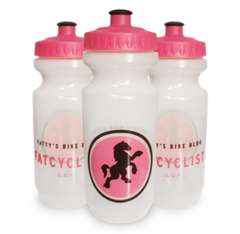
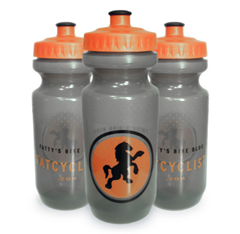
 PS: Just in case you were wondering, the Fat Cyclist water bottles are made by Specialized. They’re good. (But I still wish they came in bigger sizes)

image image

Brilliant Moments in Cycling: The Surge

10.12.2005 | 7:13 pm

I am a clumsy oaf who can only barely manage to make a bike do the most mundane things: go straight, turn, go faster, go slower, stop. I was reminded of this recently (um, today) when I sat up to ride no-handed on my fixed gear bike, and immediately started veering hard to the right. I just — but only just — managed to put my hands down in time and avoid dropping into a ravine.

Really, this was lucky. It served as a reminder: I am not the guy who can do tricks on a bike. I am not the guy who can pull pranks. I am not the guy who impresses the neighbor kids by riding a wheelie down the street or sitting backward on the handlebars and riding the bike facing the wrong direction.

Because when I show off on a bike, bad things happen.


The Surge

The most powerful example of my oafishness happened three years ago, the day before the Leadville 100. Kenny, Mark, Serena, Bry and I were out on a short ride, just to keep loose. We were joking around, doing 5-second sprints, trying to ride our bikes up stairs, and just having a good time in general — enjoying the nervous energy that comes before a big ride.

Caught up in the moment, I forgot that I am incapable of doing anything clever on a bike, and decided to try a prank that Kenny had played on me once: pass someone on the left, and as you go by, grab their bike lever to slow them down. Finish off by pushing off on your victim’s handlebar to give you an additional surge of speed.

When Kenny had done it to me, it had worked beautifully. He brought me to a near standstill, and shot on ahead of me 30 feet or more before I was able to get back up to speed.

So, thinking how funny I would be, I passed Bry on his left, grabbed his brake lever, and pushed off, yelling "Surge!"

To say it didn’t go off very well would be an understatement. A vast understatement.

I had grabbed Bry’s brake too hard; I didn’t just slow him down, I put him into a nose-wheelie. And my push-off was way too enthusiastic. It didn’t so much as push me forward as crank Bry’s handlebar hard to the left.

The result was as predictable as it was embarrassing: Bry’s handlebar hooked up nicely with my seatpost. Everyone gasped as Bry tumbled down to the left, landing squarely on top of me. I landed half on the pavement, half splayed on my bike.

It took half an hour and a borrowed pair of the Jaws of Life to untangle us.

Later, the scrapes and bruises from the fall would hurt like crazy. At the moment, though, the only thing I could feel was intense humiliation. I had just caused a good friend of mine to wreck the day before a race he had been training for for an entire year. Probably ruined his bike, too.


Whew

As it turned out, Bry hadn’t been hurt much at all. He had landed on something soft: me. His bike had some scratches, but nothing severe. I’m lucky; Bry’s an easy-going guy and he didn’t get anywhere near as mad at me as he should have.

However, every time we ride together now, Bry shies away from me if I get too close. "Please, Fatty" he begs, "Don’t try The Surge."

Don’t worry, Bry. I won’t try that kind of thing ever again, or at least not until the next time I forget that I’m a spaz.


Today’s weight: 161.0


Bonus Search Engine Wonderfulness: If you do a search on "Assos" in MSN Search, guess what the 4th-highest result is?

« Previous Page« Previous Entries     Next Entries »Next Page »