04.14.2016 | 2:01 pm
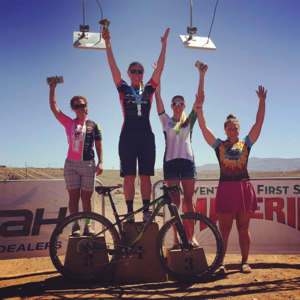
Erica Tingey is probably the most human, normal person I’ve ever interviewed for the FattyCast.
Except she drinks bone broth.
And she rides no-handed on her rollers while doing the robot dance to entertain her son.
And she lays down a flat-out monstrous 293 watts of power in her most recent FTP test.
All in spite of the fact that she just took a year off her pro cycling career with Jamis, battling sickness and depression.
A great conversation with a pro cyclist who’s both human and superhuman: yup, it must be Erica Tingey on the FattyCast.
Find it on ITunes, use the fattycast.com/RSS feed, download it directly, or listen here:
Show Links
Comments (3)
04.1.2016 | 1:01 pm
An Accountability Note from Fatty: Today I weigh 170, which is up a pound from my last weigh-in. The reason why? Because when I worry and stress, I tend to eat, almost out of weird kind of spitefulness toward my better instincts. And right now, as I work on this very difficult writing project, I am reliving a pretty remarkable worrisome and stressful time. Which is compounding with the stressful and worrisome time I’m having in the present.
That’s all just excuses, though. It’s still me making the decision to buy myself a Dunford Donut Milkshake at Arctic Circle. So. I’m going to be better. I promise.
I am doing well on my exercise commitments, though. yesterday, I did a particularly brutal TrainerRoad workout: Lamarck. Forty minutes of this one-hour workout are spent at your FTP, giving this workout an intensity factor of 0.91. I have to say: I’m pretty proud to have completed it. I need to do a new FTP test soon; I hope and suspect that it will be going up.
The book…well, I haven’t written as much as I would have liked to. This is partly because I’m also chasing down job leads, and that takes time (and has to be a priority).
And sometimes, it’s just very difficult to go back in time. There’s a lot of pain there still, and while it’s worth writing about, it’s not easy.
So, for this excerpt, I decided to give myself a break: talk about something that is very much a positive memory: searching for and buying our house in Washington.
Tree Farm: An Excerpt from Fight Like Susan
Here’s a practical tip I hope you never find need to use: don’t go house hunting while you’re undergoing chemo. It’s not fun, and it’s not practical, and your real estate agent is unlikely to be enthused at all the vomit you leave in the backseat of her car.
But Microsoft had given us this rental house for just a few months. We needed to find a place to live, and we needed to close on it before Susan even finished chemo.
And so my friend David Lazar — another Microsoft guy and cyclist —recommended a real estate agent to us, and we started shopping. Driving around neighborhoods in Sammamish, looking at houses we could afford.
Susan was torn about whether she’d come along for each of these outings. On one hand, she really wanted to be involved in choosing the neighborhood and house. On the other hand, we’d be sitting in the back seat, getting tossed around as our agent drove us from house to house.
I would get queasy; Susan would get truly ill. To the point that sometimes when we did arrive at a house we wanted to walk through, Susan felt unable to get out of the car. So I’d go through the house while she rested, with the promise that if I found something I thought she’d really love, I’d come back and we’d re-walk it together.
I never saw one good enough to have her walk through. Not the house that smelled of dog urine. Not the house where the owner sulkily walked behind me the entire time. And not the house that was on a lake…but was three stories tall.
OK, actually I did have her come into the three-stories-tall house, because I just couldn’t help myself. “You’re not going to mind having to go up and down two flights of stairs whenever you want to get to the bedroom for the next three months, are you?” I asked.
“You’re funny,” Susan said. “So funny.”
We went to dozens of houses, most of which were beautiful and large and just a few years old (or sometimes brand new). But while they were nice inside, they felt so cramped outside. Which just felt wrong: to live in a beautiful green place like Washington, but have a house that was packed as close to other houses as the law would allow.
And then we visited Tree Farm.
Tree Farm is the neighborhood you expect all of Washington to be. Tall evergreens almost completely obscuring the sky. Blackberry bushes thickly covering any space they weren’t actively fought back. Windy narrow roads. Big yards, with enough trees between every house that you felt like your house was alone in the forest. A winding walking path through the extensive wooded that surrounded the neighborhood.
And a restrictive covenant for the whole area that guaranteed that all of this would remain just as it was.
“Here. I want to live here,” Susan said, before we even arrived at the house the agent was going to show us.
And I agreed.
The First House
There was a problem, though. We were not the only ones who had discovered Tree Farm. Houses that went up for sale there generally sold instantly. Unless they had a big problem. Like, if roof needed to be replaced. Or there were a crazy number of stairs. Or the wood was rotten. Or there were holes in the walls.
Which pretty much described the house we looked at — the only one for sale in Tree Farm. Nothing that couldn’t be addressed, except for the minor issues that Susan was dealing with chemo and recovering from her surgery. And I had a new job. And we had twin toddlers, both still in diapers. And our boys were reeling from being moved from the only home they had ever known.
There was just no way we could add a house restoration project to all that.
But we kept coming back to the house, parking close to it, and taking the kids on walks on the little one-mile wooded path that went through the neighborhood. The kids were amazed that they could just pick and eat blackberries right off the bushes. And there were frogs and fish in the pond. And we could watch as, over the course of a few days, a woodpecker completely decimated a dead tree.
We knew fixing up this house was beyond us. But we also knew this was neighborhood where we wanted to live.
So we stopped looking elsewhere, and I just took to driving through the Tree House neighborhood, road by road, every day as I rode my bike home from work.
The three months allotment Microsoft had given us in the rental house ended. I called the person who recruited me to the company and begged for another month in the house. She said yes, but just one.
I kept riding through Tree Farm every day.
The Second House
And…then I found it. It wasn’t a gloriously beautiful, big house. In fact, it was quite small. But there were four bedrooms: one for Susan and me, one for the twins, and one for each of the boys.
And it was all on one floor: no stairs for Susan.
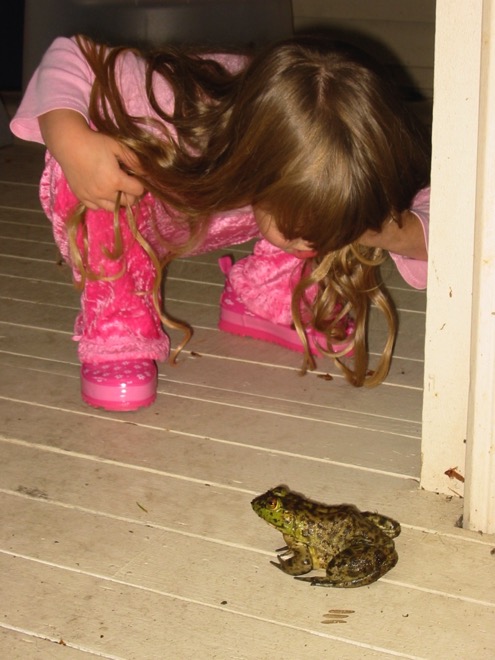
There were quail and squirrels running along the backyard fence. Frogs on the deck. Raccoons in the trash cans.
And there were two fireplaces: one in the family room, one in the living room.
And there were more evergreen trees than you could possibly count, including one pair of trees right in the front that seemingly fused together, forming one massive canopy that covered the front yard and much of the roof.
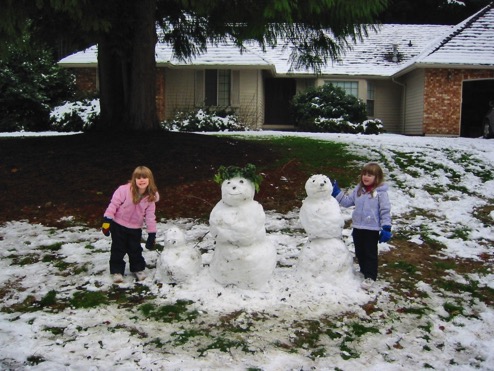
The grass in the yard never had a chance against that kind of shade or that many pine needles.
It didn’t have air conditioning. It didn’t have an office space. It didn’t have much storage space. It didn’t have overhead lighting. We didn’t care; we’d figure out how to take care of or live without all of those things.
Within 48 hours, we had made an offer. Within two weeks, we began to move in. This would be the place Susan finished her chemo, and then we’d have the cancer behind us. I had a great job at a great company. We had a good house in a dream neighborhood. We planned to make Tree Farm home forever.
And you know, maybe it would have been, under different circumstances. Because there really were some wonderful, beautiful things about where we lived and the time we shared in Washington, in that house, and — especially — on the paths in the neighborhood woods of Tree Farm. This house, in fact, is where my best memories of our time in Washington are centered.
But there was also a lot I just didn’t understand about how chemo would affect Susan, and how this house would be part of that. A lot I didn’t — maybe couldn’t? — prepare for.
And to be honest, there was a lot I just simply did wrong.
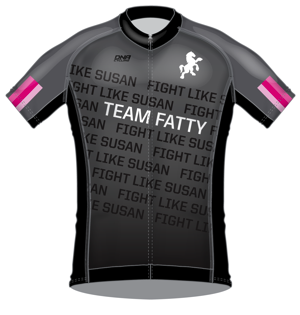
PS: If you’re enjoying these excerpts and want to support me asI write this book, please pre-order a copy of the book and buy any of the very cool jerseys, shorts or bibs, socks, bottles, hoodies, or t-shirts that go with the book. Thanks!
Comments (12)
03.30.2016 | 10:52 am
A “Hey You Should Read This” Note from Fatty: As you have probably noticed, The Swimmer, The Hammer, and I are all-in with TrainerRoad; it’s been making a big difference in for all three of us (more on this when I start my True Grit writeup). So it was pretty exciting to have TrainerRoad interview The Hammer and me about how we train together, especially since it really is something I think we really both are proud of.
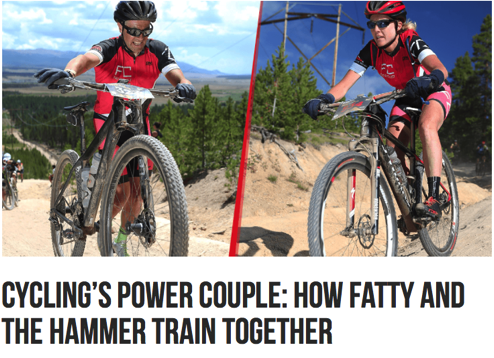
Click here to check out the article, and feel free to leave a comment with tips or questions you might have about how partners can train together.
Today’s Accountability Check-In: Yesterday I did in fact do a double workout, as promised. In the morning, on my own, I did the first hour of the Tray Mountain workout and when The Hammer got home, we both did Darwin.
What I need to do now is pull back on how much I’m eating. With the number of calories I’m expending (more than 1500 yesterday) on exercise, I should start losing weight. But that only works if I don’t pig out. Which, so far, is not going well. My office is too close to the kitchen (they’re adjoining rooms). That doesn’t matter, though; my self-discipline needs to not be location-dependent. I guess.
Weight: As of this morning, my weight is 169.0 — two pounds down. I’m going to work hard today to keep this downward trend going.
Writing: I am making good progress on writing Fight Like Susan. And in fact, today I’m going to post an excerpt from the “Living With Chemo” chapter I worked on yesterday.
First, though, I’m going to ask you (again) to support me as I write this: please pre-order the book, the jersey, and any of the other gear (by the way, I have added women’s shorts to the gear available). Right now, as I’m writing this book, you are my source of income.
Hair (from the “Living Through Chemo” Chapter of Fight Like Susan)
When you go through most kinds of chemo, your hair’s going to fall out. It just is. There are people who will tell you stories and give you advice to make you think there are things you can do to prevent or slow hair loss. I know there were certainly people — too many people — who told Susan what she could do to keep her hair. Cold caps. Vitamins. Rogaine.
They were well-intentioned, I know. But they didn’t understand the devastating impact they had. By giving Susan advice on how to keep her hair, they were harming her in a couple ways. First, they were giving her false hope—making her think she would be able to hold onto her hair, when in reality most of it was going to fall out no matter what she did. Chemo just kills fast growing cells—and that includes not just cancer, but hair as well.
More importantly, though, by talking about how she could maybe keep her hair, friends were emphasizing how important appearances are. They were saying, essentially, “Hair’s worth the extra discomfort of an icepack on your head compounding the chemo headache you’ll have already.” Which is, frankly, a pretty rotten message to be giving to someone who’s just had a breast removed and is going to – whether she keeps her hair or not – going to be looking pretty sick and puffy (from the steroids that go along with the chemo) for the next several months.
In Susan’s case—yeah, she tried the cold cap—it didn’t matter anyway. One day, shortly after her second chemo treatment, I noticed a lot of hair had fallen onto her shoulders.
The next morning, it was a lot more obvious; it was all over her pillow.
By the time she got out of the shower that morning, Susan was crying. She showed me why, grabbing some hair close to her scalp and giving a tug. About a quarter of it came out. About as easy as pulling a few blades of grass out of the lawn.
And there it was: a new little bald spot where the hair had been.
I felt a moment of panic.
But why?
It wasn’t the knowledge that Susan would be bald soon. I had known that. It didn’t worry me. I had seen the TV shows, I had talked with the doctors.
Going bald wasn’t the cancer manifesting itself — no, that was the lump. Going bald was just the medicine’s side effects.
But I was still freaking out. Because you know that shouldn’t be happening. Just like skin shouldn’t be blistering. Just like eyes shouldn’t be red. A clump of hair falling out looks — to the people who care about you — like an injury.
So I asked Susan if I could cut it off. All of it, right then. I didn’t want to react any more; cutting it off would at least be me taking charge.
I don’t think she really wanted me to. I don’t think she was ready to let go of her hair; she hadn’t had time to say goodbye to it.
But she said yes. She could tell it bothered me. That I no longer regarded her hair as anything but a symptom.
So we went downstairs to the little kitchen we had in the rental house we were staying in while we shopped for a house in Sammamish (we were set on living in Sammamish) of our own. I got out the electric clippers, and I just cut it all off.
Front to back. Then side to side. Trying to only graze her skin, because — like everything else — it was already sensitive.
I finished, looked at her, and said, “You know I always had a thing for that bald robot chick in the first Star Trek movie, right?”
Comments (13)
03.28.2016 | 1:21 pm
Fatty’s Daily Accountability Note: As I promised in my post last Friday, I am going to keep track of three things with each post: My weight, my training, and my status on Fight Like Susan.
- Weight: I weighed in at 171.0 pounds today. That’s not good, but it’s where I’m starting. My goal is to weigh 158 by the time I race the Rockwell Relay this June. So: two months to lose thirteen pounds. I can do that.
 Training: My plan is to do a TrainerRoad session after I send the kids off to school and the wife off to work each day, so of course things got started with a derailment. The wife has today off and one of my kids is sick. And Monday mornings is when we record The Paceline. So: I’m all those things and people are squared away for now, so I’m going to go do a TrainerRoad session as soon as I publish this post. I’m on the Sweet Spot Base – High Volume II schedule, doing Week 3. Which means I’m doing the Haeckel workout. [Update: Completed and recorded on both TrainerRoad and Strava.]
- Fight Like Susan: Today is the day I begin writing in earnest on this book, and I have to admit it feels a little bit like approaching a cliff. I know how I begin, though, so it’s not as scary as it could be. I’ll share some of what I write today when I post tomorrow. (And if you haven’t yet pre-ordered a copy, please check out what I’m doing, why, and what’s available. Thanks!)
Ride 3 (Including My “Last Ride on the Kokopelli” Story) Now Available — And So Is My Podcast With the Publisher
Way back in the beginning of 2015, I noted that I was working on a submission to go in the Ride 3 bike fiction anthology. I was excited to try my hand at fiction, but also scared — I’m comfortable writing about what’s going on in my life, but actually creating a story…well, that’s difficult and different.
I did, eventually, finish writing that story. And it did make it into the anthology.
And it’s out. You can buy it and read it today. Check out the cover:
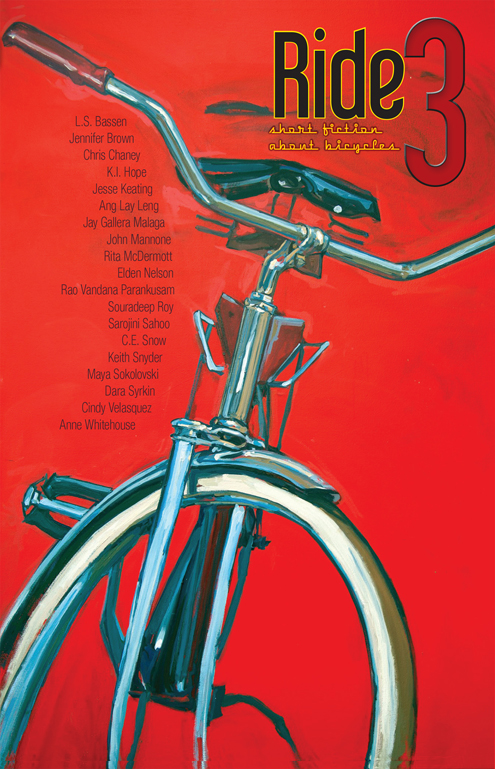
It’s got my name in it and everything (buried almost exactly in the middle, as is the eternal curse of people whose last names start with “N.”
And — totally not coincidentally — last week I recorded a FattyCast with Keith Snyder, the publisher, editor, and book designer behind the Ride book series.
So, sure, this episode of the podcast is just a little bit self-serving, because my story — Last Ride On the Kokopelli — is in it. So sue me.
Self-promotion aside, in this episode of the FattyCast, Keith and I talk about why it’s important to not tell a story before you write it down, we talk about raising twins, we talk about earworms (and Keith sings one, surprisingly well), and we talk about his favorite kind of riding — randonneuring — and whether it’s nerdier to be a randonneur or a recumbent rider.
If I were you, I’d listen to this episode of the FattyCast right now. Which you can do by subscribing in iTunes, or by just downloading, getting my RSS feed, or listening right here:
And Now For A Little Sneak Peek
Here’s an interesting experiment: go back and read the beginning of the story I wrote back in January 2015. Get that fixed in your head. The tone. The characters. The perspective.
Because hardly any of that actually made it into the final cut of the story.
Here’s the first quarter of the story, as it now reads in the book:
Last Ride on the Kokopelli
Elden Nelson
It was past time to get started again, but Lewis was in no hurry. He knew he should be in a hurry—the three guys he was riding with were way ahead of him by now—but he wasn’t. This ride hadn’t been turning out as he had imagined it, and it was good to be on his own.
Lewis always looked forward to reaching Dewey Bridge. It was a cool old landmark, it signaled that the most technical part of the Kokopelli Trail was behind you, and it meant you could fill up on water in the Colorado River.
Lewis stood on the narrow old bridge, one foot on the ground, one clipped in. He held the Camelbak’s drink tube between his teeth, sipping warm, silty water. He’d taken almost fifteen minutes to filter about 150 ounces. Plenty to get to Westwater, the next place he could expect to fill up.
It was noon now, but it already felt like it had been a long day. And in fact, it had been: they’d been riding for seven hours.
All the big climbing behind them, the promise of a brutally hot day ahead.
Already close to ninety degrees, and no breeze at all. This is going to get ugly. I guess I’d better go catch up with those three assholes.
But he didn’t go, not yet. He wasn’t the slowest guy in the group; he’d catch up. And he’d earned a little time to himself. Needed it.
Everet can be such a prick.
It wasn’t the first time that day he had thought it. Lewis had invited Everet on this ride because he knew Everet could handle twenty hours on the saddle, but that wasn’t the only reason. He’d invited him because he knew Everet. Thought he had, anyway.
This ride—The Kokopelli Trail, Moab to Mack, all 142 miles of it, in one day—is no joke. And you don’t invite just anyone to come ride it with you. You choose who comes on rides like this carefully. There are rules for this kind of thing.
Case in point: Lewis had invited Everet only after observing him, seeing how Everet handled himself in 24-hour races, how he knew when to talk and when to shut up and put his head down on big training rides. After he showed he respected big distances on bikes and what they mean. After it was clear Everet knew the rules.
And then, two days before the ride, Everet said to Lewis, “Hey, I was talking to a couple of guys I ride with about coming and doing this ride with us, is that OK?”
“Sure, that’s fine,” Lewis said. But of course it wasn’t fine. Invitees don’t get to be inviters. Didn’t Everet know the rule?
Evidently not.
And that’s how Lewis’ most important ride of the year—this beautiful and quiet ride—had become a loud and confrontational networking event. Everet, Trevor and Harlan—all three worked at the same company, Lewis was now learning, and Everet was Harlan’s manager—yelling about competing product lines, scrum meeting etiquette, and slipping release dates…as they ignored the trail around them.
To make matters worse, Harlan seemed to think he was an Australian Shepherd, surging forward and dropping back, trying to keep the group together. Meanwhile, Trevor kept quoting from Adam Sandler movies.
Lewis needed to get away from them, and intentionally dropped further and further behind, so that by the time he had gotten to Dewey Bridge, the other three riders were nowhere in sight.
Well, they either filtered water really fast and continued on, or they…just went on.
Those guys probably gambled they had enough to get them to the Westwater Station. But it won’t be. Nothing I can do about it now.
If I don’t get moving, it’ll be three in the morning before we finish.
He clipped in and rode across the bridge.
— — —
Are you seriously trying to make this ride into a race?
Lewis had been pushing the pace since the beginning of the ride, and Trevor was sick of it. He, Everet, and Harlan were just trying to enjoy an epic day in the saddle, but Lewis kept half-wheeling or outright pulling ahead.
What is your problem? Trevor wanted to ask out loud, but didn’t. Are you trying to prove a point? Show you’re the alpha rider? What?
Finally, Trevor responded to Lewis’ attack, Harlan and Everet on his wheel. Lewis had started it, but they had superior numbers. There was no way this ill-considered solo breakaway was going to work.
They reeled Lewis in, and then the surly loner dropped back and—often—out of sight.
This day—this day, which should have been perfect—sucked. The only good moment of the day, in fact, had been watching Harlan, who was doing his absolute best to hang with Trevor and Everet, turf it on the loose, rocky descent toward the Colorado River.
— — —
Lewis crossed Highway 128 onto the desert doubletrack, got into the flow of the ride, and felt clear and strong. Not hungry. Not thirsty. Not tired. Not—in spite of the rising temperature—hot. Lewis didn’t feel anything.
To achieve this state: this was why Lewis rode. He stood and rowed his bike up a short, steep climb. Sat and got low for a short rocky descent. Climbs, descents, flat: Lewis loved it all.
Low. Light. Lean the bike, stay upright. Lewis was tempted to rest a finger on the brake levers, but didn’t, even as he he dived into the left-turning blind, banked downhill corner.
Something in the trail. Big.
With no time to ride around it—a rock wall on the left and exposure on the right there was nowhere to go anyway—Lewis grabbed two big handfuls of brake.
People like to talk about time slowing down and everything happening in slow motion when you crash, but that is not what usually happens. You’re riding and then you’re sliding, with very little time to think in between.
Everet. Not moving. That’s all Lewis had time to think as he went over his handlebars, and then he was taking the impact on his left hand.
Amazingly, he did not fly down the steep, exposed embankment. He didn’t break his collarbone. He didn’t even break his wrist.
He was scraped bloody, and that wrist was probably sprained, but Lewis wasn’t aware of any of these minor injuries in the moments after he crashed. He jumped up, the adrenaline hitting him hard and fast.
“What happened?” Lewis yelled.
Everet didn’t say anything, but someone did.
“I think he’s dead.”
I’ll be interested to hear what you think of the rest of the story once (if) you read it.
Comments (24)
03.21.2016 | 9:47 am
I’ve started work on writing Fight Like Susan, and have been making a lot of decisions: what will go in the book, and what won’t. How far back in time will I reach, and where is its finish line.
I’m happy to say that so far, the answers to these questions have been pretty clear to me. My vision for this book is very clear, maybe because I have been thinking about it for close to a decade.
It will be Susan’s and my story, and it will incorporate much of my best writing from this blog during her fight. This means that about half of the writing exists, and I’ll be writing the other half.
A story, interspersed with essays.
An Outlet
As I go back and read what I wrote during Susan’s fight, I’m struck by how my time for riding was so clearly a pressure release valve. I remember how my friends noted that when I rode with them, I would attack. Riding angry.
When I rode alone, I’d attack anyway. Or sometimes break down.
Then I’d come home and could be the stable presence again. For my kids. For my wife.
This time was the defining test of my life. I know, that sounds hyperbolic, but I think it’s true: it fixed the “me at my best” in my mind, and it is who I continue to try to be.
But without the balance the bike provided me — a time and a way to empty out all the frustration and rage and sense of unfairness I felt — I don’t know if I could have been the person I’m so glad I managed to be.
A Respite
Now I’m dealing with some new stuff. This stuff is maybe more ordinary, less life-and-death; it’s just looking for work. But as I’m pouring myself into this task and into the work of writing a very emotional book, I find myself…mentally and emotionally cooked. Exhausted.
And once again, the bike is there to give me balance. But this time in a different way. I find that I look forward to my time on the bike not as an outlet for excess energy and emotion, but as a time to recharge, to relax.
I’m not riding with the intensity I’ve felt in recent years, not even when I race. After I finished the True Grit Epic a couple weekends ago, I was incredibly happy for how fast The Hammer and Swimmer had gone…and felt like I had raced a good race too, in spite of the fact that I had gone slower than the previous year.
Why? Because I had enjoyed myself, and had ridden and talked with other guys who were also enjoying themselves. I had gotten a much-needed break from the things that were weighing me down.
I’ve been riding, as often as I can, for at least twenty years now. And once in a while, this simple act can still surprise me with how much it affects me and means to me.
Somehow, no matter what I’m going through, the bike gives me balance.
Comments (19)
« Previous Page — « Previous Entries Next Entries » — Next Page »
