04.4.2011 | 12:19 pm
 I’d like to take a moment and list a few things I really, really, really like.
- American Fork Canyon: The fact is, when I moved back to Utah, I made a point of moving as close to it as I could afford. This is because it’s beautiful and hosts incredible biking, both road and mountain. It’s also where Tibble Fork is, which is the best place in the world. (In fact, The Runner and I like American Fork Canyon so much we got married there)
- Fighting Cancer. I should probably be more clear about what I mean by “fighting cancer,” because I think different people mean different things when they say they’re joining the fight against cancer. One way to join the fight is to help raise money for research. That’s awesome. Another way to join the fight is to help people who have cancer and are fighting it. Because of my own experience, this is the fight I am motivated to join in.
- Running a Half Marathon. You know what’s good about running a marathon? The first half of it. You know what’s a good distance to work up to running that most people can achieve? A half marathon. (I swear, The Runner did not force me to say any of these nice things about running.)
So when some people at Intermountain Health (which is where The Runner works as a nurse) asked The Runner and me to help organize the first annual American Fork Canyon Half Marathon and 5K, with all proceeds going toward helping people who can’t afford cancer treatment, answering “yes” was easy.
And if you’re local (I.e., if you’re anywhere near American Fork Canyon, UT) I’d love to have you join us — either as a racer, or helping us out on before and during the race day.
A Little About The Race
There are a few very important things you should know about this race.
1. It will be downhill. Since the AF Canyon half marathon starts at Tibble Fork Reservoir, comes down the canyon, and finishes at American Fork High School (click here to see the course in Google Maps), it has a really nice, moderate, downhill grade pretty much the whole way. Check out the elevation profile:
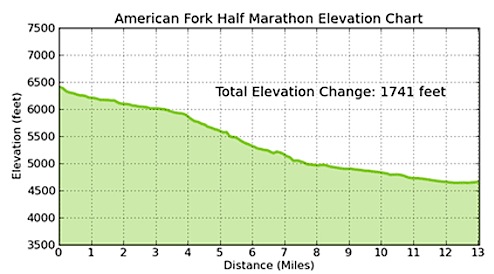
So even if you’re not normally much of a distance runner, think about the fact that gravity will be on your side.
2. It will be beautiful. I don’t love American Fork Canyon merely because it’s a good climb or has good access to terrific trails. I love it because it is a beautiful canyon. I don’t have any video of me running down it, but I think it might be worth doing a replay of a video I took a couple years ago riding down this canyon:
Seriously, if you’re going to run a half marathon, this is a beautiful place to do it.
3. The cause couldn’t be better. I get a knot in my stomach thinking how much more stressful and awful the cancer experience would have been if I would have had to be considering finances the whole time. Horribly, that’s the reality for a lot of people. All of the proceeds from this race will go to lighten the financial load of people who are fighting cancer here, close to home.
4. The race will be June 25. So you’ve still got time to prepare for it.
Sign Up or Help Out
I’d love to see hundreds and hundreds of people lining up to participate in this event, and I’d even more love to see some Fat Cyclist jerseys at the finish line (I’m not sure, but think that’s where The Runner and I will be helping out on race day). In which case I will give you a hug.
Unless you don’t want one.
If you can open the day up, please go visit the race site, learn more, and register. And I’ll see you there.
Or if you don’t think you can (or want to) sign up to race, we could sure use your help volunteering to make this event as awesome as possible. Email me with the subject line “AF Canyon Half,” and let me know when and how much you can help.
Comments (18)
04.1.2011 | 10:45 am
Note: This is Part V of Fatty’s Inferno. Read previous installments here:
“Please,” I begged The Cyclist as we once again found ourselves standing at the junction, the word Whiners appearing on the signpost by the road upon which we had just traveled. “I’ve seen enough. I just can’t take anymore.”
“And you’ve been here only a moments,” said my guide. “Imagine eternity here. Or, on the other hand, don’t worry about it. You’ll be here for good, soon enough.”
“But in which of these places am I doomed to ride?” I asked, terror (or something) welling up in my throat.
“Wow,” replied The Cyclist. “That’s actually a really interesting question. I’m not sure I’ve ever met another rider as deserving of being in multiple cyclists’ hells as you.”
“Thanks,” I said, not sounding at all thankful.
“Hey, maybe you could move around,” The Cyclist mused. “A few millenia in this one, a couple of millenia in that one. You know, mix it up a bit. Let you get the full effect of all of the sins for which you are guilty.”
“Whatever,” I replied.
“Yeah, I knew you’d say that,” responded. “Anyway, we’ve still got a lot to see down here, so let’s check out this next road.”
“You mean,” I asked, “You’re not even going to pretend to let me choose?”
“No, no point in that anymore.”
Fifth Circle
We began on the road, which immediately turned downhill, sharply. Suddenly, I could see the entirety of this circle of hell, and I had to stop, trying to let my mind process it.
Before me lay a pristine valley. Clean air. Pines and aspen. Tall grass, waving gently in the light breeze. Not a single building in sight.
A single road dropped sharply down into this valley, at which point — with no flat to speak of — it immediately climbed steeply back up. The only riding to be had here would be hard climbing and steep descending.
“This is a beautiful place,” I told The Cyclist. “And this is an incredible road. How can you call this a level of hell?”
“No kidding,” agreed The Cyclist. “Actually, I vacation here. It’s one of my favorite places.”
And then I saw something far down at the bottom of the valley that perplexed me, deeply. Thousands — perhaps millions — of bikes laying down (drivetrain side down, of course), littering the valley floor.
Meanwhile, not a single rider was in sight anywhere. “Where is everyone?” I asked. “Why is nobody riding?”
“Take a closer look at the bikes,” replied The Cyclist.
And then I got it. Every single one of them was a fixed gear bike, built without brakes, for showing off and for urban riding — and entirely useless in a place like this.
“But where are the riders?” I wondered.
“Oh, they’re here all right,” smiled my guide. “It’s just that I have made them invisible. You see, fixie care much more about being seen than about the ride itself. In the absence of an audience — not to mention coffee shops and thousands of pedestrians and exhaust from a road choked with cars –they quickly lose interest in riding.
“So what are these guys doing for all eternity?” I asked.
“Mostly they spend their time reloading Bike Snob’s site, hoping they will someday be the first to comment on his blog. They don’t realize that I’ve ensured that never happens because the internet here is on a twenty-second delay.”
“Well, I don’t even have a fixie anymore,” I said. “I guess this is one hell I don’t have to worry about winding up in.”
“Yeah,” agreed The Cyclist. “You don’t have to worry about winding up in the place where you just mentioned you’d love to go riding. Isn’t hell ironic?”
Sixth Circle
Back at the junction — where Fixie Hipsters had just appeared on the signpost by the road we had just been on — I told The Cyclist, “You know, you’re kind of mean.”
“You have no idea,” affirmed The Cyclist. “Let’s check out this next road.”
We were back on our bikes, and riding together on a road that felt strangely familiar. The road was perfect. The partially-obscured sun was overhead, staying out of our eyes. The temperature was exquisite. The variety of terrain would suit any taste. This was a perfect spot to ride.
It took a moment, but then it occurred to me. “Hey, you’ve brought me here before. This is Limbo, the very first place you brought me!”
“No, it is not Limbo, though it is very similar,” replied The Cyclist. “In fact, your mistake is understandable, since the place itself is identical — we saved a lot of expense when we had it constructed by using the same blueprint.”
“But,” he said, “It is not the same place. Look at the people.”
As soon as I saw them, I understood. Millions upon millions of people were here. All of them very fit, all of them in cycling clothes — shorts, jersey, gloves, helmets, shoes, the works — all of them clearly ready to ride.
But none of them were riding.
In fact — apart from the bikes The Cyclist and I were on — there were no bikes at all in this place.
“This is the true cyclists’ hell,” said The Cyclist. “This is the place where are sent those who have lost the right to ride. This is the place made for biking, but where there are no bikes.”
“In this place are the people who bought bikes, then hung them up in their garages.”
“In this place are the dopers, as well as doping conspiracy theorists.”
“In this place are those who inhibit innovation in cycling in the name of tradition.”
“In this place are triathletes who only did the bike part of the race because they couldn’t find any events that did just swimming and running.”
“In this place are the people who stopped riding because they claim to have burned out.”
“In this place,” concluded The Cyclist, “Al Trautwig commentates every single move every single person makes.”
I collapsed on the ground, sobbing uncontrollably.
Seventh Circle
We were back at the junction. No Bikes Allowed appeared on the sign by the road we had just been on.
“What new horror will you show me on this final road?” I demanded of The Cyclist. “A road paved with nails and glass? A place with an atmosphere specially designed to rust chains? A hell where bike thieves outnumber cyclists three to one?”
“No,” replied The Cyclist. “Nothing like that. In fact you’ve got it all wrong. In fact, this last road doesn’t lead to a version of hell at all.”
“This seventh road,” continued The Cyclist, “goes to Cyclists’ Heaven.”
“Please, Cyclist, please take me there!” I begged, now on my knees. “Show me Cyclists’ Heaven, so I will have something to strive for, something to think about and earn for the rest of my days!”
“Oh, I don’t need to take you on that road,” replied The Cyclist.
“Why not?”
“You’ve been there before,” said my guide. “Many times, in fact.”
“I have?” I asked, dumbfounded. “In my dreams, you mean?”
“No,” said the spectral figure that had guided me through these many levels of hell. “In real life. This seventh road leads to Moab, Utah.”
“Heaven,” said The Cyclist, just as I began to wake up, “is for mountain bikers.”
PS: Believe it or not, this story is my April Fool’s joke, or at least it was supposed to be. My idea was to do a week-long shaggy dog story (a guided tour through hell), with a weak punchline (heaven is for mountain bikers) on April 1. Which is sort of what I did, but pretty early along the way I got a lot more into writing the story and kinda stopped thinking about the fact that it was supposed to be just a long, drawn-out joke. So, April Fools! I guess!
PPS: If you want to spend a few minutes reading a good bike-related April Fools joke, I liked the one over at Gu. I also like the one about Johan Bruyneel over at Velonews, mostly because they mention me in it (but would it have hurt to link to me, guys?)
Comments (49)
03.31.2011 | 1:12 pm
Note: This is Part IV of Fatty’s Inferno. Read previous installments here:
We were back at the crossroads again. The signpost indicating where I had just been now read, Cycling Laziness, Selfishness, and Unbridled Greed.
“You know,” I said, “I’m beginning to think that hell kind of sucks.”
“And you have as yet seen so little of it,” mocked The Cyclist. “Choose now another road.”
“OK, I choose that road,” I said, pointing at the one that seemed opposite from the Laziness sign.”
“It is well that you choose that road,” replied The Cyclist with the hint of a smile. “But that’s not the next road you’re going to ride.”
“Well, why’d you even bother having me choose one if you’re going to send us on a different road anyway?” I said, knowing that while I was doing my best to hide my irritation, I wasn’t exactly succeeding.
“Just to jerk you around.” said The Cyclist.
“Well, why did you wait ’til now to take me on a different road than I chose?” I was getting worse at hiding my irritation.
“You just got lucky the first two times and picked the roads I was going to take you on anyway.”
“Whatever.” OK, I had given up on hiding my irritation. A part of me wondered at what happens when you start acting peevish toward the grim reaper of cycling.
“I can’t believe you just said ‘Whatever’ again. You sound like a fifteen-year-old when you say that.”
“Can we please just start riding?” I asked.
Later, I would regret being in such a hurry to get started.
Third Circle
This time I was ready for the way The Cyclist always took off before I was ready, and I got the jump on him. I pedaled furiously, at the absolute limit of what I was capable of, feeling a fierce pride in being able to drop this guy.
Three seconds later, The Cyclist blew by me, hands resting on the hoods, his legs spinning comfortably at what I would guess at 140rpm.
“How’s it goin’?” he said.
He then eased up, letting me draft, giving me the chance to assess this version of a cyclist’s hell.
But for the life (the death?) of me, I couldn’t figure out what was so bad about this place. Sure, the road wasn’t perfect – it was chipseal — but it was chipseal that had at least been laid down several years ago, so the vibration wasn’t too bad.
And there was a bit of a headwind, but I’d hesitate to call it a hellish headwind.
The surroundings were perhaps a little bleak, but not horrible. Boring, but not catastrophically ugly.
And I suppose it was uncomfortably warm, but I’ve ridden in hotter. In fact, I ride in hotter weather every day, two months out of each year.
And, looking around, I could see that there was in fact a wide variety of OK riding terrain. I could see some flats (maybe not as long of flats as I’d like), and some mountains (which I’d have preferred to be perhaps a little taller).
And in short, it didn’t seem like a half-bad place to ride. Not great, but not terrible.
“So what kind of half-baked hell is this?” I asked. “I wouldn’t want to move here, but I wouldn’t mind riding here if I had to.”
“You make an interesting observation,” allowed The Cyclist. “But do you see anyone riding here?”
“No,” I said, realizing for the first time that we appeared to be totally alone. “Where are the other riders?”
The Cyclist pointed. “Look, off in the distance. There’s one rider far ahead.”
“Cool,” I replied. “Let’s catch him.”
“Go for it,” said my guide. “I’ll let you lead.”
And so, for the second time in just a few minutes, I stood up, shifted into a big gear, and gave chase. This time, though, I kept my eye on the guy in front of me, looking for signs that I was reeling him in.
And, briefly, I believe that I was gaining on that rider. Just before I blew up. The rider ahead of me vanished over the horizon
“Oh, that’s too bad,” The Cyclist — who apparently had been drafting behind me the whole time — said. “It looks like you were starting to gain on him, too.”
“Yeah,” I wheezed.
Which is when another cyclist — one I had not seen before — flew by, not acknowledging me. In pursuit of…something, I guess.
“Are you beginning to see the nature of this cyclist’s hell?” asked The Cyclist.
“No,” I replied, honestly.
“In this hell,” said The Cyclist, “the only other cyclists you can see are the riders who are faster than you. Which means you can see other cyclists who are passing you, but they cannot see you. You can see — and pursue — cyclists who are ahead of you, but you will never be aware of catching one. Here, you will never see another cyclist who goes your speed or slower.”
“OK…so what’s the point of that?” I asked.
“This hell,” said The Cyclist, “is reserved for those who treat every ride as a race. In life they did not acknowledge slower riders, so now they cannot.
“In this hell, cyclists who felt they had to pass every rider they ever saw will never feel that warped sense of accomplishment again.
“In this hell, cyclists who didn’t look around and enjoy the world around them now have a monumentally uninteresting universe in which to ride. Forever.
“In this hell are the cyclists who, in life, chose to ride alone. Now they have no choice.
“But what about the headwind and the heat?” I asked. “What is the significance of those?”
“It’s hell, duh,” replied The Cyclist.
And then we were back at the junction. The signpost by the road we had just been on — the road to the left of the Laziness road — read Eternal Attackers.
“Ready to see another road?” asked The Cyclist.
“Could we pick this up another day instead?” I replied. “This whole thing’s kind of got me down.”
“Oh, that’s too bad,” sympathized The Cyclist. “Let’s keep going.”
Fourth Circle
Up until this fourth circle, I had been pleasantly surprised at how nice the roads were in hell. This sensation now gave way to horror.
Chipseal. Brand spanking new chipseal. And there were cracks in it — cracks that seem like they had been specially constructed to be exactly the right width to grab onto your wheel and flip you over.
And there were potholes, too. And where there weren’t potholes, there were patched potholes, if “patched” can be applied to the way loose asphalt had been dumped and roughly stomped into the holes.
And it was so hot. As hot as . . . well, as hot as hell, to tell the truth.
But in spite of the heat, the shoulder was unusable, being completely covered with sand, salt and gravel, as if it had only recently been winter and the roads had not been cleared. There was clearly no way to ride there.
And then a sports car flew by, honking hard, with the driver yelling something at me.
This was followed by an SUV, the driver of which threw a bottle at me as he went by.
And don’t even get me started on the crosswind.
“So who is this hell for?” I asked. “It’s got to be the very worst sort of cyclist there is, because this is truly an awful place.”
“Actually,” answered The Cyclist, “This road is for cyclists who like to complain. The ones who tell anyone who will listen that the road sucks, that there are too many cars on the route, that the pavement surface is no good, that the pace is too hard (or too easy). The ones who ruin the ride for everyone else.”
“This place,” said my guide, “gives them something to complain about.”
At that moment, a large group of riders went by, each trying to talk over each other. Each endlessly bemoaning their fate.
“Surely,” I told my host, “this is the most awful cyclists’ hell of all.”
The Cyclist looked at me, and I knew his answer before he spoke it into my mind.
“Not even close.”
[To be concluded in Fatty's Inferno, Part V]
Comments (31)
03.30.2011 | 10:20 am
Note: This is Part III of Fatty’s Inferno. Read Part I: Prologue here. Read Part II: Limbo here.
We were back at the junction. I could not remember arriving there, nor getting off my bike, but there I was, and my bike was laying on the ground — drivetrain side down. I could also no longer see cyclists on the road we had just been on, but the sign was now illuminated and symbols on that sign — and that sign alone — had resolved into words: Cyclists’ Limbo: A Much, Much, Much Better Place Than Where You’re Going.
“Really?” I asked. “The sign needs to use ‘much’ three times? That’s hyperbole, right? Also, it’s not very creative.”
“Choose the next road you wish to travel,” said The Cyclist.
“Well, it’s pretty clear I don’t want to travel any of the roads beside the one I’ve already been on,” I said. “But I’ve read the Wikipedia entry on Dante’s Inferno, so I have a pretty good idea where this is headed. So how about I just skip all the intermediate levels and you show me the final road? I choose this one,” I said, pointing to the road to the left of the Cyclists’ Limbo.
“How naïve. What makes you think the Roads of Hell are arranged in a nice order like that?” sneered The Cyclist. “Furthermore, what led you to think that hell would be arranged clockwise? You Western thinkers crack me up.”
“Whatever,” I replied, fully realizing that I had just given the weakest of all possible retorts.
“Indeed,” said The Cyclist. “Now. Let’s ride.”
Second Circle
As before, The Cyclist got the jump off the line and I was left to pull my bike out of the dirt, mount, and give chase. All that time in the dust seemed to have affected the drivetrain; there was considerable grit in the chain and it was now making a distinct grinding sound, as opposed to the the delicious, smooth meshing sound a clean, well-lubed chain makes.
I shifted to a bigger gear, then stood up and pedaled hard — and nearly racked myself as the chain slipped, hopping continuously between two cogs on the cassette.
“OK, don’t use 5 or 6,” I told myself, finding a gear where the chain wouldn’t jump around.
It took minutes, but I finally caught up with The Cyclist. By the time I reached him, however, my hands were buzzing from the constant road vibration. I looked down.
Striated concrete. Yuck.
“It’s not really that bad of a road surface,” said The Cyclist. “Just a lot of road noise, plus constant vibration you can feel through the handlebars. Oh, and then there’s the bump as you go over the joints every twelve feet.”
“I suppose, however,” mused The Cyclist, looking sideways at me, “It would be a rather annoying surface to ride for eternity.”
I shuddered at the thought, flexing my already-numb fingers.
“But where are the cyclists?” I asked, thinking back to the busy road in Cyclists’ Limbo and noting the relative barrenness of the concrete we were riding on.
“Look at the side of the road.”
I looked, and saw countless cyclists. All with beautiful bikes.
Very few of those bikes were being ridden.
Some cyclists were twiddling barrel adjusters. Some were digging through seatbags and jersey pockets, looking for CO2 cartridges. Some were tentatively prodding their brakes with hex wrenches. Some were staring dumbly at a broken chain held in their greasy hands. Some were slamming their wheels against the ground.
Almost all of the cyclists were weeping.
I slowed to a stop, and noticing a cyclist who was trying — unsuccessfully — to pry a wheel off the rim using nothing but his bare hands, asked, “Got everything you need to fix that flat?”
The cyclist looked up at me, repeated my question back to me — but in a sarcastic whine — and then lunged at me, grabbing my throat and choking me.
Through the horror of simply being attacked, I nevertheless managed to wonder two distinct thoughts: Why was this man attacking me for simply offering to help? And, more importantly, if you’re already dead and in hell and someone chokes you to death, where do you go?
I never got an answer to this second question because, as spots began to appear before my eyes, The Cyclist spoke to my attacker.
“Cut it out.”
Immediately, the cyclist with the flat tire leaped away, and sat cowering, clearly not willing to meet The Cyclist’s eyes.
“What was that all about?” I asked. “I was just going to loan the guy a tire lever!”
“Go ahead,” said The Cyclist, coolly. “Loan it to him.”
So I unzipped my seatbag and pulled out a blue Pedro’s tire lever. Not willing to get within arm’s reach of the guy who had been throttling me a moment ago, I tossed the lever to him. Nice and easy.
Midway through its arc, the lever disappeared. Now, neither of us had a tire lever.
The other cyclist started laughing. But not in a healthy, cathartic way. More of in a “cross the street to avoid that guy because he might be armed” kind of way.
“Why did that happen?” I asked The Cyclist. “And can I have my lever back?”
“The lever is gone forever,” said The Cyclist. “That is part of the nature of this circle of hell.”
“I don’t understand,” I said, because I didn’t understand.
“This circle of hell is for cyclists guilty of greed, selfishness, and laziness. These are the cyclists who did not stop to offer other cyclists assistance — they shall receive no assistance themselves.”
“These are the cyclists who constantly sought to purchase better and lighter and more expensive equipment, rather than to take time enjoy the bicycles they own. They shall spend eternity with two things. First, with a perfect understanding of the latest developments in bike technology. Second, with the bike they died with, never to be upgraded again.”
“These are the cyclists who never learned to fix even the simplest of mechanical problems, relying on others to fix their bicycles. These shall be required to carry the heaviest multitool with them for eternity, confounded forever by their own ambivalence toward bicycle maintenance.”
“These are the cyclists who did not carry tools to fix a chain or flat or other minor mechanical problems during a ride. They shall continue forever without tools to fix their bikes, and no other rider shall be able to offer them assistance, lest their own tools vanish forever.”
These are the cyclists,” said The Cyclist, and he turned toward me and stared at me with red fiery eyes, “who are a lot like you.”
My hands were cold now — it was no more than 48 degrees fahrenheit (“No, you don’t get new clothing either,” The Cyclist spoke into my head) and my terror was immeasurable. Was it true, that I had spent most of my cycling life lusting after new gear instead of learning to take good care of the equipment I already own?
Even before I finished asking myself the question, I knew it was true.
“Can I please at least have my tire lever back?” I asked The Cyclist. “I didn’t know the rules of this place when I tried to loan it to that rider.”
“Sheesh,” said The Cyclist, and the tire lever appeared back in my hand. “They cost, what, $1.99?”
“Whatever,” I replied.
[To be continued in Fatty's Inferno, Part IV]
Comments (32)
03.29.2011 | 1:13 pm
A Note from Fatty: This is the second part of a multi-part entry. I say “multi-part” because right now I actually have no idea how many parts it will wind up being. Anyways, today’s post will make a lot more sense if you read yesterday’s post Click here to read Fatty’s Inferno, Part I.
“Choose a road,” The Cyclist said.
“Where are we going?” I asked.
“That depends on the road you choose.”
“Well,” I replied, trying to be reasonable, “generally I choose a road based on where I want to go.”
“That,” said The Cyclist, “is total nonsense. As a cyclist, you have ridden countless miles and have, almost without exception, wound up exactly where you started. Like all cyclists, you choose the road for the experience the road brings you, not because you have a destination in mind.”
“OK, fine,” I said, wondering if The Cyclist was always going to be so annoyingly cryptic. “I choose whatever road is the best for riding.”
Frankly, I expected The Cyclist to knock the choice back into my court with some kind of mumbo-jumbo like “One man’s best is another’s bane” or something like that, so I did a mental double-take when he instead merely said, “Excellent. Let’s ride,” and smoothly transitioned from his stock-still trackstand (such was my dream that, until this point, I did not until that moment realize The Cyclist had been trackstanding the whole time we were talking) to a razor-straight riding line.
I got on my bike and pursued.
First Circle
I rode hard, trying to catch The Cyclist, and eventually managed to grab his wheel. Catching my breath, I looked down at the way he pedaled.
He was turning perfect circles. Not nearly perfect. Perfect. Somehow I knew.
“Hey,” I objected, “I’m pretty sure I read somewhere that it’s physiologically impossible to turn actual perfect circles.”
“For you, it is. And so it is for these riders, too.”
All at once, I noticed other riders, at which point I could not understand how I had missed them before.
They were riding side-by-side, talking and laughing. Riding — some easily, some not so easily — and enjoying the day and each other’s company.
The sun had come out, partially. It was light outside, but with little glare, and the sun was in nobody’s eyes. The temperature was an ideal 70 degrees fahrenheit.
“Well,” I thought to myself, “this is a really nice day for a ride.”
“It’s always this nice,” said The Cyclist. “The sun is always directly overhead here, so it cannot get in your eyes, but there’s always just enough cloud cover that there’s no glare. There’s also always just the slightest hint of a tailwind.”
“Is this guy always monitoring my thoughts?” I wondered.
“Yes,” replied The Cyclist. “However, I only reply to the ones worth replying to. Which you’ll probably find is a lot less often than you’d hope.”
“Speaking of thoughts,” continued The Cyclist, “It surprises me greatly that you have not yet considered the road surface.”
He was right. I hadn’t. Honestly, though, I think I can be forgiven for not thinking about the road ’til that moment, because there was nothing to think about. No road vibration. No cracks. No potholes. No crumbling shoulder. Just perfect, smooth, virgin tarmac.”
“This is amazing,” I said. “This is the most incredible pavement I have ever seen, much less ridden on.”
“And you shall never ride its equal again. This place has the best riding surface in the entire universe.”
“But I’m confused,” I said, with a confused look on my face. “You told me before that I was in hell, and then you take me on a place I’d gladly ride in for eternity. I can see there are long flats, curvy roads, challenging climbs, and fun descents. The road’s perfect and so is the weather. Everyone looks incredibly happy. How can you possibly call this ‘hell’?”
The Cyclist raised a gloved hand and pointed a finger at a passing group of cyclists. “Look at their bikes.”
He was right. Their bikes — and, come to think of it, the bikes ridden by everyone I had seen on this road — weren’t exactly awful, but they were far from great. Entry level steel bikes, some aluminum, a lot of hybrids. No carbon anywhere. No high-end components, either. No bike, in fact, that cost more than $699.
“So that’s what makes this place hell?” I asked. “Riding a bike that’s just OK, instead of incredible? ‘Cuz these people don’t look all that tormented. They seem to be having fun, in fact.”
“But,” said The Cyclist, “they have never ridden an extraordinary bike, and so an adequate one seems just fine to them. They have never fussed over the quality of a high-end chamois, so any pair of riding shorts seems comfortable. They haven’t ridden on enough roads in their lifetime to realize that they are now riding on the most perfect riding surface imaginable.”
“So,” concluded my guide, they’re having fun, all right,” said The Cyclist. “In fact, this place isn’t even hell for the people who are here. They’re very happy. Maybe they even think they’re in heaven. The point is, these are the cyclists who don’t know any better.”
“So this is some kind of Limbo?” I asked. “A place where cyclists who just rode for fun go, and their punishment is that they never realize how good they’ve got it, while never knowing that if they had a better bike, eternity could be that much better?”
“That’s part of it,” said The Cyclist. “More importantly, though, I take every really hardcore cyclist for a spin on this road before taking them to their final destination, just to rub their noses in it a little.”
[To be continued in Fatty's Inferno, Part III]
Comments (30)
« Previous Page — « Previous Entries Next Entries » — Next Page »
