06.25.2014 | 11:23 am
A Note from Fatty: This is part 6 in an ongoing series recounting my 2014 Rockwell Relay experience. If you’re new here, you might want to jump to the beginning. Or if you just need to catch up, this installment picks up where part 4 leaves off. The video of the event is part 5, but isn’t really part of the narrative.
We were worried about Heather. We had worried about her for weeks. Maybe months. And we had a good reason to be worried.
Heather was starting up what had been, last year, an utterly horrible leg of the race. Last year it had begun with an exploding tire, a mis-shifting derailleur, impossibly brutal heat, and a headwind that no person should have to battle alone…but which Heather had had to battle. Alone.
And we had watched her suffer.
That leg of the race has left deep psychological scars on every single member of Team Fatty. Deep scars on Heather; maybe deeper on those of us who had to watch.
And so we had prepared.
Kenny, Lisa and I had a plan where, if and when the headwind became intolerable, one of us would suit up and ride with Heather, taking turns pulling. This was an explicitly legal tactic in the race; we had looked it up and highlighted it in the race bible.
Heather, meanwhile, had been training specifically for this leg of the race. She had been seeking out opportunities to ride in the heat. To ride in the wind.
Imagine that: seeking those things out. So that she could kick butt on behalf of our team.
Heather is awesome.
And it was time to see how our preparations — our strategies — were going to play out.
Vanquished
I rolled in and Heather rolled out, then — after Kenny loaded my bike and I drank about a half gallon of cold water — we climbed into the Sprinter van and gave pursuit.
“What’s the temperature?” The Hammer asked Kenny.
“Not quite ninety yet.” Which still sounds pretty hot…until you consider this is about ten degrees cooler than it had been last year.
We caught up with Heather, worried that she would look like this:
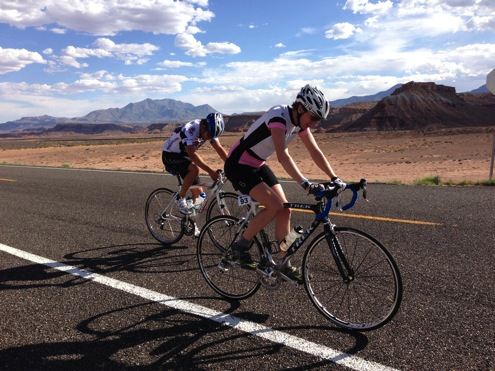
Heather, head bowed, staring at her stem and battling the wind and heat.
Instead, she looked like this:
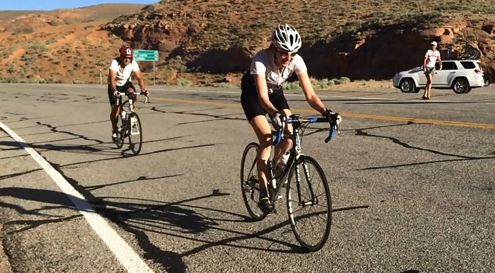
We didn’t even have to ask how she felt or how she was riding. The fact is, Heather looked and was riding great. It was that obvious. The big smile plus the guy she just dropped during the climb told that story pretty well.
Our mood shifted from anxious to excited and hopeful: just like that.
Heather was strong and feeling good! The heat was bearable! And the wind was at her back! And now I’m using a lot of exclamation points! I can’t help myself!
Deep breath, Fatty.
The point is, Heather was crushing this usually-demoralizing leg, in spite of the fact that there was nobody she could ride with.
The Secret of Our Success
In person, in email, in text messages and in comments, a lot of people have noted to me how much fun Team Fatty seems to be having in my video of this race. How it looks like it’s just a big adventure.
Well, let me let you in on a little secret: That’s actually how the race is for us. Sure, we like this race because of the route and the interesting format and the competition, but — more than anything else — we like this race because it’s a fun weekend with friends.
So let me make a recommendation to future Rockwell Relay attendees: if what you care about is winning or placing or whatever, find the fastest people you can for your team. But if what you care about is having an amazing weekend that you’ll never forget, make sure you build a team of friends.
Because that is what makes Team Fatty great.
Which leads in a tangential way to the way our team supports itself. We don’t use a “crew;” we crew for each other. Taking care of each other is part of the experience. It makes the race less about you and more about the team. And that’s a fantastic thing.
And extending from that philosophy is how much support our team gives each other. Which is to say, our team is never more than a couple miles away from our racer. We pull in front, pile out of the van (more enthusiastically during the day, less enthusiastically at night), and cheer our racer on.
Here’s Kenny (The Hammer’s right behind him, but you can’t see her in this shot), ringing the cowbell and hollering for Heather. Out in the middle of nowhere.
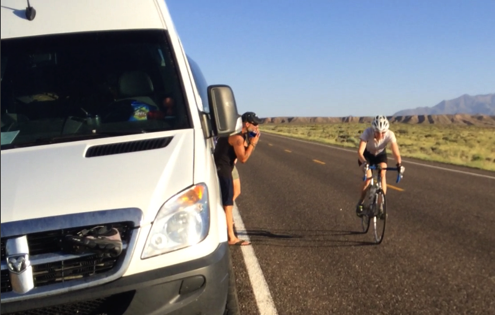
And here’s Heather about one second later:
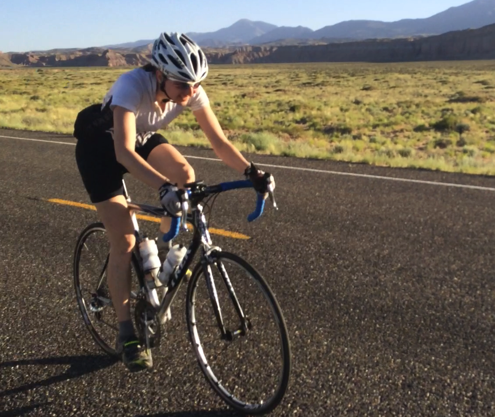
Big smile on her face. Riding with intensity. Having a great ride, in spite of the fact that it’s a barely-there uphill that goes on forever, as if it’s designed to make you think it’s flat while still slowing you down.
I tell you, having your team there — and making some noise for you — makes a huge difference in how hard you ride and how much you’re willing to give. Huge.
Plus, when you’re supporting each other, you get chances to master one of the most subtle and complicated cycling moves there is: the bottle handoff. Here’s the windup, where The Hammer starts running backward, matching speed.
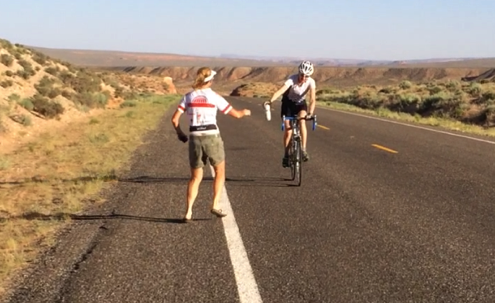
And the connection is made…
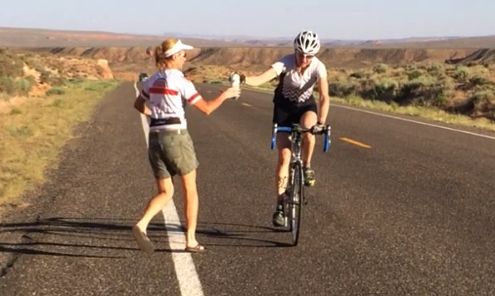
Annnnnd…success! The Hammer swings the bottle wide and out of the way:
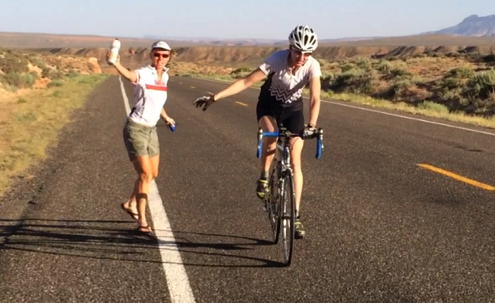
A perfect handoff. Full marks, and ten bonus points for style to each participant.
Yes, Please Tell Me How Much I Suck
Heather passed racer after racer, and was passed by not a single racer herself. What a difference a few degrees and a tailwind makes!
So when she had ten miles to go, we left her and headed out to the next exchange point, where Kenny could get himself ready. Time seemed to go so fast during this race that it felt surprising that Kenny’d be riding through the sunset and into the dark. But that’s how it would be, and he got geared up in his reflective belt and headlamp — a blinky light in back.
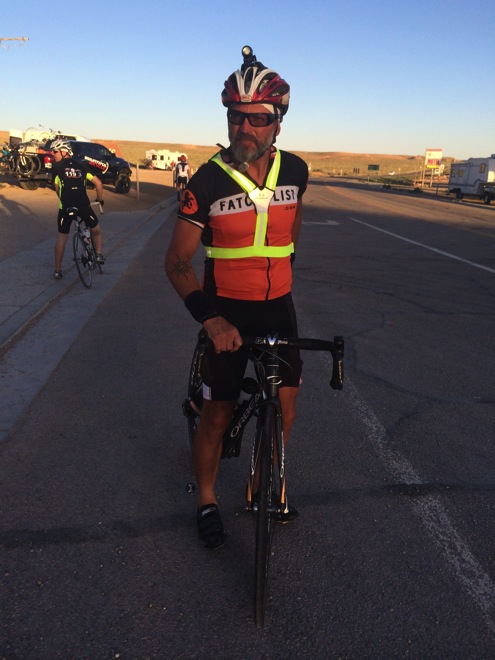
All he needed to do now was wait for Heather.
I, meanwhile, was in the busiest transition of the day. The Hammer was up next, and she’d be riding in the full dark, with a significant descent. And then after her, I’d be riding in the dark with a big descent. And once it got dark, it would be a lot more difficult to get lights mounted on her bike, my bike, her helmet, and my helmet.
Also, the next two exchanges happen quickly; I wouldn’t have a lot of time to get the riders (The Hammer next, myself the time after that) as well as the bikes ready.
So this was my opportunity on getting bikes prepped for night riding, and I was pretty focused. And probably a little terse. And quite likely a little surly.
Which, somehow, made several people want to come and talk to me. And, apparently, they thought that this was a good opportunity to tell me how much faster they were than I was during our first leg. Or, in one case, how he could have been faster than me…but wasn’t really giving it his all.
Later, as I was telling The Hammer how much it bothered me that people would seek me out specifically to tell me they beat my time (or would have if they had been trying), she explained that it was really a compliment — that these people were using me as a yardstick of their own speed.
“Yeah, I get that — I do the same thing,” I said. I’ve used Kenny as my personal yardstick of speed for…well…pretty much ever. “But they don’t need to come seek me out to tell me they’re better than me.”
“You’re too sensitive,” The Hammer replied.
It’s true. I am. I’m not proud of it, but I’m extremely sensitive. Kind of a baby, really.
And I’m also the kind of person who looks for revenge.
That opportunity would come. Soon.
Real soon.
PS: To read the next installment in this series, click here.
Comments (25)
06.4.2014 | 7:21 am
No blog post (unless you count this as a blog post) today, because I had planned a book review…and am now working on revising it with an eye toward not trashing it entirely.
I am not sure whether I will succeed.
Also, this book review is likely to be a multi-parter. Which sounds incredibly dull, but here’s the thing: I get to write whatever interests me, and this review interests me.
Still, I feel like I should apologize for the likelihood that this review won’t interest anyone else, because it’s not like I just write this blog and post it without any expectation of it being read.
Which is to say, I know you readers are out there, and usually what I want to write and what you want to read coincide rather nicely.
But maybe not this time.
Hence, I apologize. In advance. And I’ll see you tomorrow.
Comments (20)
06.2.2014 | 9:46 am
One last anecdote from the Timp Trail Half Marathon: one I left out of part 3 of the story (which is where this anecdote — the one I’ll eventually get to, honest — happens, chronologically) on purpose.
We were on a climb — a hard climb, but not the hardest — and I was passing people, most of whom were walking. As I went by one guy (a guy who had passed me on a descent), he asked me, “How are you running here? I’m walking and my heart rate is pegged at 170!”
I didn’t have to think about my response: “Don’t wear a heart rate monitor.”
At the moment, I meant that statement in the very simplest possible way. I.e., I don’t wear a heart rate monitor, so I don’t know what my heart rate is.
But I also think it’s a good idea for athletes in general: stop wearing a heart rate monitor, and find out what you can really do.
More Anecdotal Evidence
I get the sense that a lot of racers — cyclists and runners in particular — have become slaves to their heart rate monitors, along with the coaches that prescribe certain heart rate zones.
And by letting their monitors tell them what they can and cannot do, they sacrifice their opportunity for greatness. Their chance to say, with their legs and lungs, “I can push myself. I am more than a mathematical equation. I can go ’til I hurt, and then go harder. I can go ’til I want to throw up, and go harder. I can go ’til I do throw up and feel like I might black out… and then I’ll back off. But only just a tiny bit.”
For example, take my friend Kenny. I think of him as more than a friend, I think of him as a mentor. As the Platonic Ideal of cycling. He was they guy who told me to race as hard as I could and don’t worry about split times.
But a few years ago, he hired a coach and followed her advice and wore a heart rate monitor as he raced the Leadville 100. And he finished with his slowest time in about ten years. One of the only times, in fact, that he’s finished in more than nine hours.
Or how about this. Adam Schwarz and I have been egging each other on about weight loss and racing for more than a year now. We were going to race each other in the St. George Half Ironman this year, but I bailed out, conceded, and rode the White Rim instead.
In the end, though, Adam’s time was just ten minutes shy of being two hours slower than my 2013 time.
Of course, I asked him what happened. He said:
Heat was a big deal. Watched a lot of people have issue with it. Had to walk the 13.1 (most of it) because I couldn’t control my heart rate as a result of the heat. St George by leisurely stroll isn’t half bad.
And he also figured he didn’t eat enough — only 600 calories during the race. But the thing is, it’s always hot in St. George. And I took in maybe 800 calories during the whole race.
My assessment of what KO’d Adam that didn’t get me? I had no idea what my heart rate was. And I didn’t care. I was racing, and I was going to go until / unless I literally couldn’t.
My heart would just have to deal with it.
Here, Try This
First of all, a caveat: I’m just a blogger, and a dorky one at that. I don’t know anything about your physical state or constraints. Don’t do anything your doctor would say is dumb for you to do, OK?
With that out of the way, I know: A lot of people train with heart rate monitors. Swear by them. But unless you’re a professional athlete — and if you’re reading this, you’re almost certainly not — I suggest that knowing your heart rate is too much information. And it’s the kind of information that gives you a reason to go easier. To slow down — or give up — before you really have to.
You want to find out what your body — your whole body, including your lungs, legs, and heart — are capable of? Take off your heart rate monitor and then GO ALL OUT.
And not for a certain amount of time, either.
Instead, go at your absolute maximum effort. Cycling up a steep hill. Running at a sprint. Seeing if you can get your rowing machine to catch on fire. Whatever. And do it until you can’t. Not until it hurts. Not until you feel like you are going to throw up.
Do it until your body shuts you down. ’Til your mind and soul have nothing to say in the matter.
Then make a note of how you felt. How you felt as you were at your honest maximum effort, and how you felt right before you literally had to stop.
Then, another day, do the same thing, but this time as you’re bumping up against that feeling where you have to stop, back off. Just a tiny bit. And see how that feels. Can you hold that level of effort for longer? How much longer?
And then try other levels of effort. Listen to your lungs and your legs and your stomach and the rest of your body. If you listen to them, they will tell you, accurately and honestly, of what you are capable of at that moment. What’s too hard. What’s too easy. What you can cope with for ten seconds. Or ten minutes. Or ten hours.
Sometimes your lungs will slow you down a bit. Sometimes your legs. Sometimes — sure — your heart. But if you listen to your body, and get to know it, you’ll learn that you are the judge. You are the arbiter of your ability to keep going, or not. If you are weaker today, you get to own that…instead of blaming it on a device.
And If you are stronger today, you are awesome.
Kill your heart rate monitor. And find out how strong you really are.
Comments (68)
05.27.2014 | 7:45 am
Hey, I’m sitting here in the SLC airport, about to fly out to Austin for the next few days. I hope — hope — I’ll have time during my trip to write about some of the things that happened during the Memorial Day weekend.
Because some very awesome stuff happened.
For example, on Saturday, The Hammer, The Swimmer, and I all raced the Timp Trail Half Marathon. Here we are — oh so happy — before the race.
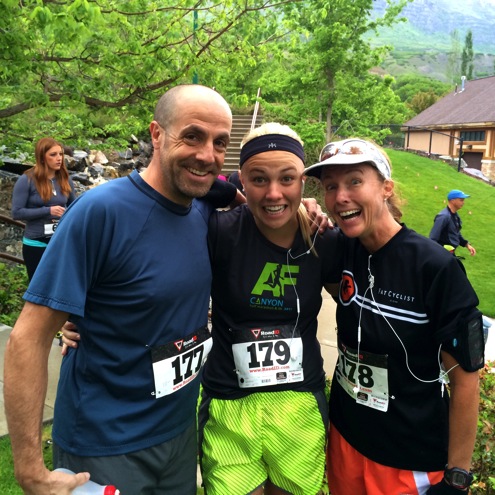
Yes, I want to be clear: that’s before the race. The “after” pictures are somewhat different. I’ll show those as I tell the story (hopefully) during the next day or two or three.
But that wasn’t the only big event of our weekend. The Hammer also took delivery of the bike she gets as one of the incredible perks of being a World Bicycle Relief Athlete Ambassador. Here she is with Taylor Felt, the manager of Bountiful Bicycles, where her awesome new Specialized S-Works Roubaix was built:
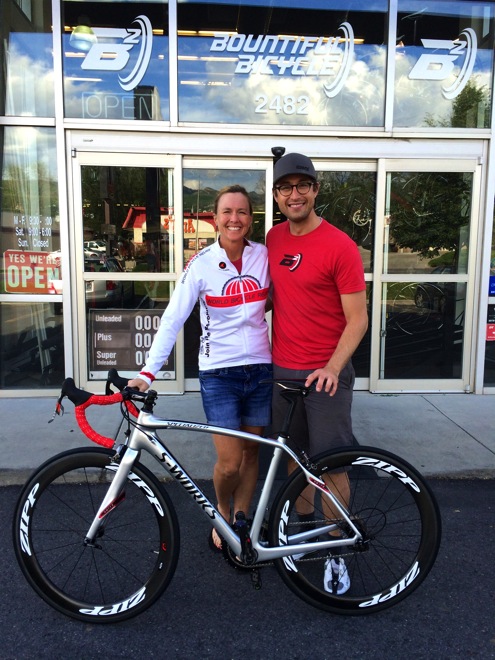
She’s had that bike for two days, and has already put around 150 miles on it. So yeah, I’d say it’s going to be a well-loved, well-used bike.
More on that soon, too.
So, how was your weekend?
Comments (23)
05.23.2014 | 9:09 am
Today at 3pm EDT / 2pm CDT / 1pm MDT / 12noon PDT (people in AZ are going to have to do their own time-related math), I’m going to be hosting a video Q&A about the Rockwell Relay on Spreecast. Now, I’ve talked about this race before. In fact, I’ve probably talked about it more than anyone else has, ever.
But today, we’re going to talk tactics. And strategy. And gear. And other stuff. If you are considering doing this race or have already signed up, you should watch. Here, let me make things easy for you by embedding the viewer here:
You should know, though, that the whole experience is going to be better at the Spreecast site, where you can enter questions and stuff.
Oh, and speaking of questions, please, for the love of all that’s good in the world, start thinking of some questions you can ask, or this Spreecast will wind up being a very awkward ten minutes of people staring blankly at the screen, humming softly to themselves (i.e., ourselves).
And nobody wants to see that. Or maybe you do. But I hope not.
So Who’s Going To Be On the Panel?
For this chat, I thought I’d bring on a variety of folks to talk and answer — as well as ask — questions:
- Me: In spite of all my efforts, I seem to have become someone who actually knows something about this race. Weird.
- The Race Director: Tyler Servoss is race director for the Rockwell Relay, and so will be able to give actual official answers, as opposed to the answers which I will be pulling directly out of my butt. (Luckily for everyone, this will remain off-camera.)
- An Experienced Racer Guy: Spencer Story has done the Rockwell Relay before, and knows a thing or two about a thing or two. He’ll be a good person to ask questions if you expect a sane experienced perspective on the race, as a counterpoint to my perspective.
- The New Guy: Ted Twogood has never raced the Rockwell Relay, and should therefore have a lot of questions. It’s my hope that he’ll want to ask us these questions, in order to help us avoid the aforementioned awkward silence.
Questions I Think Someone Ought To Ask
OK, really this is just me writing some notes to myself for things I’d like to bring up. Please give me more ideas in the comments section, OK? I’m begging here.
- Why the staggered start? And how will it affect race tactics?
- Any course changes this year?
- How long will Dave Towle be commentating? For the entirety of the race? Because I think he may be the only person in the world who could commentate for 35+ hours straight.
- If Dave isn’t commentating for the whole thing, does he want to drive our van for us? If he’s on the clock, he ought to be doing something.
- What kind of riders are best suited for which stages? I’ve detailed probable weather conditions for each stage before, but it might not be a bad idea to talk about what the elevation profiles indicate, rider-type-wise.
- What kind of vibe should you expect at the Rockwell Relay?
- What are some clever food ideas? Load up on Paradox Pizza the night before and stow it in plastic bags, of course. But what else?
- How do you keep your rider from catching fire? It gets kinda warm out there in the middle of the day.
- When do you need to register by? Registration closes June 1. So that’s probably going to be a pretty brief Q&A moment.
- What are things that people do that are against the rules?
- What kinds of stuff — tools, clothes, other gear — should people bring?
- What if your team is having a crummy day? What are your options?
- Have you ever been in a Turkish prison?
- Will there be brats at packet pickup this year?
- How many teams raced last year? How many are registered this year?
- What if someone wants to do this race, but doesn’t have a team?
Oh, and how about one last question: Will Team Fatty employ new race strategies to defeat or at least confuse the sudden profusion of high-zoot coed teams? The short answer is “yes.” I’m not sure how much detail I’m going to go into, though. Let’s just say that the phrase “no shortcuts allowed” doesn’t appear anywhere in the race bible and leave it at that.
Comments (7)
« Previous Page — « Previous Entries Next Entries » — Next Page »
