12.27.2012 | 1:29 pm
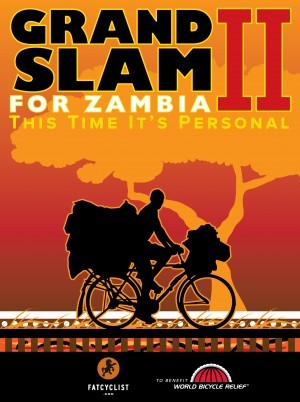 A month and a half ago, I set an ambitious goal: raise $125,000 for World Bicycle Relief (WBR) by December 24. That money, thanks to a dollar-for-dollar matching commitment secured by WBR, would then be doubled to a quarter-million dollars.
I then set about telling the story of my trip to Zambia with WBR last summer. And I started rolling out the prizes.
It became the focus of my blog, to the extent that some people correctly complained that I never talked about anything else anymore.
What I didn’t reply was that I kind of agreed with them, and that it would be a lot easier for me to write fake news and semi-real observations and about bike rides.
Because — believe it or not — writing fundraiser contest posts are absolutely positively the most difficult and taxing kind of posts there are for me to write.
But they’re worth doing.
And they’re especially worth doing when the results are stunning. As in, as of this moment we’ve raised about $168,500. Which, when matched, will come out to $337,000. And by the time some more corporate matching gifts get factored in, the total matched amount Grand Slam for Zambia 2 will have raised should be at — or very close to — $350,000. That’s $100,000 more than our goal.
Yeah.
In a recent post, I thanked the folks who donated prizes, as well as everyone who made donations. Now, I want to especially want to thank Patrick Dempsey, who did both. Not only did he — along with Tom Danielson — donate a slot in their ultra-deluxe winter training camp, but he also donated $5000 of his own money.
Pretty remarkable, especially considering that all I’ve ever done for him is give him a donut.
What Does This Mean?
$350,000 sounds like a lot of money. Because it is. What’s amazing, though, is what that money will buy:
- 2500 bikes ($134 * 2500 = $335,000)
- 50 mechanics (1 mechanic for every 50 bikes) trained ($250 * 50 = $12,500)
- 50 (1 for each mechanic trained) toolkits ($50 * 50 = $2500)
Bear in mind, too, that each bike benefits more than one person. So what does this mean? It means that your generosity has made a difference for thousands and thousands of people.
I feel pretty good about that.
What’s Next for Grand Slam for Zambia?
My job is done in this project, more or less. Now it’s up to Katie over at WBR to generate the random numbers and start sending out email. Within the next few days, some of you will be hearing from her, asking you to select which of the prizes you want to select.
There are so many amazing prizes here that I honestly do not know which of them I would select out of this batch. I do not envy those of you who will have to make this choice.
No, that’s a total lie. I do envy you. A lot.
What’s Next for FatCyclist.com?
So with this project out of the way, what am I doing next? That’s a fine question, and I’m glad I asked it of myself. Here’s my reply to me, in the form of a bullet list.
- I’m taking a vacation. I’ll be back at this blog starting January 7.
- I’m thinking about what I want to do next in terms of fundraising. I plan to continue to fundraise for the two causes I’ve chosen: fighting cancer and fighting poverty. How much, how often, when, how, and for whom are questions I’m currently considering.
- I’m thinking about what kind of blog writing I want to do. When I started this blog, I was in my very-late-30’s. Now I’m in my mid-late-40’s. This almost-eight-year period has seen a lot of change for me. An unbelievable amount of change, really. It’s ridiculous for me to think in terms of writing the same kinds of things I wrote the first few years of this blog; I’m no longer that guy. But I do still want to write, and I still want to write about biking. Do I have any idea of the direction or extent of changes this blog will take next year? No. But I do know that I’m not going to try to make this blog be the same thing it was in 2006. Or even 2010.
- I’m thinking about how long I want to write this blog. I’m closing in on eight years that I’ve been doing this. For the last year or two, I’ve been thinking that ten years is the maximum shelf life for any blog. But now I don’t know. Maybe ten years is too much. Or too little.
- I’m thinking about other projects I want to do. I want to publish Susan’s unfinished novel. I want to write the Caregiver’s Companion. I want to write Fight Like Susan. I want to compile and edit Volume 2 in The Best of FatCyclist.com. I know for sure I can’t do all of those this year, but I think I can do at least two of them. Which two is the question.
If you’ve got an opinion on any of these things, I’d love to hear from you.
Until 7 January 2013, thanks for reading, commenting, and — as often as I’ve asked — donating. Have a great holiday, and make some time to get on your bike — even if it has to be indoors — and ride.
Comments (80)
12.21.2012 | 8:18 am
UPDATE: Super-duper extra thanks go to Specialized, which — in addition to donating two of the grand prizes for this fundraiser (an S-Works Roubaix SL4 and a S-Works Stumpjumper FSR Carbon 29) — just donated $13,000.00 to the fundraiser as a “congrats on hitting your goal” gift.
This catapulted us right into the $140,000+ range, and makes me wonder: what if we raised $150,000 by the end of this fundraiser, which — after matching — would bring us to $300,000? That would be unbelievable in the very best way.
To everyone at Specialized who worked on promoting and donating to this project: thank you for your generosity and passion to make this ambitious fundraising project succeed. I was already a fan of your bikes; now I’m a fan of your company.
This is it: the last day before the end of the contest that I’ll be posting about Grand Slam 2 for Zambia (although you can continue to donate right up through midnight on Christmas eve to be eligible for any of the prizes in the contest).
For this post, I really just want to say thank you.
And I’m not the only one who wants to thank you, either.
The Hammer, my 1617-year-old son, and I made a slide show of our trip to Zambia last night as a reminder of what we’ve seen and the good you have done (and continue to do!) by helping us with this Bicycle Relief project.
I recommend watching it all the way through (by the way, it looks best if you watch it nice and big over on Vimeo) — the last minute is a video of a really fantastic speech made by one of the students at the Nanswisa Basic School, expressing gratitude for these bikes.
Note that the beautiful singing in the soundtrack for this video also came from the children at the Nanswisa Basic School during the bike distribution ceremony.
A Thank You Poem
For those of you who were wondering whether there would ever be another “Free Verse Friday,” well, today there is. But this isn’t the normal self-consciously horribly bad poem in the style I write.
No.
This is a poem that was written by the children of Nanswisa Basic School and performed by them during the bike distribution ceremony, and is titled “Bicycle Relief, We Thank You.”
Never believe that a few caring people
Cannot change the world
For indeed
They are the only who ever have
We thank you
The real measure of our wealth
Is how much we would be worth
If we get educated
Through this educational offer
Bicycle Relief
Bicycle Relief
We thank you
We are never given a wish
Without also being given the power
To make it come true
We indeed wished for better education
And we have been empowered
Through the education materials
These white horses
Bicycle Relief
We thank you
Gratitude unlocks the fulness of life
It turns what we have
Into enough and more
Oh we thank you!
Help is like snow
The softer it falls
The longer it dwells
And the deeper it sinks into our mind!
We will now write
Our long sufferings of long distance
And less educational materials
On the sand
And write you good will
Of making our education simple
On a piece of marble
Bicycle Relief
Bicycle Relief
We thank you
Less Eloquent Thanks
I want to thank you, as well. First, thanks for donating. We have reached and surpassed We’re down to the last $1000 before we hit our $125,000 goal, which means — thanks to a generous matching promise — our money will double to $250,000. A quarter million dollars.
UPDATE: Even though we’ve crossed the goal, additional donations continue to get matched, dollar-for-dollar, through the end of the contest! Also, donations continue to count toward the contest right through December 24.
The generosity of you people is astonishing. And shows of generosity like this — more than a thousand people coming together to improve thousands of strangers’ lives in permanent, powerful ways — are especially wonderful to see in times like these, where the news is often too ugly to contemplate.
So thank you.
I also want to thank the incredible people and companies who have made this the most extraordinarily prize-ladened fundraising contest I could ever imagine. Specialized. Levi Leipheimer and Levi’s Gran Fondo. Patrick Dempsey and Tom Danielson. Rebecca Rusch. Twin Six. Miir. Chris Horner. Honey Stinger. Ted King. Greg Herbold and Western Spirit Cycling Adventures.
Your generosity has gone so far beyond what I would expect of anyone. So, although it’s beginning to sound like I’m a broken record, I’m going to say it again:
Thank you. Thank you so much.
Comments (33)
12.17.2012 | 1:18 pm
There was just no way I could write something funny today. No way I could write about a ride. No way I could even talk about the Grand Slam 2 Fundraiser. Because like everyone I know, I’m too messed up — horrified, stunned, sad, angry, scared, dismayed, you name it — over the killings in Connecticut to think meaningfully about anything else.
So I’m going to write a little bit about this. And see if I can, by trying to order the jumble in my mind into sentences, make some sense.
Sick to My Stomach
I was driving to a company Christmas lunch and white elephant exchange when I found out about about what had happened. I called Lisa — who was out doing some Christmas shopping — and told her what I had heard.
Then we just took turns saying variations of “I can’t believe this,” and “Why would anyone do something so unspeakable?” The fact was — and is — there was simply no way we could understand or grasp something so unimaginably evil.
The rest of the day, this horrible thing kept coming to mind. I’d push it out — unable to understand, unable to help, physically ill at the realization there could be someone so perfectly vile as to kill. Over and over. Or — even worse, though I would never have imagined this to be possible — to kill children. People who were just starting to become their individual selves. Just starting to reveal who they were to their parents.
I kept thinking how much like my own children’s school this thing happened at. Then — like millions and millions of parents, I suspect — I felt a little wave of panic and wished my twins would get home soon.
What I Know and What I Don’t
The whole weekend I kept thinking about what this killing. I thought about the kids. The guns. The parents. The families. The killer. The loss. I knew that it was on my mind too much to not write about it when Monday arrived, but what do I have to say that’s worth saying?
I know enough about how people feel about guns and gun laws and the second amendment that I know I don’t want to talk about that. Yes, I know it needs talking about, but I’ll leave that to others; it’s too complex a topic — and too politically loaded — for someone like me to approach.
I know enough about mental illness to know this isn’t something I can really talk about with any authority either.
But I do know a little bit about loss. I’ve been through tragic loss — of a much different kind, but still: a tragic loss. And I have the sense that most people, at some point, at least get frighteningly close to someone who’s been through a terrible, incomprehensible loss.
Here are a few things I remember. Maybe some of them will help. Maybe some of them won’t. I’m just one person, and what helped me might not be much help at all to another.
I don’t presume that this will help anyone remotely involved in the Connecticut tragedy. But maybe it will be useful to you as you deal with others’ loss, or maybe loss of your own.
Or maybe it won’t help at all. I don’t know.
Coming Over
The night Susan died, one of my friends called, asking if I’d like him to come over. I said “no,” and I meant it honestly. I didn’t want to be with anyone. Didn’t want anyone to see me. Didn’t have the energy to see anyone.
Another one of my friends just came over. He didn’t ask. As it turns out, having a friend there amidst all the family was good. I don’t remember what we talked about or whether we talked at all, but it was really good to have him there.
So which is the right way? Both, I think. If you’re the kind of person who calls and asks, do. If you’re the kind of person who can just show up, do. Both are signs of solidarity.
Helping
Everyone’s impulse is to ask how they can help. I will tell you that I hated that question. It required me to do so much thinking and deciding. What do I need help with? Am I willing to admit that I need help with this? Is this a person who I trust to handle something I need done if I ask for that help, or will I just be exchanging the work of doing something for the work of managing the doing of that thing?
Does this person really want to help, or is this just an offer of condolence?
On the other hand, when a friend of mine — who manages a lawn care company — said, “I’m going to take care of your lawn for the rest of the summer, OK?” I was incredibly grateful.
I think there’s a lesson there. If you have an offer of help to make, try to make it concrete — what you’re going to do (in particular if it’s something you have expertise in). And make the offer as a statement, rather than as a question (“Do you need help with anything?”)
Also, remember that offers of help tend to come in a giant flood at first, and slow to a trickle within a week or a month or whatever. As your loved on goes from being overwhelmed with offers to simply being overwhelmed, a renewed offer of help a few weeks or months down the road might be more helpful than one right away.
Religion
This is one topic I almost decided to leave out, because it’s as potentially inflammatory as the guns and politics part of this discussion I’m trying to steer clear of.
Which is maybe ironic, because steering clear of religion is actually the piece of advice I have to give.
You may have good reason to ignore this piece of advice — if you’re strongly religious and you are absolutely certain that the person you’re comforting is also strongly religious, for one example. Or if the person you’re comforting has initiated talk of faith.
However, unless your confidence on the person’s feelings toward religion are absolute, you might want to steer clear. Your world view may not be their world view, and this isn’t the time to put them in the awkward position of deciding whether to smile and listen to something they find offensive.
Or — supposing the person you’re talking to is ostensibly even of the same religion as you — you don’t know whether the person might currently be feeling some serious anger or at least ambivalence toward your deity at the moment. Is this really a good moment to ask for a show of faith?
This may be a good time to — instead of assuring this person of the power of prayer and letting them know that you personally have plenty of faith — pray on their behalf and let it work its power without you telling them about it.
On the Bright Side
Maybe some people really do get cheered up when others try to find a silver lining to a tragedy. For myself, only my inability to yell at well-meaning people kept me from shouting, “Don’t try to tell me that this death came with perks.”
Eventually, many people — including me, I hope — can take something horrible and use it for a catalyst for good. But don’t presume that anything good comes bundled, no charge, with any tragedy.
Telling Your Own Stories
For me, it was helpful to hear people who had actually been through the same thing tell me “You’ll get through it; you’ll be OK.”
It was not helpful, on the other hand, when people simply knew of a similar tragedy, and thought they were showing solidarity or understanding by recounting it. I was already so distraught and angry and worried about the future that every time someone told me their story, I’d just hear that they knew someone who had endured something worse than I had, and had handled it better than I was.
Saying “I’m Sorry”
What makes a tragedy a tragedy — and not just a problem — is that it can’t just be fixed. There’s not much you can say that will make it better. And saying “I’m sorry” just doesn’t seem like it’s enough.
But you know what? I appreciated every single person who just said that. An acknowledgment that something terrible has happened along with an expression of sympathy.
It’s not much, which is part of the nature of tragedy and loss. No matter how badly you want to do enough, you just can’t do much to help.
But it’s something. And sometimes that has to be enough.
PS: My sister Jodi has a good piece today on what she’s thinking and doing after this attack. Read it here.
Comments (47)
12.10.2012 | 4:02 pm
A Note from Fatty: I will not be posting tomorrow, because I am having some surgery done. Left index finger and right elbow. Wheeeee!
A More Awesome Note from Fatty: This Wednesday (December 12) at 12:00noon ET / 9:00AM PT I’ll be doing a live interview with a couple of extremely awesome people. Specifically, first I’ll be talking with F.K. Day, President of World Bicycle Relief:
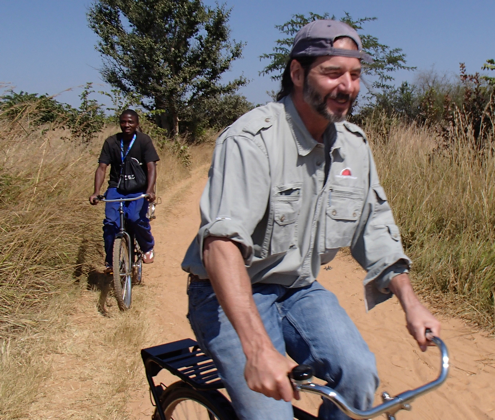
We’ll be talking about how World Bicycle Relief works, why it is where it is, and what’s next. F.K. is one of the smartest, most genuine people I have ever met, and he’ll be happy to take your questions.
Next, we’ll talking with Rebecca Rusch, also known as The Queen of Pain. Rebecca is the four-time champ of The Leadville 100, an advocate for women’s cycling, an ambassador for World Bicycle Relief, a three-time 24-hour Solo Mountain Bike World Championships winner, and otherwise has an astonishing race resume.
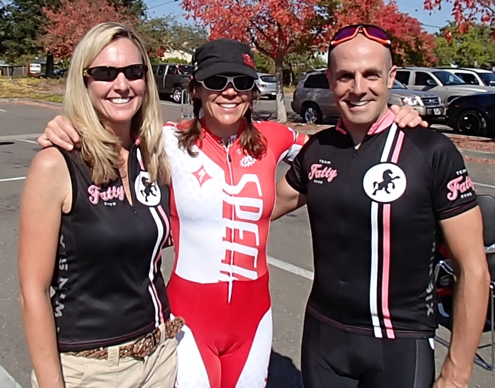
I’m not even going to try to pretend I’m anything but a superfan when we talk, especially since we’ll also be talking about the latest and greatest Grand Slam for Zambia grand prize, which Rebecca will be donating.
So, to recap: Wednesday at 12:00noon ET / 9:00AM PT. Be here. (or at Spreecast)
talking with FK and Rebecca on Wednesday
One Last Awesome Note from Fatty Before I Begin Today’s Actual Post: It’s no surprise that Grand Slam 2 is loaded with prizes (and there are more to be announced, of course). But just for fun, when we hit the 1000 donations mark today, we went ahead and picked a random number between 1 and 1000 (which is to say, we didn’t take into account how much each donation was for, just that there was a donation) and gave that person a cool ZIPP disc wheel clock, like this one, being held by Ironman World Champion Mirinda Carfrae:
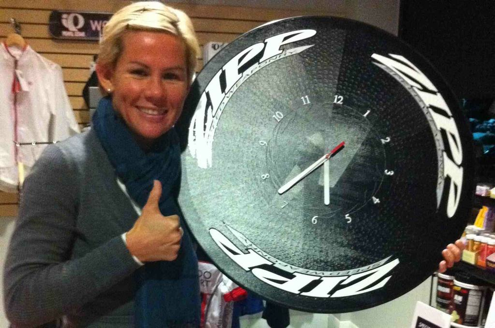
That prize went to Allison H, wife of extremely frequent commenter David H. And since I’m not the one drawing prizes, I don’t have to worry about choosing favorites or anything.
Oh, by the way: that’s not the only time we plan to do random drawings for cool prizes like this. So — whether you donate enough to buy a bike for a child in Zambia ($134) or the amount you’d spend on lunch or a coffee ($5 – $10), you may still win either a grand prize or a bonus prize. So go donate now.
We Don’t Suffer
Once in a while I think about all the rides I’ve done, and try to decide on which ride it was that I suffered the most.
Maybe it was when I raced the Kokopelli Trail solo, unsupported, injured and with a broken rear derailleur. That was some serious suffering.
Or maybe it was the first time I raced the Leadville 100. I didn’t know what I was up against. I didn’t know what I was doing. My knee hurt so bad I still remember the pain today. My nipples bled, for crying out loud (oh yes, quite literally crying out loud). And I was so very, very exhausted.
It’s also possible the time I suffered most was in the Summer of 2011 on a short anonymous training ride, where I turned myself inside out, giving it everything I had and quite possibly a little more — i.e., I gave 100.01%, thus defying mathematics — in my quest to give my all and hopefully get onto the Strava Top 20 for the Alpine Loop climb (American Fork side). My suffering paid off, too: I took the 18th spot, which would maybe mean more to you if you knew the guys in first through seventeenth place.
In each of these cases, though, I hurt. Bad. My legs ached — sometimes acutely, sometimes dully. Sometimes both. My lungs burned. My morale was incinerated in a fiery furnace of hot flaming burnination.
And in short, I suffered.
Except I didn’t.
Because it is my contention that, as cyclists, we do not suffer. At all. No matter how hard you’re riding, or how much you hurt. Or how dramatic the stories are that you (and by “you,” I mean “I”) tell yourself as a way to keep riding even though you are hurting and aren’t having fun anymore and are this close to giving up, getting off, and making the Phone Call of Shame.
Please. Allow me to explain.
One of These Things Is Not Like The Others
Here are some things that you might associate with suffering:
- A compound fracture
- Eating boiled okra
- Imprisonment
- Being tasered
- Watching season two of Twin Peaks
- Riding a bike really far or really hard
What’s different between the last item and the other items? Simple. You do not take the circumstances of the first three items upon yourself by choice.
My point being that suffering — true suffering – is something that is pressed upon you. Suffering is the act of putting up with something difficult — and probably painful — that you didn’t ask for.
Suffering is not the pain you feel when you are riding your bike.
You want to know what the correct word is for that pain you feel when you’re exerting yourself on your bike?
You do? Are you sure? You might not like it.
You still want to know? OK. Don’t say I didn’t warn you, though.
“Entertainment.”
See? I told you that you wouldn’t like it. But that’s what it is. That pain you’re experiencing is what you do for recreation. For fun. If you chose it and you can stop it whenever you want, you’ve got to admit: that pain you’re experiencing is your idea of a good time.
Congratulations. You’re officially a masochist.
The News Is Not All Bad
It would be easy to read up to this point and think that I’m trivializing what you (and I) experience on the bike by asserting that we don’t suffer.
But that’s not what I’m doing. At all.
Instead, I’m suggesting that you pivot your thinking a little bit the next time you find yourself having an argument with yourself about which hurts worse: your legs or lungs.
Instead of saying to yourself, “I’m suffering” — which is something you do passively, when a horrible circumstance is forced upon you — say to yourself, “This pain is mine.” Embrace it fully. After all, you created it and you decide how bad it’s going to hurt and how long it’s going to last. Why not own it?
Smile. Sure, clench your teeth or open your mouth as far as it will absolutely go or do whatever it is you do when you’re at your limit, but let your eyes at least still be smiling.
Because you’re not suffering. You’re not taking something someone else has put upon you. You’re hurting because you are willing to hurt to go that fast, or far, or high.
And those two things are worlds apart.
PS: For those of you who are about to suggest that if you’re watching season two of Twin Peaks, you’re bringing it upon yourself, I’d suggest that you’re dead wrong and anybody who actually watches that entire second season did so against their will and has in fact suffered mightily.
PPS: For those of you who watch The Sufferfest videos to train and furthermore claim citizenship of Sufferlandria, I have two things to say:
- You are a special, wonderful kind of sick, and I congratulate you on your commitment to pain.
- You’re still not suffering.
Comments (35)
12.7.2012 | 9:01 am
A Note from Fatty: Free Verse Friday is suspended today, due to me having something more interesting to write about, and the inclination to actually do that writing.
Yesterday was intense.
I did a serious interview with Levi Leipheimer, the replay of which you can see over at Spreecast, or right here:
Today, Velonews is talking about that interview, and on Twitter and elsewhere, people are saying really nice things about it.
So I’d like to write a little bit about what went on in putting this interview together. Because this is not the kind of thing I do every day.
Deep Background
You could say that the seed of this interview got planted as a result of the GranDonut Race. One of the things Levi agreed to do if I won — which was never in question, since I had slanted the rules so there was no way I couldn’t win — was be interviewed at some point on my blog.
My intention, of course, was to just do a silly fake interview, maybe with a side-intent of doing some good fundraising for a good cause.
And then, of course, the USADA report came out, and I figured that if I was ever going to do an interview with Levi, it wasn’t going to be a jokey one.
Less Deep Background
Flash forward a couple months to last Sunday. I’m deep into the World Bicycle Relief Fundraiser (you didn’t really think I’d let a post go without mentioning that, did you?), and had arranged with TourChats to go on their show with Tom Danielson and Patrick Dempsey to promote the big grand prize they’re giving: a week riding with them at a Malibu resort.
At show time, the video streaming service TourChats had been using — Vokle — completely self-destructed. To their massive credit, the TourChats guys quickly moved over to SpreeCast and did the show anyway. And the technology worked flawlessly.
Suddenly, I knew how I wanted to do the interview with Levi. And I knew when, too, since Levi himself was also providing a huge prize for my fundraiser.
Getting Ready
I was actually really amazed at how easy it was to get Levi on board with doing the interview. the biggest logistics problem, in fact, was that Levi has lousy Internet at his house; he’d have to go to BikeMonkey HQ for a good internet connection.
But preparing myself for actually doing a serious interview wasn’t anywhere near as easy.
First, I made sure Levi knew that I wasn’t going to be just joking around; that I planned to ask him serious questions about doping and being fired by Omega-Pharma-Whatever. I am not a big fan of blindsiding folks (usually).
“That sounds great,” he replied.
Next, I spent some time reading. And I spent some time asking people what they’d ask Levi.
And then I spent a lot of time writing questions.
That step was crucial, because I know myself pretty well, including my tendency to be nice, rather than tough. I figured that if I just let the conversation flow, it’d wind up being pretty soft.
Then I printed the questions up onto cue cards — like I was a talk show host — and ordered them the way I wanted to use them. I held them right in front of me during the interview, which is out of the camera’s view.
I then cleaned up my office — my wife was incredibly embarrassed at how messy it appeared on TourChats — and even moved a Christmas tree into the basement where I work.
Then, at the last moment, I moved the Christmas tree out of the field of vision. Too festive for what I planned to do.
Then, at even the more last moment, I unscrewed the lightbulb that is directly over my head, so there wouldn’t be such a huge glare off my head.
And the rest, well you can see how it went. I’m proud of it, and I plan to do more video interviews.
Though I’d prefer them to mostly just be goofy.
Comments (20)
« Previous Page — « Previous Entries Next Entries » — Next Page »
