04.10.2012 | 9:05 am
An Update from Fatty: I’m no longer sitting in the airport, and this post is now done. If you’ve already read this post, though, be sure to go to the updated “Upgrade” section, which I’ve changed to include something ridiculously cool Timothy Hutton did for me that I didnt even know he had done (and, oafishly, therefore never even thanked him for).
I’m sitting in the PDX airport, which has — astonishingly to anyone who has visited a good number of airports — really fast, free wifi and cubicles with power. I’ve got two hours ’til my plane leaves. Let’s see if I can tell the story of my trip to Portland and my adventure in “acting” on Leverage during that time.
And just for the fun of it, I think I’ll continuously update as I write.
Sunday
I got to Portland late Sunday afternoon. It was raining. No, just kidding. It was sunny and perfect outside. In fact, the weather was perfect. I tend to have that effect on places. Have me come by your hometown someday. I’ll bring good weather with me.
I had a couple hours before Paul Guyot (honcho at Leverage and guest blogger here) were to meet for dinner, so I took a walk, just to see Portland. The thing that struck me, in my 2-3 block radius walk, was the incredible number of parks and open space around, even though I was pretty close to the city center:
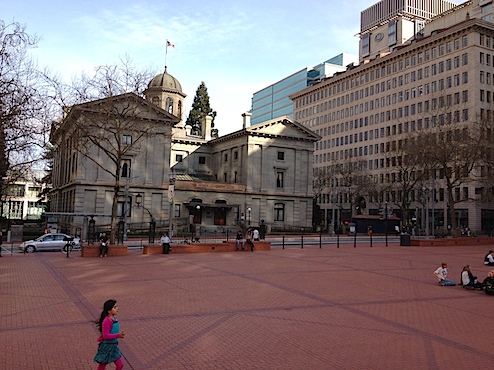
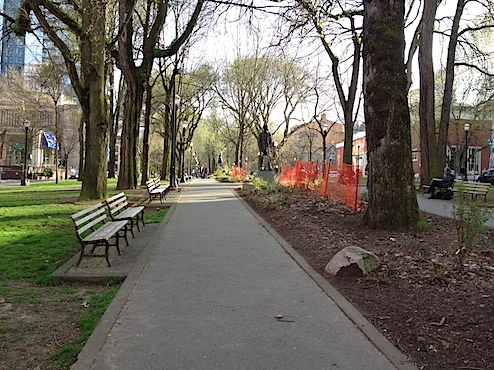
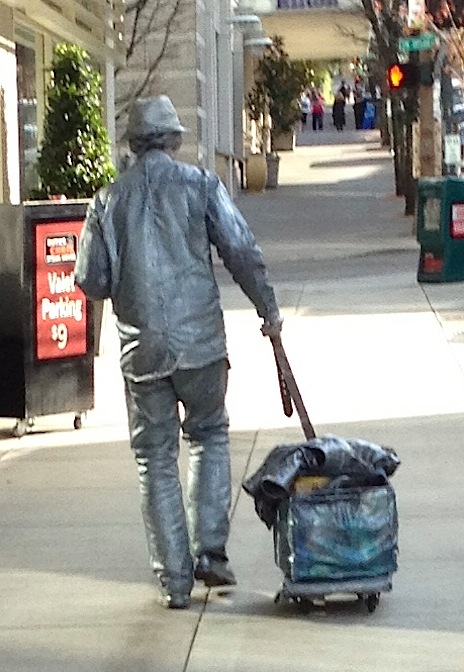
I didn’t photograph all the parks. That would have gotten repetitive. I did, however, get a picture of a statue walking home from work, with his silver laundry in tow:
After this, it was time for dinner with Paul.
We met at the hotel lobby, where he gave me a big ol’ hug, in spite of the fact that this was the first time we had met in person.
Paul, as it turns out, is just that kind of guy. As in, one of the nicest people I’ve ever met, who still obviously manages to keep a big ol’ television crew humming along very smoothly.
We went to a great steak place, called Ringside. We got both onion rings and fries to go with our steaks.
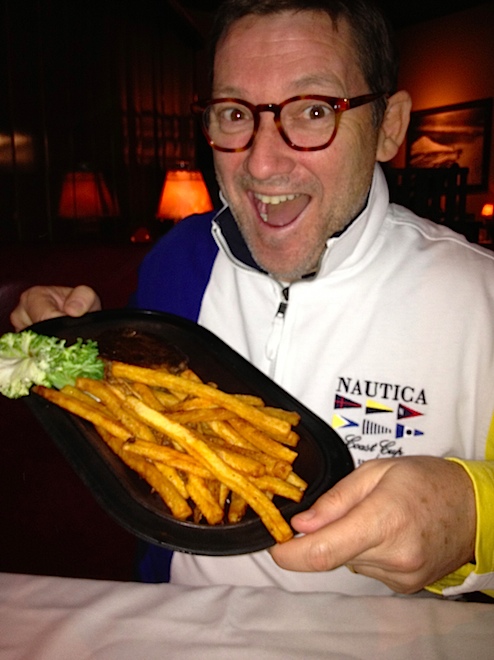
Though I got a salad to offset the massive amount of food I ate. So I’d call it a calorie-neutral evening.
Since I needed to be in the hotel lobby at 6:15 the next morning and Paul had to be on the set even earlier, we did not party as if it were 1999. Even though we are both old enough to remember that song from when it came out.
I went back to my hotel room and practiced my acting. Since I was not slated to have a speaking part, I worked on conveying meaning and emotion merely using facial expressions.
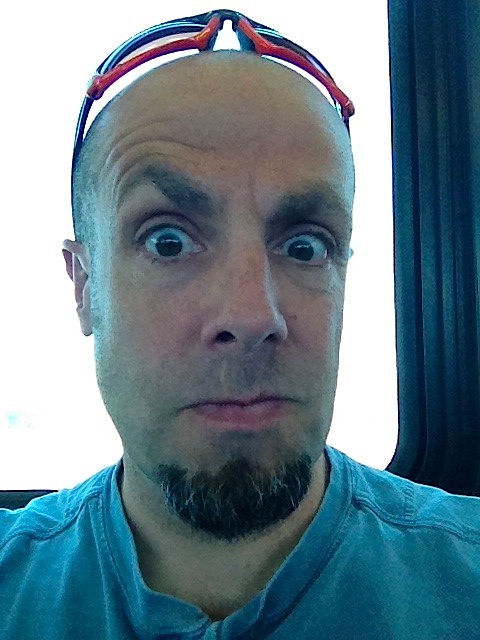
Disgust! Bemusement! A call for help! I can do all these things with a raised eyebrow, a flared nostril, and compressed upper lip.
I’m that good.
The Big Day
I got a ride to the set — a pair of converted warehouses in an industrial area — with a couple guys who looked very familiar — I’ve seen them both before in TV and movies. I wondered to myself whether they were hoping I would speak to them so they could ask me for my autograph without it seeming awkward.
They did in fact begin talking, but apparently were too shy to ask for my autograph. I didn’t mind.
They started talking about Parkour. I listened for a bit and then got out my phone. “You like Parkour? You should watch a Danny Macaskill video,” I told them.
They finished the ride to the set, watching, in stunned silence.
Once we arrived, Paul found me and started showing me around. Starting, of course, with the food services tent, where we each had big ol batches of scrambled eggs with everything made for us.
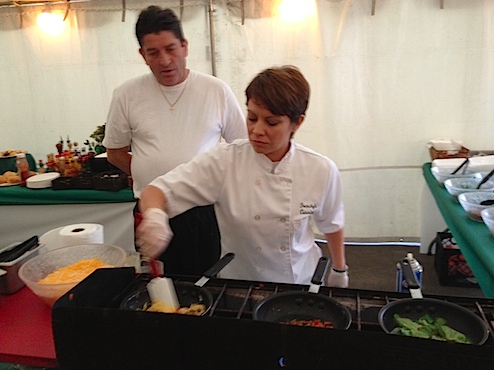
Paul and I are a lot alike. Except I’m more beloved, I’m pretty sure.
Next, I got shown to my dressing room. Yes, I really had my own private dressing room, which was almost as big as half a standard prison cell.
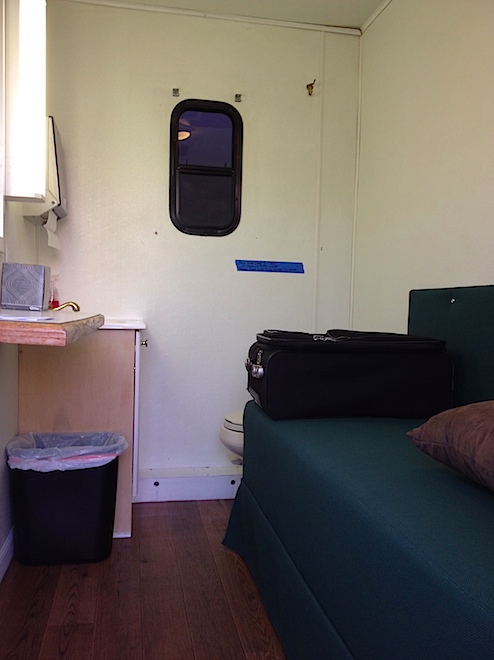
Still, it’s more than I expected, and it’s nice to have a toilet you can call your own.
The costume director was called “Critter,” so I said, “Hi Critter, my name’s Fatty.” It was like we were secret agents with code names or something.
I showed her the suitcase full of Fat Cyclist gear I had brought along. She told me to put on the black Smartwool t-shirt, my Fat Cyclist hoodie and and cycling cap, the orange Jawbones, my Giro fingerless gloves, my MTB shoes (which would make a loud clacking sound on the concrete the whole day) and my awesome new Twin Six 3/4 pants (which I had Twin Six rush to me last week special for this part).
Self-portrait time:
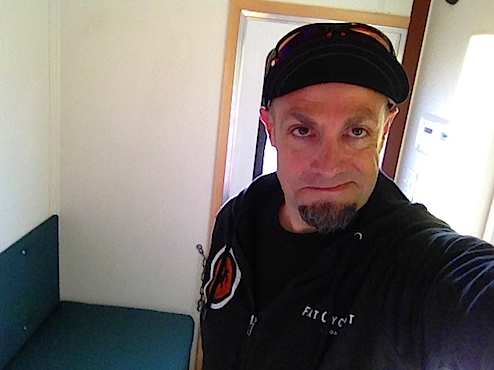
Then — finally! (at least I imagine you’re saying “Finally!”) we went on the stage.
And that’s a bizarre experience.
On the Set
When you enter the warehouse, it’s dark. Cold. And fog-generator foggy. Like you’re on the set of X-Files or something.
I had about four hours to wait before it was time for my scenes (I was to be in two), so I settled in and watched.
There was a lot to be amazed by.
First, it was pretty amazing to step into one of the sets. Suddenly, instead of a dark warehouse, you’re in a nice brewpub.
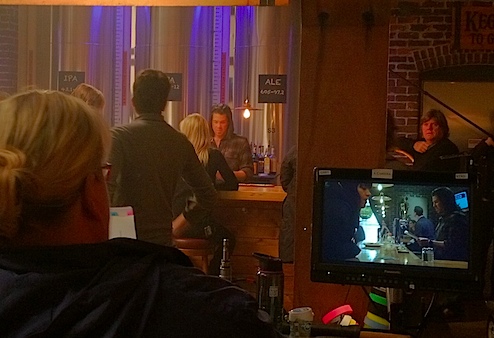
Except, of course, the brewpub has a ceiling made of scaffolding and wires and whatnot.
And there are cameras everywhere. And people and monitors. And lights. Above all else, lights everywhere.
Next, it was
incredible how many people were there. I don’t have the foggiest idea what they were all doing, but they were all amazingly busy. But it wasn’t so much that there were a lot of people there, or that they were all busy.
What was amazing and fun to watch was how well everyone was working together. Perhaps some sets are full of freak-outs and high drama and emergencies, but — and of course I just had one perspective on one day — everyone at Leverage seemed happy and engaged in their jobs and amazingly friendly. From the actors to the sound guys to the props guys to “The Oracle” (the woman in the bottom left of the photo above, whose job it is to ensure shot continuity and to make sure all scenes are shot in all appropriate ways), everyone was great.
The next thing that caught me off-guard was how quietly all the actors spoke. For no good reason, I just assumed they would be projecting, like stage actors. But no. They use their indoor voices, talking totally normally. Maybe even more quietly than normal. From 15 feet away, watching from behind the cameras and monitors, you could not hear them at all unless you had a headset on.
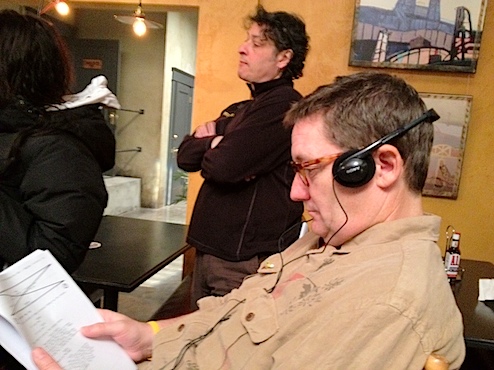
Paul, transformed from goofball to grown-up producer-man.
My Turn
After a couple scenes, it was almost time for my scenes. First, I got made up:
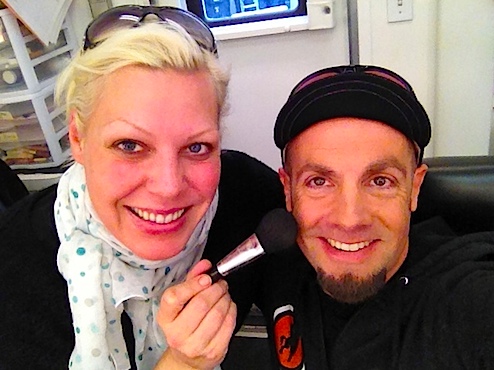
Obviously, she took the grey out of my beard. She also filled in my eyebrows (because I keep them trimmed extra short — otherwise they grow into crazy mad scientist eyebrows that get into my peripheral vision) and covered up the circles under my eyes, and de-shinified my face in general.
No eyeliner or anything though. And — sadly — no vampire teeth or gaping wounds. I would’ve loved to get a part that would give me a gaping wound.
My job was — as a bike messenger — to deliver a package. Check me out, getting all directed by the director and stuff:
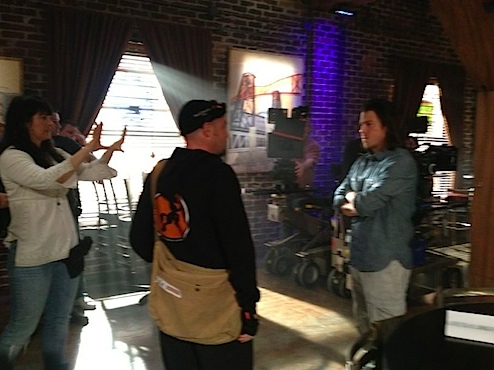
And here’s how I looked on the monitor, looking over the cameraman’s shoulder:
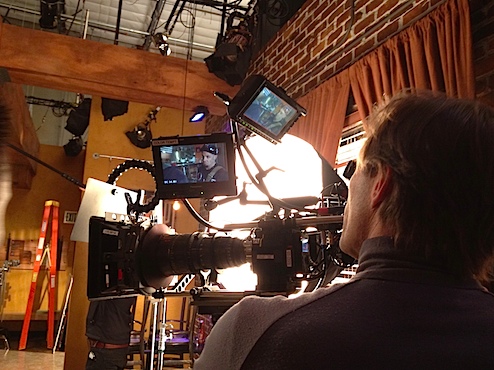
Again and Again and Again
Here’s the part that stood out from the day above pretty much everything else: how many takes they do of every scene, and from how many angles.
For every one-minute scene (including mine), there would be rehearsals.
Then the crew would set up one big shot where they filmed everyone.
Then the crew would move things around and train the cameras on just one or two people. Then moe things around and do the same scene, trained on the other people. Then the same scenes, with cameras trained on just one person’s face.
It’s an incredibly labor-intensive process, and pretty eye-opening to observe how much work goes into the making of a TV show.
And in short, I delivered that package a lot of times.
Then they moved things around, I went and changed into a different jersey (because I was supposed to be delivering another package on a different day), and we did it all again, some more:
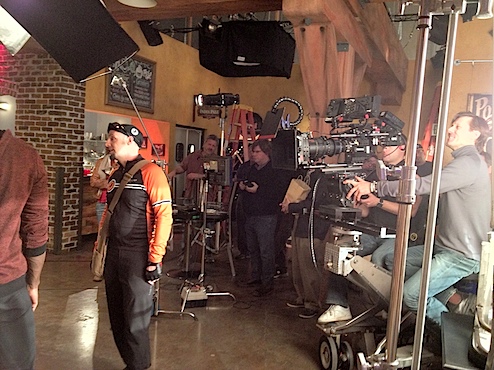
Nice gut, Fatty. I am going to be mad at myself forever for not having lost the weight I needed to before this show.
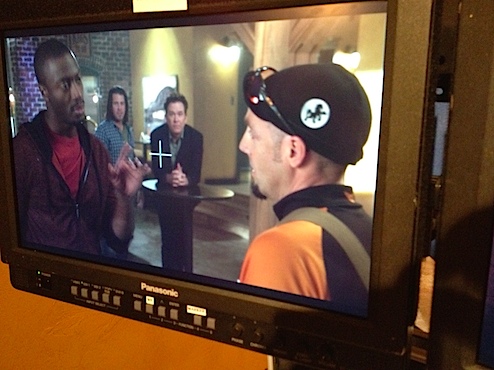
They sprayed non-glare stuff on my Oakleys before filming, rendering them both non-shiny and non-useful.
Interacting With the Actors
I am — as you know — quite beloved and famous in my own right. Still, I was curious what it would be like to be around other famous people.
Well.
Unfortunately I didn’t get to talk with Beth Riesgraf, the actor who plays Parker on the series. And my interaction with Gina Bellman was pretty much limited to terrifying her and making her look around for security when I came from nowhere and told her how awesome she was in Coupling.
But I did get to talk with Aldis Hodge (Hardison), Christian Kane (Eliot), and Timothy Hutton (Nathan).
Aldis is an amazingly funny person, and a remarkable improvisational actor. He’d deliver his lines perfectly each time, then go on to add some hilarious additional lines of his own. Funny and different, every single take. I looked forward to every take, just to hear what he would say.
Christian is an amazingly nice guy, and went out of his way to talk with me, offer helpful suggestions, and just chat. Then, when it was time to act, he’d suddenly turn on this pissed-off stare, and it’s like he’s a totally different person.
And Timothy Hutton, when I told him what a fan my sister Jodi is of his work, looked up her site, then let me get a photo of him holding up a photo of her.
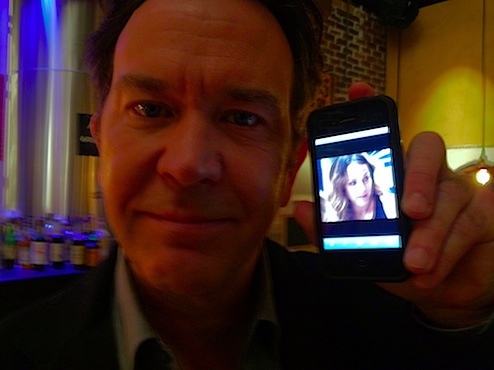
Jodi said it was the best birthday present ever. And it certainly was the least expensive, so that’s doubly awesome.
And as it turns out, without my knowing it — because I was dealing with sensory overload at about twelve different levels — Timothy had given me a present, too.
Upgrade [UPDATED]
Originally, I was slated for a non-speaking role. I delivered a package and left. Which is way cooler than any other acting experiences I’ve ever had (i.e., none) before, but still, you know, non-speaking.
But — due to a case of coolness I can’t even describe (and failed to thank him for because I wasn’t even aware he was the one who effected this change), Timothy Hutton made some calls and used his own real-world kind of leverage to get me upgraded to having a couple of lines in the show. Paul and Aldis then came up with a couple lines for me (one straight line, one funny line).
Having a speaking line meant I had to sign a bunch of places on a surprisingly thick contract. And it meant some new (kind of strange) guidelines.
Mainly, it meant that I could no longer stand on my “mark” (the place where I was to be filmed) while the camera and light crews set up the shot, but instead had to have a stand-in stand there for me.
Union rules or something.
But it’s not like I had anything better to do, so I just stood there right by my stand-in, talking to him.
And rehearsed, over in over, the four words I had to remember. And how I would say them.
Wrapping Up
Here’s how much of a wimp I am. I wasn’t able to make it through the whole day. At around 7:00pm — at which point I had been there for 12 hours — I told Paul that I had to get to the airport early, and I headed back to my hotel.
They were still working when I left, and probably would be for another couple hours.
What an amazing day.
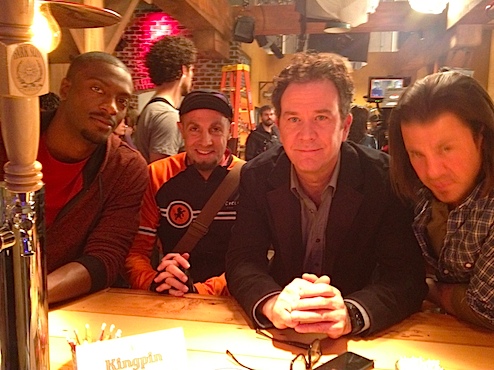
PS: The show will air sometime in August, I believe.
PPS: Time to fly!
Comments (54)
04.8.2012 | 2:46 pm
Hi there! I’m sitting in an airport right now, about to fly out to Portland. And it occurs to me that — fool that I am — I have not posted winners from week 2 of the challenge, nor reminded people that it’s time to do your week 3 weigh in.
I have reasons, and I’ll give you a hint of what they are:
- My day job
- My family
- My book projects (yes, plural)
- Spring weather that makes me want to ride instead of write or blog or otherwise be near a computer when I don’t absolutely have to be.
- Laziness
I suspect that most of you sympathize with the first four bullet points above, as well as secretly suspect that the final bullet point is the real reason.
And you’re probably right.
Anyway, those of you in the challenge who haven’t yet checked in with your weight, go to this page to do so.
Very Interesting Statistics
Here are some interesting things we’ve learned from last week’s weigh-in:
- Women continue to dominate the challenge! With an average weight loss of 0.99% (as opposed to the men’s average of 0.72%), women are demonstrating that the old adage that men lose weight more easily than women may be true, but that easy doesn’t matter over the long haul — being self-disciplined matters. And the women are beating the men handily in the self-discipline department. Nice work, ladies!
- Midwest is best: This week, the Midwest US jumped to the top of the leader board, with an average of 1.18% weight lost. Last week’s leader — outside the US — dropped to fourth place this week, at 0.75%.
- Why Tri: The bonus question this week was “What’s your favorite kind of riding,” and I’m horribly embarrassed to say that triathletes won, with 2.5% weight lost. And that’s all I have to say about that.
- Ku-Ku-Kukui: Monster congratulations to Kukui, who lost an astonishing 4.08% last week and is therefore the winner of the box o’ Honey Stingers!
- Tommysmo is luckily random: The random number I drew this week is 26, which is the number associated with Tommysmo (who lost a very respectable 2 pounds, by the way). Tommysmo will get a gift certificate to Twin Six — which will come in handy for maybe buying a t-shirt a size smaller than what you’re used to, eh Tommysmo?
Monday Stuff
Honestly, I have no idea what it’s going to be like to be on the set of Leverage. Maybe it’ll be totally cool for me to take and post pictures throughout the day, in which case that’s exactly what I’ll do. If not, expect a recap on Tuesday or so.
Honestly, I’m pretty nervous for tomorrow. Wish me gluck.
Comments (21)
04.5.2012 | 10:41 am
Yesterday was the kind of day I’ve been waiting for all Winter. Shorts and short sleeve weather. Warm, but not hot. Absolute, total weather perfection, on the heels of what’s been an amazingly dry couple of weeks.
It was time for me to head over for my first outing at Corner Canyon. Find out which trails are clear, and which aren’t.
It was time to go mountain biking.
Wow
There’s something special about having terrific mountain biking you can get to from your front door (just ask pretty much anyone who lives in the Suncrest neighborhood). And there’s something special about getting back on a trail — after a long absence — you’ve ridden hundreds of times.
So hopefully I can be forgiven for jumping the curb and riding over my neighbor’s lawn in order to get to the trail two seconds faster than I otherwise would have.
I was riding alone, because The Hammer can’t go outside during the daytime for the next couple days for medical reasons (which I assure you is going to drive her crazy). Knowing she would want details on the trail condition, I paid attention.
The climb up Hogges’ Hollows was dry for almost the entire climb, though what little Spring runoff there’s been has cut a deep new trench down the center of the road; the old line is gone forever.
That’s OK, though. A new line is already forming. Obviously, I’m late to the party with this being my first climb of the year up the Hog.
I get to the Saddle, and am amazed. It’s not muddy at all. Every trail I see in every direction looks good. Instead of having to cobble together a ride by working around the routes closed due to mud, I can take my pick of rides.
So I start by heading down Ghost. It’s beautiful. Perfect. The trail is just barely tacky — just enough that my tires get perfect traction, without ever collecting anything at all in the tread.
I smile the whole way down. There’s no descent in the world more perfectly suited for a rigid singlespeed.
I see four or five other cyclists — some going down, some climbing up — as I descend. Everyone looks as happy as I feel. Someone asks me about how Ghost is; I tell him it’s perfect. I ask him about the condition of Clark’s; he says it’s clean.
Nothing but good news all around, so I drop all the way down Canyon Hollow, with the plan to climb Clarks.
Furious Fred
I’ve talked about Clark’s trail before. It’s a hard climb, and it’s going to hurt, no matter how you ride it.
If you take it easy, it hurts a little for a long time. If you go hard, it hurts a lot for a slightly shorter amount of time.
On this day, I went for the “hurts a little for a long time” route. I wasn’t necessarily soft-pedaling. I was just enjoying the fact that I was on singletrack on a beautiful day.
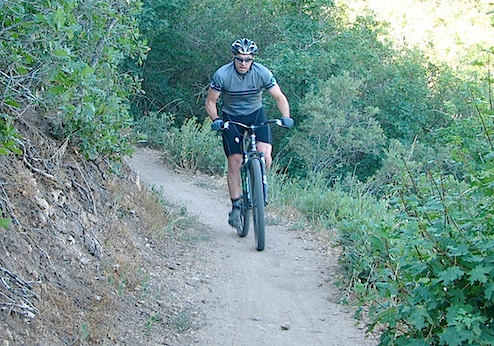
This is me climbing Clark’s. But it’s not a recent photo. I just wanted to show this picture again, to remind myself of what what I look like when I’m not a big tub of goo.
Another rider, however, was very clearly not just out enjoying the ride. For whatever reason, he had apparently decided he needed to take this climb balls-out (not literally).
I could hear him coming up behind me, breathing hard.
In his mind, I’m sure he was Lance Armstrong. Making me Pantani. On mountain bikes for some reason.
The trail was wide enough that I could move over to one side and let him by. Which is what I did, and then — as he passed — I said, “How’s it going?”
He was panting too hard, though. Standing and rocking his bike while breathing fast and loud, he barely scraped out a “Hey.”
He was looking straight down at his front wheel. Giving it everything he had to give. Which, I suppose, is why he didn’t see the tree that had fallen across the trail.
The tree that was leaning just perfectly at his forehead height.
Yep, he rode — still at his passing speed, so giving it pretty much all he had — right into the tree. Smacked his head right into it.
Briefly, his bike continued on without him, then decided to wait up.
He, meanwhile, landed and then remained on his butt for a moment. His clock cleaned.
Then he spun around to face me and yelled, “What the hell was that for?!”
I was astonished into speechlessness. Somehow, he blamed this on me? Then in a split second, I understood it all. First, I was witnessing the “fight or flight” response to being attacked in action, and this guy had apparently gone for the “fight” option.
Second, he somehow had linked his accident with me. In his concussed mind, I had — immediately after being passed by him — taken out a brickbat and swung it with all my might at his noggin.
To clarify the situation, I (wordlessly, because I was still speechless) pointed at the tree he had just ridden into, full-tilt.
“Wow,” he said, understanding dawning in his eyes. He continued, “I didn’t even see that.”
Which is kind of a funny thing to say, because how bizarre would it have been if he had seen it, but had decided to ride into it anyway?
He then said, “That thing really cleaned my clock!” Which is what I was thinking, too.
Apparently no longer interested in seeking revenge against me for his hitting his head against a tree, he offered to let me go on ahead.
Hoping to see him crash into other stationary objects further up the trail, I declined.
PS: I should probably point out that in the “Furious Fred” section of today’s post, I am writing from the point of view of the other guy. Which is to say, it was actually me who clobbered the tree with his head. Otherwise, the story is accurate.
Comments (54)
04.3.2012 | 11:20 am
I’m really excited for this year’s 100 Miles of Nowhere. Which seems weird, somehow. One should not — obviously! — get enthused about the prospect of riding 100 miles in one’s basement or around one’s block or up and down the same stupid hill over and over and over until one wishes one could simply hit oneself over one’s head and slip into blessed oblivion, right?
And yet, I am excited for this year’s 100 Miles of Nowhere.
And I believe that you will be, too, as soon as I tell you about what I’ve got up my sleeve. And I will tell you, eventually.
But first, I need to explain what the event even is, for those who are new to the idea of this event.
What Is The 100 Miles of Nowhere, And Why Should You Do It?
The idea of the 100 Miles of Nowhere is to ride an infuriatingly small course for 100 miles (or 50, or 25, but ideally 100), to raise money for the fight against cancer. And also to demonstrate that you have no sense at all.
The 100 Miles of Nowhere is a race without a place. It’s an event in which hundreds of people participate . . . all by ourselves.
You’ll have fun. You’ll be miserable. And, thanks to the fact that there won’t be hundreds of people all over the place, you almost certainly won’t have to wait for fifteen minutes to use an overflowing portapotty.
And you get some pretty decent bragging rights. Namely, if you take some good pictures of you (and your friends) doing the 100 Miles of Nowhere and send me a good writeup, I’ll post it on the blog.
Also, you get to claim that you won your division . . . since you get to create your own division. For example, I am the four-year consecutive reigning champion of the “Alpine Men’s 40-45 Year-Old Award-Winning Blogger” division. Which is a pretty big deal, if you ask me.
Most importantly, though, is the fact that you’re joining Team Fatty in our ongoing fight against cancer. And that matters.
What’s the Status of the 100 Miles of Nowhere?
I am hard at work right now with the Twin Six guys, working on the T-Shirt design (by “hard at work,” I mean that I give them bad ideas and they ignore them and instead give me great designs based on ideas of their own). And, because I am really great at multi-tasking, I’m also hounding companies to be Swag sponsors of the 2012 100 Miles of Nowhere.
I’ve got some good sponsors on board already, and am working on more. I’ll reveal who they are . . . soon. Because I am mysterious, and a little bit of a tease.
Registration will start next week, and will be strictly limited to 500 paid registrations (plus whoever beats me in the weight loss challenge, which I’m afraid is going to be practically everyone). Which is to say, I’ve learned my lesson and — unlike last year — will not add additional registrations this year. Once we get to 500, we’re done.
The event itself will be on June 2. Or another day near June 2, if you happen to already have plans on June 2.
For what it’s worth, if you happen to be interested in joining my own particular crazy course for the 100 Miles of Nowhere, I’d love to have you come along. Depending on course conditions, it will either be the climb of the Alpine loop, or Suncrest (like last year).
What’s Going to be Special About This Year’s Race?
I’ve got a story to tell. It’ll take a while. Stay with me; it’s worth it.
Of course, the 100 Miles of Nowhere is absolutely ridiculous. And — if you’re lucky — fun. But there’s always a serious purpose behind it: helping in the fight against cancer.
And, as you know, I am a big supporter of LiveStrong, so that is what we’ve raised money for in all prior editions of this event.
Lately, though, I’ve been thinking. And about a month ago, I wrote my thoughts down and sent the following email to Doug Ulman, the CEO of LiveStrong:
Hi Doug,
I’ll try to keep this reasonably short, but honestly, long-winded is more my style. So if I’m not terse, I’ll at least try to be interesting.
There have been a number of events that have happened recently that have really gotten me thinking about LiveStrong, Team Fatty, and how I can be as useful as possible.
- A new blanket warmer at a hospital: Last summer I sponsored a local race — the Utah Tour de Donut — to raise money for a new blanket warmer in the cancer center where my late wife went for treatment. It was a no-brainer thing to do; I remembered Susan talking a few times about how cold she was while getting chemo there. She would have appreciated a blanket warmer. So it was a nice tribute. A few weeks ago I went to the hospital where they had a nice little “Thank You” ceremony and put a “Fight Like Susan” plaque on the blanket warmer. While this was probably my smallest fundraiser of the year (I only needed to raise $4K for the blanket warmer), it was incredibly touching and meaningful and made me want to do more to help.
- World Bicycle Relief: One of the cool side-effects of my blog is that I’ve gotten to help not just with LiveStrong (and other anti-cancer causes), but I’ve also gotten to know Johan Bruyneel and work with him fundraising for World Bicycle Relief. We raised enough money last summer to buy more than 1000 bikes for kids in Zambia. WBR has made a great video I put on my blog recently, showing some of those bikes being given to kids whose lives will be changed by having those bikes.
- A kid in my neighborhood needed money for treatment. A teenage boy in my town — I’ve met him and know his parents a little, but that’s it — has really aggressive Hodgkins Lymphoma. And no great way to pay for treatment. So I did a weekend-long fundraiser where the proceeds from my new book went to his treatment. I sold more books that weekend than I have before or since.
- The American Fork Canyon Half Marathon: Last summer I was on the organizing committee for a new local half marathon in my community, with all proceeds designed to go to local people who could not otherwise afford cancer treatment. Even in its inaugural year, we netted $50K.
What all of these things have in common is that they are really small, targeted, achievable missions. They’re things people can understand and get behind, and then celebrate and say, “I made a difference, and there’s something I can point to to show what that difference is.”
And what I would really love to do is — both personally and with my readers — engage in more of these kinds of projects.
While I can (and definitely will) fundraise with my team toward the LiveStrong Challenges, I wonder if that’s really the most powerful way for me to help. I wonder if maybe there’s some small, targeted mission a guy with 20,000 daily readers might be able to accomplish with LiveStrong. Something we (you, me, my readers) can point at and say, “We saw a problem, we attacked it, and we made a difference.”
It’s the kind of thing that gets people energized to do more. This is a lot to chew on — probably too much. But I appreciate your taking the time to read it.
I look forward to helping LiveStrong, in any way I can.
Thanks,
Elden “Fatty” Nelson
Doug replied right away, inviting me to an event that happened last week — The LiveStrong Assembly — saying he thought it would be a great place for me to find exactly that kind of project to get behind.
And he was right.
Meet Camp Kesem
One of LiveStrong’s Community Impact Partners is Camp Kesem, a (from their website) “college-student run summer camp for kids with a parent who has (or has had) cancer. [The] one-week sleep away camps are a chance for kids 6-13 to have a fun-filled week and just be kids.
Camp Kesem (“Kesem” is Hebrew for “magic”) was represented in force at the LiveStrong Assembly; I got to know some of the counsellors, and I got to understand their mission: letting kids who’ve been affected by having a parent with cancer catch up on being a kid.
As a dad of kids who mostly remember their mom as someone who was sick or dying, the idea of this camp really resonates with me.
And it resonates with Doug Ulman, too — here we are together, wearing very awesome Camp Kesem headbands (which are acquired by making a $5 donation to Camp Kesem):
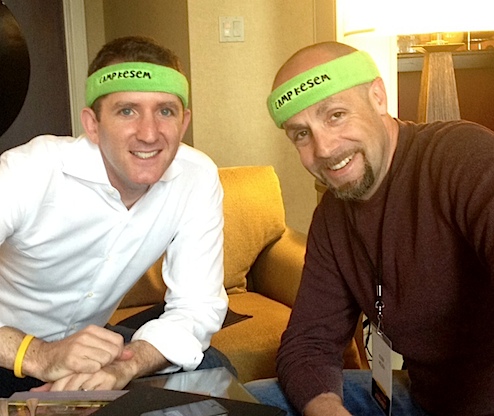
Right now, there are 23 Camp Kesems across the U.S., and they’re looking to add more all the time.
But they need help.
And that’s what this year’s 100 Miles of Nowhere is going to do.
Big Goals
What I want to do with this year’s 100 Miles of Nowhere is raise $30,000. That money will go to LiveStrong, which will then turn around and donate it to Camp Kesem.
And Camp Kesem will use part of that money to launch a brand new camp — one in Southern Utah, which I’ll be sending the twins to this year (so watch for their camp report late this August).
And the balance of that money will go toward sending kids to existing camps (no child has to pay to Camp Kesem).
I hate the way a parent’s cancer robs kids of what should be a fun, carefree time in their lives.
And I love the simple, direct way Camp Kesem is addressing this: by giving kids some of that fun, carefree time back.
And I appreciate you joining me for the 100 Miles of Nowhere. As always, we’ll have fun. As always, we’ll be doing something in the fight against cancer. But this year, we’ll be getting a little more specific about who we’re helping, and how.
Comments (67)
04.1.2012 | 8:51 pm
I don’t do a lot of reviews on this blog. Partially, that’s because I tell everyone who asks about sending me something my policy on returning stuff, which is: “I don’t return anything.” I used to have good intentions and intend to return things, but I finally realized that I’m just too lazy to re-box anything and send it back.
Part of it is that I’m not qualified to review many things.
Part of it is that when I review stuff, it brings out my cranky side; for no reason I can adequately explain, I tend to get downright mean when I start reviewing things. Sometimes after reviewing something, it takes me days to return to my incredibly loveable normal self.
And part of it is that most of the time someone sends me a press release with a “Contact me for more information if you’re interested,” I don’t contact the PR person. Because I’m not interested.
In the case of the Cardo BK-1, however, I was interested. Because the Cardo BK-1 is a new mike / speakers / radio setup designed for bike helmets. Using them, a couple (or three) riders are supposed to be able to easily talk with each other, hands-free. Not to mention listen to music or take calls on your phone via Bluetooth.
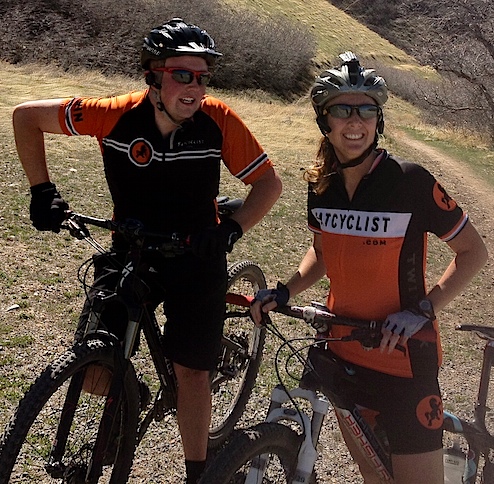
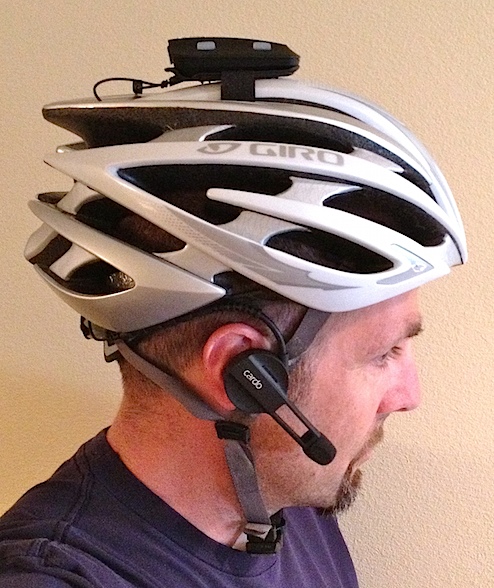
The most obvious difference between a helmet with the BK-1 is the mike boom on your right side.
I liked the idea of being able to talk with other riders without shouting over wind noise, and then having to repeat myself – or shouting at the other rider to repeat herself – several times over.
So I said I’d be interested in trying these out. [Full Disclosure: Cardo sent me two of the Cardo BK-1 DUO at no charge. However, lots of people send me stuff at no charge, with no assurance I will write anything. I only write about stuff I really like, or really hate.]
In Short: What It Does
The BK-1 uses a combination of Bluetooth (to stream audio to and from your phone) and radio (to communicate with other BK-1) devices to communicate “up to 500 yards” (we never got that good of range before losing each other entirely, and when mountain biking would lose each other whenever a bend or rise in the mountain would make it so we didn’t have each other in line-of-sight).
The BK-1 is full-duplex, which means you can talk and hear at the same time, so you can interrupt each other and stuff. Each set also has an A and B channel, which means that if there are two of you, you can each use your B channel to listen to music or take a phone call (or listen to GPS voice instructions from your phone). If there are three people using BK-1s, one of the people has to act as the conferencing hub, using both A and B channel (so no background music for that person).
The BK-1 is supposed to get seven hours of talk time, and while we haven’t tested out the BK-1 for that long of a ride (yet!), we have tested it out for three- and four-hour rides with near-continuous talk; on a full charge, I expect you could get at least five hours of conversation on the BK-1. The radio uses a rechargeable battery, recharged via a micro-USB port (through which firmware updates will eventually also be available).
The BK-1 is voice-activated, so when you want to talk, just talk to wake the system up and start talking.
Setting Up
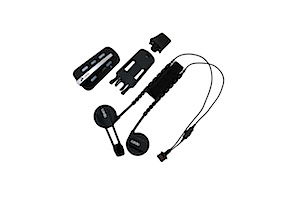 One of the things I liked about the BK-1 was apparent when I first opened the carrying case (the packaging for the product is also a zippered, padded carrying case, which is useful as well as not wasteful): it comes with lots of “spare” parts for the headset, as if they knew that in the real world, little parts can wear out or get lost. So there’s an extra spongy windguard thingy for the mike boom. There are a lot of extra adhesive-backed Velcro strips for mounting the headphone-like speakers and mike. And there are various lengths of Velcro straps for mounting the radio on the top of your helmet (along with a good instruction book describing how to route those straps on different kinds of helmets).
As it turned out I would need some of those spare parts before I ever used the BK-1 for the first time, but I’ll get to that in a minute.
The BK-1 is easy to set up. Peel the adhesive backing off a couple Velcro strips and stick them to the inside left and right sides of your helmet, toward the back. Wait ten minutes for the adhesive to cure, then stick the left speaker – which is at the end of a flexible gooseneck-y cable so you can easily position it by your ear – to the Velcro inside your helmet. Do the same thing for the speaker / mike boom on the right side of the helmet. Then strap the radio to the top of your helmet, and plug the wires from each side of the headset into the radio.
So all that’s fine, so far. It only took a few minutes, so your helmet now looks like this:
But there are some things about the setup process that you should take into account if you’re going to get yourself a BK-1:
- Size matters . The first helmet I tried setting the Cardo BK-1 up on was my Giro Prolight helmet, which does not have adjustable straps, nor any real padding. It’s a very minimal helmet, and either fits you or it doesn’t (it fits me just great and is so light as to truly feel like I have no helmet on at all). With the Velcro straps and the headset attached on the inside, my already-snug ProLight wouldn’t fit at all anymore. So if your helmet is already a close fit and cannot be adjusted with smaller pads and loosened straps, the BK-1 may push your helmet into the too-small category. (I was able to set up the BK-1 on my other helmet and make it fit without difficulty by simply loosening the Roc-Loc strap on the back of the helmet).
- You’ll want it to be permanent : Setting the headset up only takes a few minutes, but I can’t imagine taking a few minutes to attach a radio to my helmet, attaching two speakers to the helmet, routing the speaker cables through the vents and then plugging them in . . . every time I wanted to use the BK-1. It would be too much of a hassle.
- It’s got to be permanent anyway : When I tried to peel apart the Velcro attaching the speaker to the helmet, the Velcro attached to the inside of the helmet came off instead. It wasn’t because the adhesive was weak, either. No, the problem is that the Styrofoam in your helmet is weaker than the adhesive and the Velcro, so that’s what lets go first. (This wasn’t an isolated incident, either; the IT Guy had the exact same thing happen to him).
- Pairing: Radios have to be paired to each other. It’s pretty easy to do, but since it involves looking at flashing lights on your helmet, it’s something you’ve got to do before you put the helmet on, obviously.
So basically, if you’re planning to use the BK-1, you should probably dedicate a helmet to it. Pick (or get) one that has room to be adjusted for size, then set up the BK-1 really well (tie down the otherwise free-floating cables, for example) and just leave it on there, ready to use whenever you want to ride and talk with others.
Just Riding Along
Once you’ve got the BK-1 mounted to your helmet, the hard part is really over. Turning the system on is a 1-button push, and adjusting the speakers so they’re near your ears is as simple as bending them into place – you can either place them right by your ears (the way I prefer) or with some extra distance between them and your ears (the way The Hammer and The IT Guy prefer).
Either way, the first thing you notice as you ride and start talking with each other is that . . . the BK-1 works great. You can hear each other really well – nice, clear and loud (volume is adjustable by big, easy-to-find buttons on the top of the radio).
Wind noise – which I assumed would be an enormous problem with a helmet-mounted intercom – is no problem whatsoever.
You don’t have to talk in an abnormally-loud, especially clear voice. You just talk. In fact, you can talk quietly. Even whisper. So talking while riding doesn’t take anywhere near the lung power it normally does. And since the headset consists of speakers near your ears instead of in your ears, you don’t get the isolating effect you normally get with headphones; you can hear ambient sounds just fine.
Voices aren’t “clipped” (when the beginning or end of something someone says is cut off), either – something I was worried would be a problem.
Since a radio and two speakers are added to the weight of the helmet, I was concerned that weight would be a problem – kind of like the way a helmet-mounted light or camera starts feeling heavy on your head (or makes your helmet shift into a bad position) after a few hours. The BK-1, though, has its weight distributed around the helmet (with the speaker weight essentially balancing each other out) well enough that I haven’t noticed a weight problem yet.
Basically, the BK-1 makes it really nice and easy for people who are riding together to actually hold a conversation, without having to ride side-by-side (a problem on the road), or right on top of each other (a problem on the dirt).
Of course, this is a first-generation product, and so using the BK-1 wasn’t always totally perfect. When we got far enough apart to lose signal between each other, re-connecting was sometimes automatic when we got back to within range, and sometimes it wasn’t. At that point, we’d have to press the channel button to re-connect, but the re-connect process was slow enough that we’d start to wonder whether we’d done it right and press the button again, thus probably starting the process over.
The buttons have LED status indicators telling you the connection status, but they’re hard to see in daylight, and in any case, they’re on top of your head so you can’t see them yourself anyway. Maybe a voice interface would make more sense for something like this?
While voice levels were always nice and loud, the volume level for music streamed over Bluetooth comes in very quiet. (A related wish: it’d be really nice to have the option to have music continue streaming behind voices.)
The most persistent problem, however, was interference when we were mountain biking. When there was a hill or bend or rock or thick trees between riders, audio would get very sketchy or drop out altogether. Our rule of thumb became that the BK-1 was great as long as you had each other in view.
The strangest problem, though, would be when we stopped close to each other and talked. I was worried there would be a terrible feedback problem when this happened, but there was none of this at all. It was just peculiar to hear the other person’s actual voice, followed a split second later by the voice coming through your speakers.
Oh, and when we stopped and talked to strangers on the side of a trail, they looked at us as if were were space aliens.
Which, of course, I am.
You’d almost have to buy these in pairs (that’s the BK-1 DUO), unless you and all your friends are buying these. Or if you were buying it specifically as a solution for listening to music and talking on the phone while on your bike.
Wrapping Up
We actually really like these BK-1s. Since we’ve gotten them, The Hammer and I have used them on every ride we’ve been on together. If you want to talk while you ride, and are tired of yelling “What?” over wind and road / trail noise, you’ll find these a really effortless way to chat while on the bike.
It’s surprising how quickly I’ve gotten used to using the BK-1. The Hammer and I went on a 4.5 hour ride last weekend, but – wanting to see how long the batteries would last – didn’t charge the batteries before we started the ride. So, about three hours into the ride, the batteries died. After the ride, we both remarked how we had gotten used to being able to just say something in a quiet voice, and have the other person hear it.
Is the Cardo BK-1 necessary? Totally not. But – especially if you like combining conversing with your cycling – it’s fun. And you get used to having it amazingly quickly. The Hammer and IT Guy especially like these – he’s a chatterbox, and she loves catching up with her son while riding. Maybe this’ll come off as a little cheesy, but the BK-1 can bring a little more “quality” to your riding quality time.
What you say to one another is of course up to you, but I recommend continuous heavy breathing. Or yelling, nonstop, “Venga! Venga! Venga!”
Or possibly, in the lowest voice you can muster, “Luke. I am your father.”
The Cardo BK-1 costs $274.95; the BK-1 DUO ( which comes with two of the headsets) is $479.95. For more information and where to buy, go to the Cardo BK-1 website here.
Comments (34)
« Previous Page — « Previous Entries Next Entries » — Next Page »
