02.14.2012 | 8:30 am
A Note from Fatty: I’m working on filling in the gaps of Susan’s and my story, to eventually be collected in my next book, Fight Like Susan. Yesterday’s installment can be found here.
On the drive to the hospital — the same hospital where three of our four children had been born — I told Susan the same thing I had told her countless times in the past couple weeks.
“Everything will be fine.”
I said it with an intentional sort of conviction. Sure, I understood the possibility that things wouldn’t be OK, but what value is there in dwelling on that kind of future? Just assume everything’s going to be good, all the time. Then, whenever something isn’t good, you fix that thing. And meanwhile, at least you haven’t been fretting over something you couldn’t have fixed anyway.
I wasn’t new to that kind of thinking. I had evolved this philosophy during Susan’s pregnancy with the twins. See, I had made the mistake of ordering all kinds of books about twin pregnancy and infant years. Then I had made the further mistake of reading all those books.
I’m pretty sure that the authors of all thsoe “twin pregnancy” books had gotten together to try to convince parents of twins that there is a 0% chance that the babies will be born healthy and normal.
The more I knew, the more my anxiety grew, until I finally made a decision: since I couldn’t affect the outcome, I would rather assume a good — no, great — outcome than know all the possible bad outcomes.
So, for the first time in my life, I threw away some books. I didn’t even give them away or donate them or anything; I didn’t want to be party to someone else freaking out the way I had.
And the twins had been fine. Happy. Healthy. Perfect. All the worrying had been useless.
So I said it again: “Everything will be fine.”
First Call
I sat with Susan while the surgeon talked with us about what he was going to do. None of it registered. I just kept thinking CANCER SURGERY JOB CANCER JOB BILLS SURGERY.
Everything’s going to be fine. Everything will be fine.
I asked Susan how she felt, and whether she was scared. “No, I just want this over with,” she said. “I want this out of me.”
They let me stay with Susan until she was asleep.
I went out to the waiting room and sat, but I couldn’t stand it, so I went back to my car, with the plan to drive around. As I got out to the parking lot I turned my phone back on (remember how you used to have to turn your phone off when in the hospital?).
There was a voicemail waiting.
I sat down in my car and called my voicemail number; it was the recruiter from Microsoft, asking me to call back. Knowing it could be either really good or really bad news, I called.
“How are you doing?” she asked.
“I’m hanging in there,” I replied — my stock response for the next several years (it’s not as dishonest as “fine,” but doesn’t force the person I’m talking with to listen to a long story.
“I have good news,” she said. “I’m calling to make you a verbal job offer.”
I’m probably not the world’s best negotiator; I immediately replied, “Awesome! I accept.” She laughed and then told me about the terms of the offer, which were so amazingly generous I wouldn’t have been able to find much to negotiate over anyway. They would pay to move us out, with professional packers and everything. They’d pay for a couple of househunting expeditions. They’d pay for three months of a house rental, and would even find a three bedroom house since we had four kids.
And they would be fine with my start date being six weeks down the road, to give Susan time to recover from her surgery.
Second Call
Having just accepted a job, I now needed to make a second call: one to notify my employer that I’d be leaving the company.
I was nervous about this call; I felt like I was critical to the magazine and that it would be a hard blow to them to have me leave. I expected Mitch Koulouris, my boss, to take it hard. I resolved to get straight to the point, though.
“I’ve been offered a position at Microsoft, I’m going to have to leave the magazine.”
“That’s wonderful, Elden. Congratulations.”
“What?”
“It’s a tough time here; you don’t need that while you take care of your wife.”
“What about the magazine?” I asked, now — strangely — making the arguments I had worried he would be making.
“I’ll find another editor. Now tell me how Susan’s doing.”
“She’s in surgery right now. I’ll talk to you tomorrow, OK?”
Third Call (and Fourth, and Fifth…)
I went back into the hospital and found someone to tell me how Susan was doing. “She’s still in surgery; she will be for a while,” I was told.
So I went back out to my car and made a third phone call. This time, to a neighbor who is also a real estate agent.
“I’ve got to sell my house,” I told him.
Then I called my parents and Susan’s mom, letting them know that Susan was still in surgery, and that our lives were going to get even more hectic during the next few weeks.
Telling Susan
I went back into the waiting room to wait for the surgeon. He came in and told me everything had gone reasonably well. I went in to the recovery room and sat with Susan, waiting for her to wake up, so I could tell her everything.
She had one less breast. She still had cancer. She’d have to start chemo with a different doctor, in a different state, far from everyone we knew. I had a new job. We’d be moving while she recovered from surgery and we took care of four little kids, two of which were two years old.
I had done what I needed to do, but I still felt incredibly guilty. The truth is, even now, I still feel guilty about what I made Susan go through. At a time she should have been able to rest and recover, I made her go through three of the most stressful things a person can do, all at once: new job, big move, and cancer.
If I had known how bad things would be for her, maybe I would have turned down the job at Microsoft. Maybe I would have tried harder to find something local.
But I didn’t.
I took the job, thinking it was the right thing to do; the best way I could give her good treatment options. And, I told myself, everything will be fine.
So, once she was awake, I told her.
“Well, guess what I’ve been up to while you just laid around and slept all morning.”
Comments (41)
02.13.2012 | 2:26 pm
A Note from Fatty: I’m working on telling the story that will eventually be in the book, Fight Like Susan. Click here to read the previous post in this series.
I felt a strange mixture of disgust and relief. Disgust with the company, and relief that I had found out what kind of people I would have been working for, before I had joined them and moved to New Jersey.
Mixed in with that was a pretty big chunk of fear. I had four children, a wife with cancer, and a job that wasn’t paying the bills today — and I honestly didn’t know if I would still have any job at all within a few months. Or weeks. Or days.
Then, on the first working day of the new year, I got a call from Microsoft.
“We think there’s a job here that fits you a lot better than the first one you interviewed for,” she said. “Could you fly down for a day of interviews?”
Not wanting to start down a dead-end road, I told her, “You should know my wife just got diagnosed with breast cancer.”
“I’m so sorry,” the recruiter replied. “We can do the interviews later if you need.”
“No,” I said, still thinking about how my hopes for a new job had just gone belly up and not wanting to start down a path that wouldn’t go anywhere. “I just wanted to make sure that this isn’t going to be something that affects whether you can hire me.”
“Of course not,” she replied. “Usually I don’t go into our benefits ’til we’ve made an offer, but when you’re here, let’s set aside some time to talk about our health coverage. I think you’l find that it’s the best there is. Anywhere.”
Inside Track
Within a week I was at Microsoft for one of their famous interview circuits, where the first person who interviews you takes you to the next person who interviews you, who takes you to the next, and so forth.
You can kind of tell how you’re doing as you’re interviewing, because at any point during the day of interviews the person you’re talking with can say, “Thank you for your time,” and that’s it. You’re done.
If you make it to the lunch hour interview (where a person interviews you while you eat in the cafeteria), you’re doing pretty well. If you make it to the end of the workday, you’re doing really well. And if you make it to the secret-bonus interview where you talk with someone a couple levels above who you’d be reporting to, you’re at least a finalist.
I managed to stay sharp throughout the day (not as easy to do as you might think when you’re being interviewed by 6-8 very precise thinkers). During the five or ten minutes between interviews I’d sit in the lobby, awkwardly conversing with the other person who was interviewing for that job that day.
I did not tell this person that I had an inside track — the person who was the hiring manager for this position (Matt Carter) had been my manager once before, in another company.
And I’m pretty sure that he had written the position with me in mind.
I got called into the secret-bonus interview, had a good conversation about mountain biking and how riding in Utah was different than Washington, and then the day was over.
Nothing to do but wait, now.
I went back to the hotel, drained, and ordered room service. I called Susan, told her how things had gone, and that I was about 70% sure I had gotten the job. But all I could talk about was the medical coverage.
“Everything’s covered at 100%,” I said. “You can go to any doctor you want. Get any prescriptions we need. We wouldn’t pay a dime for any of it.”
“No way,” Susan said.
Susan and I agreed that even with this possibility, we couldn’t put off her mastectomy. It needed to happen right away — later that week, in fact.
Next, I got a call from my friend / former manager, asking me how I felt the day had gone.
“Really great,” I said, truthfully. But Matt could tell something was up and asked what the problem was.
“Susan’s got breast cancer.”
“Oh shit.”
“I know.”
Then Matt said something that stuck with me, maybe because he honored the statement so literally in the coming years: “Tena and I will take care of you guys.”
In a way, it was my first glimpse into how incredibly generous people can be.
Comments (26)
02.9.2012 | 12:27 pm
This post is going to be a little gooey. Not gooey as in a “Hey, here’s a recipe for marshmallow and mozerella kabobs I just whipped up.” Gooey as in I’m going to be pretty much shamelessly gushy about some bike-related stuff.
So you may want to put on some gloves or something.
We Live In The Future
It’s been the strangest winter. Instead of sweating on rollers, we’re out on the pavement (and sometimes even out on mountain bikes). It’s the November that never ended.
I’m not complaining, mind you. Far from it. Really, really far from it. (You’ll see what I mean in a second.)
So last weekend The Hammer, The IT Guy, and I were out doing a nice half-century ride (for locals: From Alpine out to Cedar Fort and back). We were on the return trip, each taking 1-mile pulls. I was taking my turn pulling for a mile, enjoying the ride and everyone’s company, when the thought struck me:
We live in the future.
What I meant was that, in a lot of the ways that are important to me — in other words, in terms of bike gear — stuff is so amazingly advanced and well-engineered and attractively designed and light and reliable that it might as well be Star Trek.
As I faded right (the shoulder of the road coming back from Cedar Fort is huge; three riders can ride abreast) and dropped back to let The IT Guy take his turn pulling, I yelled my epiphany to The Hammer.
“We live in the future!” I yelled.
“What?” She replied, which is pretty much the most commonly-used word in on-bike conversations.
“We live in the future!” I yelled, more loudly.
“I heard what you said the first time,” yelled The Hammer. “I just didn’t know what you’re talking about!”
“I’ll explain later,” I yelled back, and dropped onto her wheel. And I thought some more about how incredible bike gear is now.
Think about the bike itself. If you like carbon, you have an outrageous number of frame choices, all of them outrageously light (and many of them ridiculously strong). If you like steel, your options are better than ever before, especially as handbuilt bikes seem to be surging in popularity.
My road bike’s Shimano Di2 drivetrain hasn’t needed to be adjusted in more than a year, and I charge the battery maybe every five months. And that’s just Shimano. Amazingly, there are now three companies turning out fantastic drivetrains. The awesomeness of your choices is incredible.
Without really even trying now, you can build a 16-pound bike. If you try a little bit, you can build one that weighs under fifteen pounds.
That’s fifteen pounds. For a bike you ride all the time.
Of course, if you’re going to ride a mountain bike, the bike’s going to weigh a few pounds more. As in, it could weigh up to 25 pounds if it’s a cross country racer. Or it could weigh a ton if it’s a downhill machine, but in that case it’s going to be able to absorb hits you wouldn’t even have expected a motorcycle to tackle ten years ago.
Oh, and if you want to go all minimalist — rigid single speed — you can, without difficulty, build a mountain bike that weighs 17 pounds.
And then there are the wheels.
Thanks to tubeless tech, I hardly ever flat — road or mountain. And with some geniuses figuring out that larger, wider wheels are better for pretty much everything, my riding experience is now just unbelievably good.
And how about bike computers? Remember when there was a little wire that snaked along your stem, down the fork, and then kinda-sorta aligned with a magnet and then rewarded you with…your speed? And remember how you never had to replace batteries in your bike computers because bike computers never lasted more than the batteries they came with?
Now there are GPSs. My Garmin 500 is just remarkable, giving me all the information I could ever want (and more).
But that’s not all. Bike helmets have gotten measurably better. And so have clothes. And shoes. And pedals. And glasses. Everything, really.
It’s all so amazingly good now.
And so I wanted to say “Thanks.” Thanks to Ibis and Gary Fisher and Specialized and Orbea and Shimano and SRAM and Stans and Oakley and Garmin and Time and Giro and Twin Six and Pearl Izumi and Bontrager and Smartwool and Honey Stinger and CarboRocket and Action Wipes.
And thanks to the dozens — hundreds? — of other companies out there that I haven’t mentioned, because I can’t remember right now or I haven’t tried your stuff. You’re designing and building unbelievably good stuff that is so good I think back to just a few years back and laugh at how much better bikes and bike gear have become.
You guys in the bike industry work hard. And you make great stuff. Stuff that’s better than I would have ever even thought possible. Stuff that’s so good I can’t imagine it ever being better.
Cyclists have never had it so good. Really, we wouldn’t have even dreamed of having it so good.
So again, to you people who invent and design and manufacture: thanks. I love riding, and you’re a big part of why.
Comments (47)
02.8.2012 | 8:15 am
I am not what you’d call a classically-trained cyclist. You could fairly call me an “informally-trained” cyclist.
Or, if you were in the mood to be accurate, you could possibly call me an “ad-hoc, hard-knocks trained” cyclist.
The truth is, I haven’t every read a book on improving my riding position or technique, and the few times I’ve spoken with experts about these things, well…my mind has wandered.
And in short, practically everything I know about riding — and especially about mountain biking — comes down to this:
- You go faster when you pedal faster. Especially if you pedal faster in a harder gear.
- If you avoid something, turn.
- If you want to stop or slow down, use the brakes.
There you go. My twenty-ish years of riding experience, summed up. So I suppose I should stop writing now.
Except there is one — seriously, just one — thing I actually have considered and made a conscious change in with the way I ride, and I made it just a few years ago:
I brake with my middle finger. I have photographic proof and everything. Check it out:
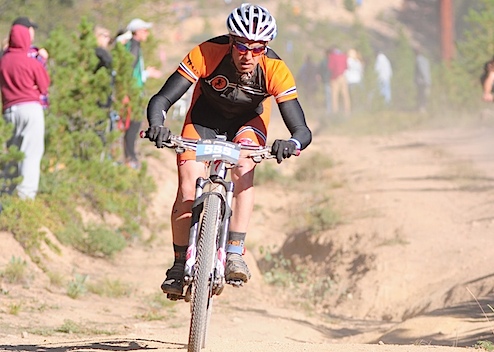
Photo by David Kutcipal, 303Cycling.com
Here’s a closeup, for some reason:
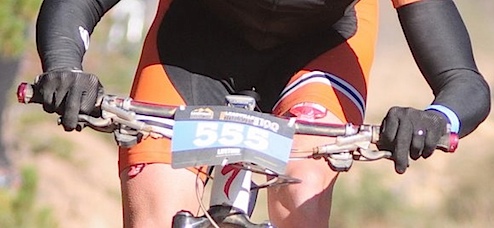
Of course, the most surprising thing about this photo is that I apparently wear my wedding ring on the outside of my mountain biking gloves.
The second most surprising thing is that I keep a Strawberry-Banana PowerGel tucked into each leg of my shorts, where I can easily absorb nutrition through my skin, saving valuable seconds during the race.
The absolutely least surprising thing about this photo is that I’m obviously braking with my middle fingers (and middle fingers only). This should be totally non-surprising because I just said this is what I do a few paragraphs ago. And because of the title of this post.
What is surprising — or at least, would be surprising if I hadn’t tipped my hand a few minutes ago — is that I actually trained myself to brake this way, and I’ve got what I consider to be a pretty good set of reasons for why you might want to consider doing the same thing yourself.
Stable Platform
The very best reason you should train yourself to be a middle-finger braker is that by doing so you will subtly be flipping the bird in pretty much every photo of you going downhill on a mountain bike, for the rest of your life.
And that’s reason enough, probably.
However, if you’re looking for a (somewhat) more practical reason for being a middle finger braker, how about this: a wider span, as well as more of your hands, stay on the handlebars when you’re descending.
Think about it. If you brake with your index fingers, the part of your palm below that finger is — best case scenario — unweighted, and is probably not even touching the grip. If you brake with your index and middle finger, about half of each hand is off the grips when you’re braking. Which is kind of unfortunate, since — generally speaking — when you’re braking you’re definitely interested in having as much control of the bike as possible.
When your middle finger is on the brake, however, the widest possible span of your palms are on the grips: from the palm to the pinky. To me at least, it feels a lot more stable.
Additional Positions
The other thing I like about middle-finger braking is that by setting my brake position up to be natural for the middle finger, I’m also automatically set up for index finger braking and two-finger braking.
Here, take a look at this closeup of me braking again:
What this tells you — apart from the fact that I’m so darn lazy I use the same image over and over in the same post — is that my hands are pretty much against the inside stop of my grips. This is because even with the brake levers butting up to the grips, my hands have to come to the inside for middle-finger braking.
To move to a position for index-finger braking, I just have to shift my hands to the outside edge of the grips. This can come in handy on a really long descent (Like, coming down Columbine), when a finger can start to get tired.
And if I need to switch to two-fingered braking (such as when I’m doing a truly enormous descent), the brake lever’s in a good position for that, too.
But What About Power?
There was a time (side-pull brakes era) when single-finger braking was an awesome, alluring marketing promise, but — at least for people without big ol’ slab-o-meat hands — the reality was a lot different. If you wanted both control and the power to stop, you needed to use two fingers to brake with.
Those days are gone. Huzzah!
Disc brakes — at least, really great disc brakes — mean that your pinkie is powerful enough to lock up your brakes whenever you want.
So the question of power kinda disappears. But even if it didn’t, for me at least, the middle finger is every bit as powerful as the index finger. And pretty much on par in terms of dexterity, too. Which is to say, since switching to middle-finger braking, I haven’t started being any more of a klutz on my bike than I was previously.
Gotta Make Adjustments
The thing is, if you want to try out middle-finger braking, you’ll need to move your brake levers from where you’ve got them for index- or two-finger braking. Specifically, you’ll need to move them toward the outside of your handlebars. In my case, it means moving the levers so they butt right up against the inside edge of the grips.
I didn’t have to change the angle of the levers, which is good, because I fear change.
Your Mileage May Vary
Of course you are no doubt now asking yourself, “Is Fatty asserting that this is the best position for braking for everyone?”
The answer to that question is, of course, “Yes. Totally.”
Or it might just be that it works for me, so I thought I’d pass it along.
It’s also possible that this position would be a total non-starter for you. Like, I can imagine if you — for some very sad reason you should describe in gruesome detail with accompanying photographs in the comments section — lost one or both of your middle fingers, this braking technique probably isn’t going to be your cup of tea.
Also, if your hands are so meaty that squeezing the lever with your middle finger will crush your index finger, don’t use this technique. For crying out loud.
And, if you’r'e a six-fingered man, this position may not work great for you because you might be confused as to which finger is your “middle” (my take on this: discount your thumb and go for the finger that is in fact in the middle).
And finally, it’s possible that you have a compelling reason why middle-finger braking makes no sense whatsoever and is just compounding my descending mediocrity (or whatever it is that hopes to someday aspire to mediocrity). In which case, let’s hear it.
Comments (37)
02.6.2012 | 2:59 pm
As anyone who follows the sport knows, it’s been an extremely tumultuous and surprising week in the world of cycling. There have been revelations. Outrage. Some people emerging victorious and vindicated, others finding themselves unexpectedly shamed.
I am talking, of course, about the Bicycling Magazine Reader’s Choice Awards, in the March 2012 issue of the magazine.
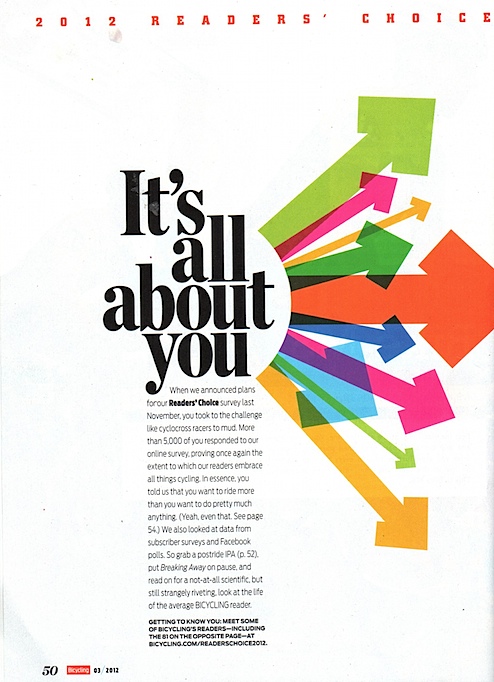
You see, I’ve been eagerly anticipating this issue of Bicycling ever since the poll came out, last November. Here, I made an impassioned plea for you to vote for me.
And now, almost three months later, we finally know the results (click here for a larger version):
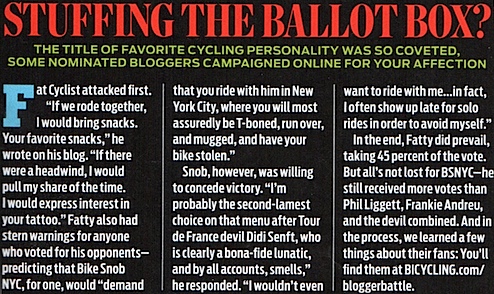
So, on one hand: Huzzah! I won! And thank you very much for voting for me.
But then, on the other hand, there’s that headline:
STUFFING THE BALLOT BOX?
Well.
Here’s how Wikipedia (The final and correct source on all human knowledge) describes ballot box stuffing:
Ballot stuffing is the illegal act of one person submitting multiple ballots during a vote in which only one ballot per person is permitted. The name originates from the earliest days of this practice in which people literally did stuff more than one ballot in a ballot box at the same time. In a government election, this is a form of electoral fraud.
It’s kinda like the headline is asking, “Hey, Fatty, how’s it going? We’re just curious — because frankly we can’t fathom how you possibly beat out Bike Snob, Bob Roll, and Phil Liggett in this vote, even after we reminded our readers that they ought to vote for someone else — have you committed fraud recently?”
Of course, there’s a question mark at the end of the headline, so that means the headline is just asking whether I committed a particularly nasty form of cheating, not insinuating I did. And the article doesn’t talk about how I must have cheated.
Which is nice.
So, Bicycling Magazine, thanks for the honor (but not quite so many thanks for inferring in huge red all-caps type that I cheated to win)!
But Wait! There’s More!
The end of the print article promises more exciting details online, where it would reveal more interesting stats.
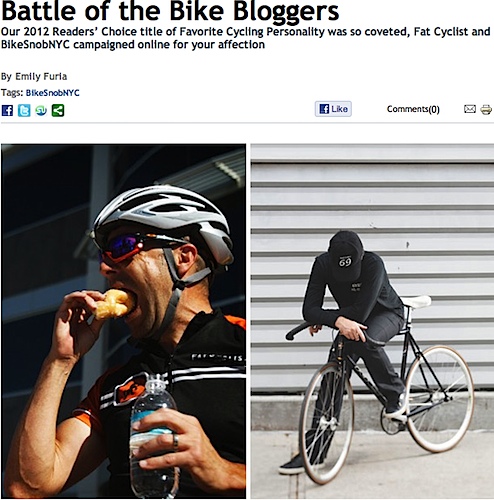
In this, it does not disappoint.
You should really read the article, but here are a few interesting tidbits about my readers from it:
- You like Levi Leipheimer: In spite of the fact that he’s always being mean to me.
- You think the worst fashion sin a cyclist can commit is wearing white shorts: Which is really too bad, because I have big plans for next year’s Team Fatty gear, which will feature shorts that are not only white, but translucent white.
- About a quarter of you are female. Which I’m going to go ahead and trumpet as the very most awesome statistic in this whole survey. Because until this point I was pretty sure there were a total of five females who checked this blog, with The Hammer and my mom being two of those people (and my mom checks only every couple of weeks or so).
However, there is one incredibly vital, crucial piece of information in this survey. One I simply could not be more proud of if I tried. And that’s the fact that enough of you — at my urging — included “Honey Stinger Waffles” as a write-in vote for what you like to eat on a ride that they got included both in the print magazine and in this little online extra.
Which, if everything goes as planned, should ensure that I will continue to be comped Honey Stinger Waffles for the rest of my life.
Not to mention helping me build a pretty darned good case for asking them to be a sponsor in this year’s 100 Miles of Nowhere.
Comments (48)
« Previous Page — « Previous Entries Next Entries » — Next Page »
