10.10.2018 | 8:39 am
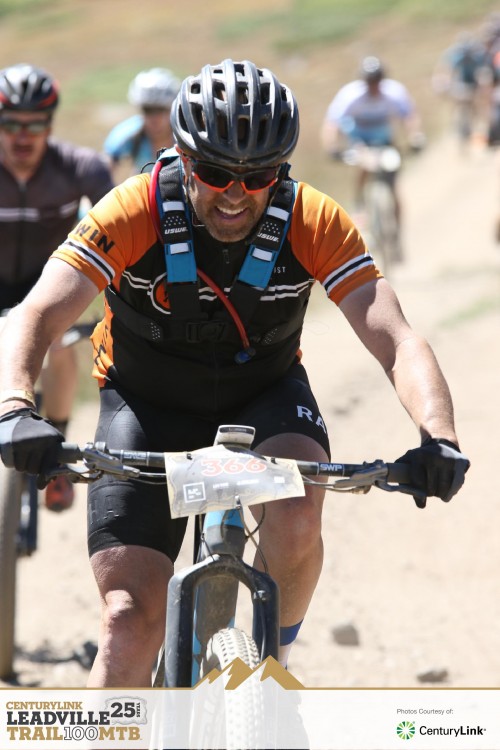
I put my entire summer into training for this endurance race. I hired a coach and followed her plan. I came out and got comfortable with the course, several times.
I researched equipment and practiced with it until I was confident in my choices. I did the same with food, getting comfortable with what I’d eat during which parts of the race, and how often.
I planned out every mile; I wrote down and memorized my course of action for every contingency.
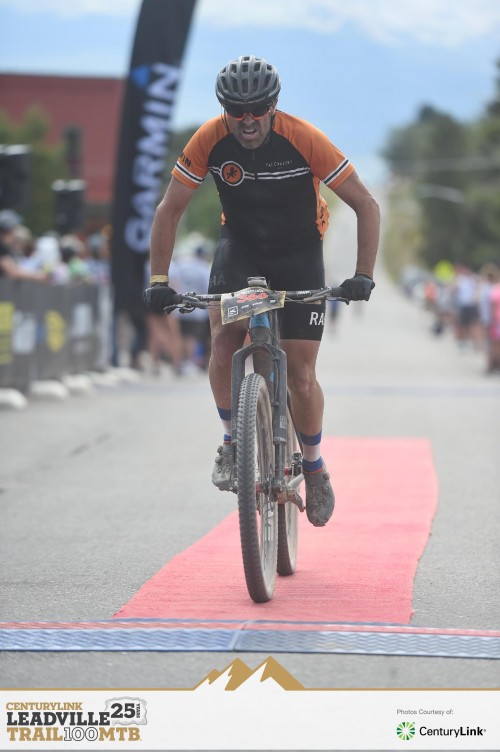
I visualized myself crossing the finish line. Oh, more than anything else, I visualized myself crossing that finish line.
And then, about forty miles into this event, I more or less jettisoned all of that nonsense I concocted before the race, because now this race is now.
Oh, I was such a fool up until this race got hard. If only I had been as wise then as I am now — specifically, now that I’m exhausted, trailing my projected split times, cramping, and generally demoralized.
I see everything so much more clearly now.
OK, if I’m going to be completely honest, I actually started having race-moment epiphanies right from the starting line. Sure, I had been told to not go hot off the starting line, but dammit I felt great. “Why shouldn’t I allow the possibility of having an exceptional day to play out?” I asked myself. “Maybe this is the day I completely shatter all expectations. Maybe today is the day I discover that I can fly forever.”
It was also during this race that I discovered that I am stronger than everyone around me, and that if my group is going to have a fast day it’s up to me to set the pace. Which meant pulling for about an hour and a half. These guys were lucky to have me, and it was a disgusting show of poor sportsmanship when they surged ahead and dropped me when I pulled around to let them take over for a bit.
Oh, there’s that stupid “Eat” chime on my GPS I arrogantly set to go off every thirty minutes. That thing is so annoying. I know when I’m hungry and when I’m not, and right now I am not. In fact, the very idea of food is utterly repellent to me right now, and has been for about two hours. My stomach feels terrible and I hate the very idea of GU right now; it completely makes me gag. I don’t know how I managed to choke it down every half hour during long training rides the whole summer.
All of that, though, is just a bunch of little examples. They’re almost beside the point.
The thing I’ve actually truly learned about myself during this race is that racing is not what I love doing. I love endurance riding, not endurance racing. When you’re out riding for hours on end, you’re self-supported, going at your own pace, with people instead of against them, enjoying the beauty of the ride and the perfection of being alone with your bike.
Endurance racing is just a vain mockery of everything that’s pure and perfect about endurance cycling.
And then there’s my crew. My family, my friends. They’ve traveled a great distance and used their precious vacation days to come see me…and I’m hardly even seeing them at all today. I’m into the aid station, grabbing something, barking instructions at these wonderful people like I’m some kind of angry ingrate, and then I leave them.
That’s messed up.
They came to see me, I should be with them.
I don’t know what I’m even doing out here. This isn’t proving anything to anyone, I’m not having fun, it isn’t the kind of riding I love to do, and I’m not with the people I love. I’m ending this race as soon as I get to the next aid station.
I understand everything so much more clearly now.
Comments (22)
09.4.2018 | 10:49 am
A Note from Fatty: Oh hi there. You know how I said I was going to start up blogging again? It turns out that it’s a tricky habit to re-establish! I have a lot of stories to tell about rides and races and other stuff, and I really will tell all these stories. I’m just not going to beat myself up when I have other stuff in my life cut in line, priority-wise. Thank you for your patience, or for your impatience. Thank you, in short, for being you.
This is my story about having a basal cell carcinoma removed from just below my right eye a couple weeks ago. I will include pictures, and they will not be pretty, for two reasons:
- I am not pretty to begin with, so there’s that.
- I show the open wound and then stitches and my black eye and stuff like that, as if I were an oversharing blogger who reveals waaaay too much about stuff that most people would have the good sense to keep private.
So that you don’t accidentally see something you don’t want to see, I’m going to push all of those images — and even the discussion of this event — down below the pre-scroll part of your browser, using this cleverly written paragraph, and a photograph of a rainbow I took from my backyard a few weeks ago.
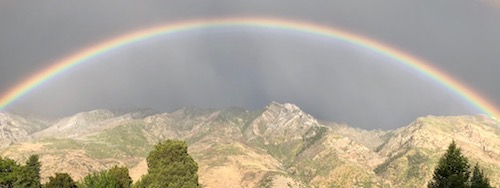
Isn’t that nice? That really is nice.
OK, let’s get on with my story.
Cancer-Lite
Technically, basal-cell carcinoma is a kind of skin cancer. In fact, it is the single most common kind of skin cancer. But here’s the thing: I hesitate to even write “I’ve had treatment for cancer,” because the seriousness of what I had and what the treatment was is like a 0.01 on a scale of 0 – 10. As in, not even really approaching the onramp of how serious cancer is.
It’s slow-growing. It’s easy to treat. I’m in no danger at all. So yeah, I wish it didn’t even have the association with cancer, because I’ve had several people give me worried looks or expressions of concern, when in fact really this is, once detected, more or less about as serious as having a mole removed. Or, in my case, what I in fact thought was a slightly weird-looking mole I asked my dermatologist about, and she told me: “No, I’d bet money that’s a basal cell carcinoma,” then she biopsied it, found out she was right, and set me up with an appointment for what is called a “Mohs Surgery.”
Surgery-Lite
Here’s the idea behind a Mohs surgery: cut out what looks like the gross thing growing on someone, then let them sit around with a loose bandage on their face while you get out a microscope or something and see if you’ve got a clean (i.e., no cancer) margin on the gross thing you’ve cut out.
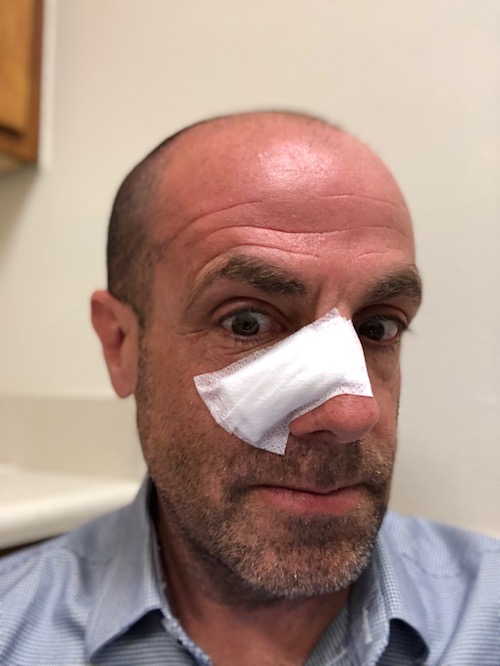
There is a real danger, by the way, that the person you’ve been cutting on will eat all the little complimentary packets of cookies you left in the patient room while you’re looking to see if you’ve got it all.
If, by chance, you haven’t got it all, you cut out some more and check again. But in my case, they got it all on the first pass. Which meant it was time to fix me up.
Head With a Hole
The surgeon could have just stitched up the little pit he had cut out of my face, but that would have left a little crater-scar right below my eye. Which would not have been a huge deal, but this surgeon subscribes to the leave-no-trace ethic, so he got out a marker and showed me his plan: cut at right angles to the pit and then sew it up tight:
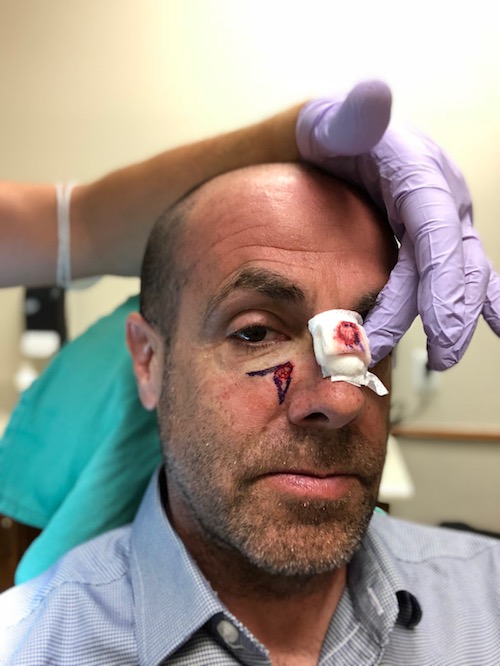
(And yes, he let me take a selfie here. I texted it to The Hammer. Her response: “Holy shit!”)
I was thoroughly numbed up for all this, but could still feel the sensation of both the cutting (which felt like how it feels when I cut steak, except on my face) and the stitching (which felt like sewing, but on my face). Weird. I focused on other things, because I didn’t really love the image my brain was serving up to itself.
There was some cauterizing mixed in there, too. The smell was…unpleasant.
Here’s how I looked afterward:
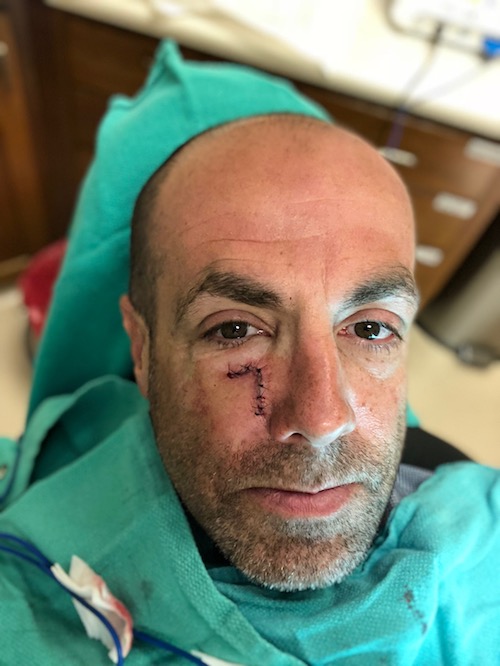
I texted this photo to The Hammer. Her response: “Holy shit!”
Then came the bandaging:
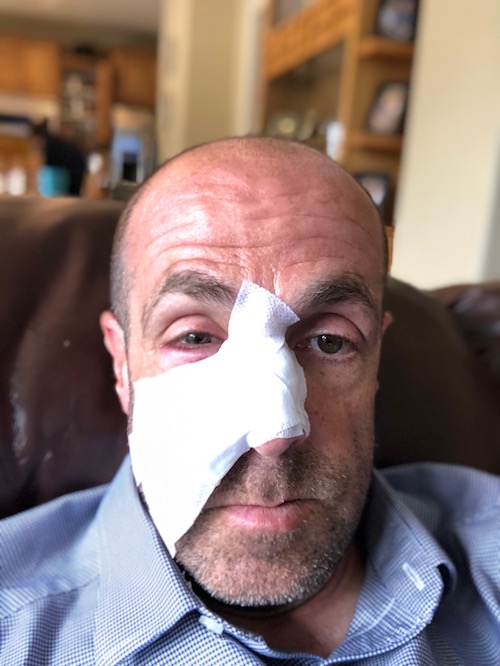
And that, to be honest, just felt ridiculous and excessive.
I’d had plans for the rest of the day (I was going to go to SLC to record a podcast with Alex Grant, but texted him some of the pictures above with the explanation, “Sorry, this turned out to be a little bigger of a thing than I expected.” He understood.)
I drove home and took a nap, then watched daytime television. It was awesome.
Day 2
I had planned to go back to work the following day, but I was simply unwilling to go into the office and show off my bandages, even after I had taken off the ginormously comical top layer:
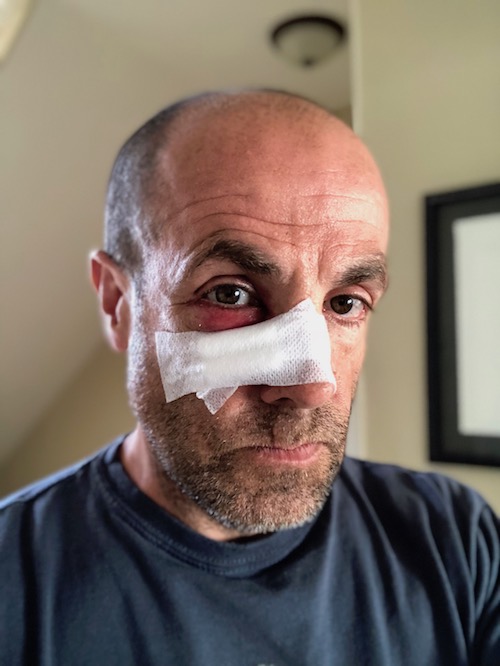
Oooh. That’s quite a shiner.
I worked from home, feeling fine, but finding excuses to go audio-only on the teleconferences I had. Not that I’m vain or anything; I just wasn’t in the mood to explain or get sympathy for something that was pretty non-sympathy-deserving.
Day 3 and Beyond
On day 3 I was allowed to take a shower, which both I and everyone around me appreciated. I also felt like it was time to cut it out with the bandages already.
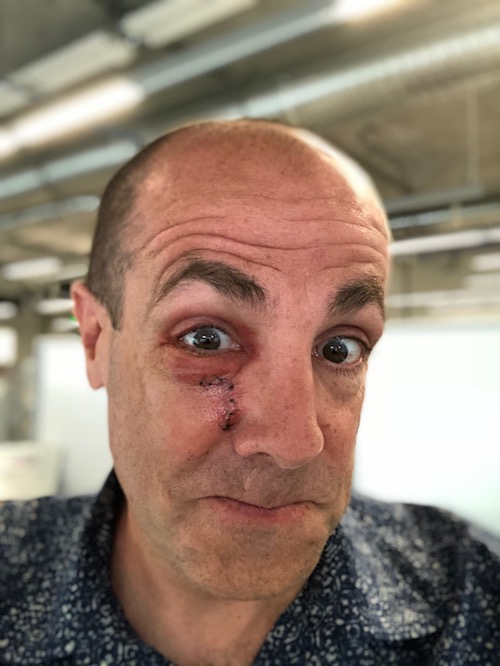
So handsome. Oh, and also that’s me in an office environment, in my office clothes. I bet you didn’t even know I have an office environment or clothes, did you?
By day 4, I had no pain at all.
But by day 5, I had a new annoyance: one of the little stitch threads had decided it wanted to stick out in just such a way that it was always in my peripheral vision. I found myself frequently swiveling my head around and down, trying to catch a glimpse of whatever it was that was not quite in view.
And Now
One week after the Mohs procedure, I got my stitches out:
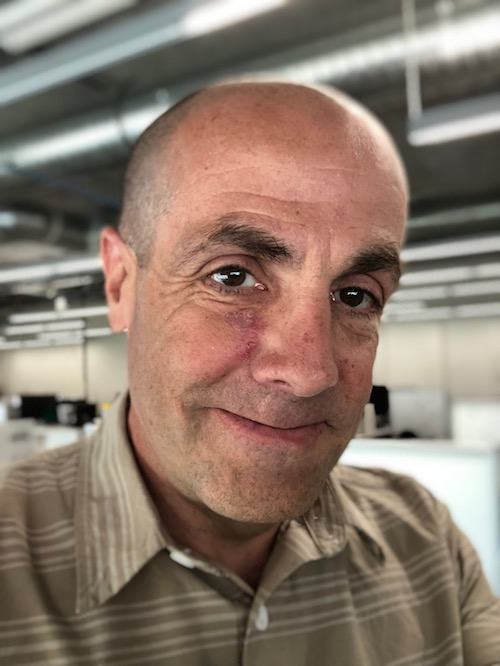
So nice to no longer be chasing that blue thread around.
It was kind of interesting when the surgeon took out the stitches. He said he was super happy with how I’ve healed; that this scar is going to more or less fade away, that I’d hardly even be able to see it. I kind of got the sense that he must normally get a lot of questions about scarring and looks and stuff. Honestly, none of that had occurred to me (see #1 way back at the top of this post).
And in short, I should probably be better about applying sunscreen.
Comments (20)
08.15.2018 | 9:02 am
A Note from Fatty: As many of you know, I love writing race reports. As many of you also know, I have lately been investing a lot of energy into learning the craft of podcasting. So, this year — as part of my Leadville 100 Podcast series, my race report is in audio format. Which means, for the first time ever, you’ll get the entire story at once.
The training, the logistics, the stress, the excitement, and the actual racing are now all behind us…at least for this year.
Now it’s time for some storytelling. Listen to episode 13 of the Leadville 100 Podcast here:



(For those of you who like my cliffhangers, I have good news for you: a VERY long multi-parter about the Breck Epic I intend to write.)
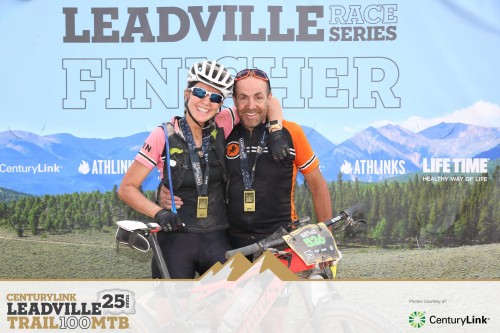
In this episode, I tell Michael Hotten a little bit about my Breck Epic experience (it matters, because it determined what bike I rode in Leadville), as well as give a full-on blow-by-blow of my 21st Leadville 100.
We do away with our normal show structure for this episode — it’s a lot more like one of our bonus episodes, with a couple of friends talking about a race both of us love.
This is the last “regular” show of the season. Hottie and I want to thank our listeners for your kind feedback, and I definitely want to thank the dozens (really!) of you who — before, during, or after the race — mentioned enjoying the show. I’m really proud of what we created, and it’s awesome to have that work acknowledged. We also want to thank Rebecca Rusch and Jonathan Lee for their generosity with their time and insight.
If you have an amazing story that would make a great bonus episode, leave a comment with with the short version of it here.
Finally, a big thank-you to our sponsors, all of which took a big gamble on an experiment, and stuck with us through every episode:
The Feed, which fueled Fatty to and through this race, including getting me through a very tough spot at a critical moment.
Shimano, which gave both Fatty and his wife an utterly flawless, no-maintenance-needed, trouble-free shifting and braking for seven straight days of mountain bike racing. XT Di2 is so good it makes Fatty mist up.
ENVE Composites, for bombproof wheels, bars, and stems. Seven days of mountain bike racing on the M525 for both Fatty and his wife, with not a single pinch flat. Perfect, confident riding for the whole week for both of them.
Banjo Brothers, for sturdy, affordable, great-looking bags that do exactly what they should. Somewhere out there, there’s a rider who DIDN’T have a Banjo Brothers seat bag whose race didn’t end because Fatty does.
Comments (11)
08.2.2018 | 5:17 am
A Note from Fatty: I know I’m not getting a lot of FatCyclist-exclusive posts up lately. Work + podcast commitments + prep for the Breck Epic / Leadville 100 race vacation has left me with little time for writing. I will have a lot of stories to tell when I come back, however, and I am looking forward to writing them!
Meanwhile, please do listen and subscribe to my podcast. Alongside this blog, it is my proudest cycling content accomplishment (and like this blog, it’s free).
New BONUS episode of the Leadville Podcast out today — a compilation of all of our segments on “The Course,” taking you from when you’re standing in the cold to powering across the finish line.
Of course (ha), twelve segments at around fifteen minutes each means this show clocks in at over three hours. Which means it’s just about right for your flight to Leadville. Or for a few hours of your long drive to Leadville. Or as you’re on your last ride of any significant length before racing in Leadville.
Guess My Time, Win a Prize
Our presenting sponsor for this episode, The Feed, is launching a contest for this episode. Be one of the 5 closest guesses to my finish time this year and win a Leadville Box from The Feed. Listen for details in the show, and go to http://bit.ly/fattyfinish to enter (you’ll be registered for The Feed newsletter, and no charge to enter).
PS: Episode 12 will come out this Monday instead of the regular Tuesday release, to give the many of you traveling this week another thing to listen to.
PPS: Michael Hotten and I are planning to record a post-race episode 13 the evening after the race — it will be a different kind of show than we usually do: just a stream-of-conciousness recounting of how the day went.
PPPS: We are considering doing a show 14 and 15 for this season as well, where we interview other folks to get their amazing race stories. Message either Hottie or me and give us the short version of your story and we’ll be in touch.
Comments (3)
07.31.2018 | 8:45 am
We’re down to the second-to-last regular episode In season 1 of The Leadville Podcast, and I’m happy to say that in my opinion this is the most useful show we’ve recorded so far.
Be sure to listen as Rebecca Rusch — The Queen of Pain — talks about the advice she gave my wife a few years ago: just four words that Lisa says changed her from a nine-something racer into a sub-nine racer:
“Pedal! Pedal! Pedal! Pedal!”
There’s (obviously) more to it than that, so don’t miss the “Questions for the Queen” segment this time. You’ll find that while it’s too late to do much about your fitness, it’s not even close to too late to have a much faster finish time than you ever thought possible.
Of course, before you RACE in Leadville, you’ve got to GET to Leadville. Once there, what are you (and more importantly, your family and crew) going to do for fun? And where are you going to eat? Michael Hotten and I have a long list of great ideas for you.
And we get to the penultimate episode of our detailed description of The Course, talking about the rocky descent down Sugarloaf, the flight down Hagerman’s Pass (on which we now have a ruling from Cole Chlouber for correct pronunciation) and then the climb up Turquoise Lake Road, which you’ll either love or…not. Hottie and I are going to have to agree to disagree on this one.
This is a packed and fun episode, with plenty of useful info for both you AND your family and friends. Enjoy!
PS: By popular request (seriously, the single most popular request we’ve received), we’ll be releasing a bonus episode that’s a compilation of all our “Course” segments this Thursday. Usually I put bonus shows up on Fridays, but you’ll need some extra time for this one. There’s a contest in this one where you can win one of 5 $50 boxes from The Feed, so don’t miss it (hint: winners will be the 5 people who guess closest to my LT100 finish time for this year. Get the jump on others by making your guess now.
PPS: A little pre-announcement here. We’ve already recorded episode 12 because I’m going to be racing Breck Epic starting this weekend and don’t expect to have time / energy to write and record a show (but we also don’t want to skip a week for this show). So i can already tell you that In that episode, we’ll be asking you to get in touch with us to tell us your amazing LT100 stories for the show. So start thinking about your story and get ready to share it!
Comments Off
« Previous Page — « Previous Entries Next Entries » — Next Page »
