A Note from Fatty:Today, I am happy to present the fourth installment of “The Fat Cyclist Explains,” the series in which I answer questions that you would have wondered about, if only those questions had occurred to you. Previous episodes of this series arehere,here, andhere, but are not required reading. In fact, they have nothing to do with the topic at hand. Honestly, I’m just linking to them to increase my page views for the day, in a desperate bid for self-validation.
And now, let’s make with the explainification, already!
Yesterday, I was surprised to receive an email I had sent myself. The fact that I was surprised shouldn’t be much of a surprise to you, considering that few people — including myself — rarely spell my first name correctly, which means that a certain eldon@eldonnelson.com is probably getting a ton of email that he probably wishes he weren’t.
Anyway, here’s the email I received.
Dear Fatty,
Like most cyclists, I have a lot of bike bottles — probably fifteen or so. The thing is, very few are by the same maker, so they’re all slightly different from each other.
Furthermore — like most cyclists — I have a few bikes, each with two bottle cages. On each bike I have a different brand of bottle cage.
As I took bottle brush in hand for my annual spring bottle cleaning yesterday, it occurred to me that it’s actually kind of amazing that all these bottles — made by various different bottle manufacturers — fit in all my bottle cages, which are all also made by completely diffferent bottle cage manufacturers!
And then I got to thinking and it occurred to me that all of these bottle cages screwed right on to all my bikes’ bottle cage mounts. Wow. I mean seriously, wow.
Until now, I had never taken the time to consider how awesome it is that all these different bottle, cage, and bike manufacturers have come up with a system where products from competing companies work so well together.
Could you explain how and why this system came to be?
Thanks for your wisdom,
Duane
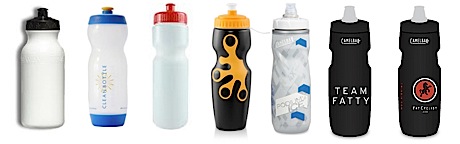
Thanks for your note, Duane. I must admit, until reading it (and shortly before that, writing it), I had never considered the beautiful way in which bikes, bottles, and bike bottle mounts work seamlessly together, regardless of which component of the whole system is purchased from which manufacturer. I mean, consider the wide variety of bottles:
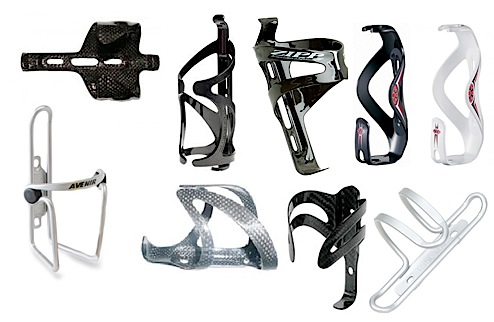
And the mind-boggling variety of cages:
It’s amazing that any of the bottles work with any of the cages. And yet, most all of the cages work with most all of the bottles. So I became fascinated with Duane’s question, and have spent hour upon hour researching it.
I am pleased to now present you with the electrifyingly educational answer to your question.
Early Days
You’ll be astounded — as I was — to learn that until 1946, it never occurred to anyone to affix a water bottle to a bike. Indeed, it wasn’t until the previous year (1945) that anyone even used a bottle to carry their beverages at all. Instead, most people rode along the rough-paved (or often, unpaved) streets while holding a tin cup full of water in one hand. Or, during the Great Depression, during which time tin cups were difficult to come by due to the fact that hobos had commandeered all tin cup supply chains, many cyclists would simply either begin their ride with a mouthful of water held in puffed cheeks, or perhaps try to ride with both hands held together in a cup shape, holding as much water as they could.
This method was, in most cases, only marginally successful.
Then, in 1945, a young lad — whose name is unfortunately lost to history — was riding a tandem biycle one day with his mother. As stoker, his job was to hold both tin cups (they were from a wealthy family and could afford a tin cup for each person therein), while his mother steered the ungainly and heavy (bicycles were made of solid core iron back in these days and could weigh upwards of 240 pounds) bicycle.
Sadly, the bicycle hit one of numerous potholes, jostling the two cups of water and spilling half of each.
Quickly, the bright young lad (the word “boy” had not yet been invented in 1945) poured the remaining contents from one cup into the other, then turned the empty cup over on top of the full cup, creating an improvisational lidded container.
Thus, in one moment inspired by need, the lad had invented water bottles for bikes, but lids in general (most people don’t know that lids did not exist before 1945).
From this prototype quickly (like, in two days) evolved the bottle industry, including screw-top lids (the impetus behind the invention for this particular device is not suitable for children to read) and bite valves (even more disturbing than screw-top lids).
And then, in 1946, Thomas Edison invented the bike bottle cage, quite by accident. Having — as a prank — built a bicycle frame out of strong magnets, his iron bike bottle (until 1982, all bike bottles were made of one metal or another) stuck fast to it. Always the opportunist, Edison shouted, “Eureka!” as if he had done this on purpose.
And the rest is history.
Innovation and Fragmentation
The years immediately following the invention of the bottle and the bottle cage were heady years indeed. Piggybacking on the post WWII prosperity, the bicycle industry — and all its attendant accessories — presented a huge opportunity for the big manufacturer and the lone inventor, alike.
It must be said that the first commercially-available bike bottles and cages were not especially convenient to use. Following the lead of Edison, Trecke Bicycle Company created a bicycle with a bottle that was formed as part of the bicycle frame itself. While this was certainly an improvement over the tin cup approach, it was not without its difficulties. Specifically, when the thirsty rider wanted to get a drink, she would need to tip the bicycle upside down in order to pour the contents out of the bike.
This was not as easy as it sounds.
Before long (approximately 24 years), inventors came up with the idea of having the bottle be detachable from the frame, so that the water container — as opposed to the entire bike — could be raised to one’s mouth and tipped back.
Once people realized the value of this innovation — having the bottle be both attachable and detachable at will — things went a little crazy, and dozens of products could suddenly be found on the market (albeit, for some, quite briefly), all utilizing to some degree the startling innovation that a bicycle could passively carry a beverage almost indefinitely.
For example, there was the Little Brown Jug Cage, a bottle cage designed to hold an earthenware corked jug, which in turn would hold up to 3/4 gallon of any desired liquid. This product was on sale for a fairly short period of time, due to the high incidence of bicycle crashes riders tended to suffer while riding with a Little Brown Jug Cage. Mistakenly, consumer advocate agencies blamed the size and awkwardness of the jug and cage for the number and frequency of these wrecks, instead of considering the contents of the jug itself.
A more popular cage size, thanks in part to its more-manageable size and in part to the ubiquity of school lunch programs, was the half-pint milk carton cage. The surge in the popularity of this cage ended quickly, however, due to non-cage-related problems. Specifically, the tendency of the milk to sour while sitting outside for the whole day. Further, there was the not-insignificant problem of trying to open a milk carton while riding a bike. We can only speculate as to how many people have suffered horrible, crippling accidents while trying to accomplish this fiendishly difficult task while simultaneously piloting their bikes.
Then, in a brilliant marketing move in 1964, the Coca Cola corporation created a bottle cage holder designed specifically to hold its signature bottle shape. Thanks to the indentation in the middle of the bottle, the specially-designed cage was able to hold the bottle more firmly.
Were it not for the fact that riding a bike with a bottle of Coca Cola was guaranteed to shake the bottle up so much that it was guaranteed to spray 40 feet into the air upon being opened, we may all still be using this bottle and cage style today.
Still, bottle and bottle cage makers everywhere took note of Coca Cola’s bottle/cage interdependency and started making bike bottles and cages that were designed to work together, as a system.
The problem was, there were too many systems.
Bottles that would appear similar at first glance would be too thick to fit in one cage, and too thin to fit in another. Cages required bike mounts that were proprietary, as well.
As one particularly egregious example, Gary Fisher created a bottle (and associated cage) that was slightly thicker and longer than any other bottle so it held three more ounces of fluid than the more-common 26-ounce bike.
This bottle — which Fisher called “The 29er” — developed a loyal following, but illustrated the fundamental (and growing) problem behind bike-mounted hydration: there were just too many systems.
Standardization and Process
There were many people who did not see this fragmentation of an industry as a problem. Indeed, some said it was good for the industry. “Let everyone make and bring to market whatever they want,” said these people. “Those products that are good will survive and gain popularity, resulting in a de-facto standard that can nevertheless continually evolve and improve with future development. In the end, market forces will ensure the availability of the best products; growing pangs are just a necessary part of that.”
Fortunately for all of us, these voices were drowned out. Instead, a much more sensible and orderly solution was arrived at. An official solution was settled upon. Indeed, so official was the solution that it was spoken of only in the passive voice.
Specifically, it was deemed necessary to create a governing body overseeing all things bicycle-related. Thus, Union Bottle Internationale (UBI) — was formed.
The objective of UBI — a small (only 98 employees) team of professionals, most of whom are retired government employees with plenty of experience with committees, memos, and regulations — was simple and clear: to institute a sensible set of standards and processes to ensure that everyone would have a uniformly excellent bike mount / cage / bottle experience.
The UBI immediately went to work, forming fourteen committees, each with overlapping (and to untrained eyes, often contradictory and / or redundant) goals. Some would later question the fact that none of these committees included actual cyclists, bicycle manufacturers, or people who had every used a bottle or bottle cage in their lifetime, but that is because some people are nincompoops and do not understand the intricate dance of regulatory bodies and how difficult it is to negotiate with other committees and take their needs into account.
Some people argued that the UBI should have maybe just asked cyclists what they’d like, document it, present that information to bottle, bike, and cage manufacturers, and then get out of the way. But those people are, as recently made clear, nincompoops.
In a relatively short period of time (seven years), UBI arrived at its first spec for mounts, bottles, and cages. The 483-page document, called The Liquid and Viscous Matter Containment Regulatory Specifications, was regarded by all members of the UBI to be very thorough and official-sounding. To make a (very) long story short, it had concluded that:
Bottles were to be glass orbs with a radius of 0.47 cubits
The glass orbs were to be stoppered with rubber bungs, or in the case of a severe rubber shortage, with cork.
The orbs were to be contained in canvas bags, woven from raw, undyed yak wool.
Each canvas bag shall contain two orbs.
The bags are to be affixed beneath the seat using a system of wire and straps
The two allowable beverages to be contained in the orbs are mineral water or whey
The reactions to this specification were mixed, ranging from confusion to extreme confusion to bafflement. Especially over the whey. And the yak wool.
Compounding this problem was the fact that during this seven year period, the bicycle bottle industry had, on its own, pretty much settled on the bike bottle / cage / mounting system you frequently see on bikes today. Which is to say, there was tacit agreement that there should be some commonality between bottle diameter, and that mounting screws should be a certain distance apart.
This kind of thinking, of course, was pure folly, and the UBI immediately went to work prohibiting this ridiculous, non-regulated, non-evaluated, and definitely non-standardized system. Indeed, they went so far as to create an “Approved by the UBI” logo, which was to be affixed to all glass orbs of the appropriate dimensions, approved yak orb bags, and approved containers of whey.
Surprisingly, most people didn’t care about whether the UBI put a logo on their bottles or not, and went about their business, continuing to use the (highly illegal) bottle cage system you often see on outlaw bikes throughout the world.
Harmony and Lawfulness Prevail
In 1987, the UBI reconvened to make revisions to the The Liquid and Viscous Matter Containment Regulatory Specifications. This (new and revised) publication is 793 pages long, and holds the Guinness World Record for being the “longest book ever written that can be condensed into a single sentence without data loss.” Specifically, the specification specifies that the existing bottle / cage / mount setup is acceptable, with two crucial caveats:
No bottle, cage, or mount can use any material or technology that did not exist or have popular acceptance before 1974.
All bottles, cages, and mounting systems must demonstrate compatibility with all existing bottles, cages, and mounts.
The first point was pretty much expected. The second, however, proved to be a difficult nut to crack. This is due to the fact that there are thousands of different bottles, cages, and mounts, which in turn leads to approximately 10,000,000,000,000,017 combinations of the three, with that number rising at an alarming rate each day.
Luckily, the UBI is up to the task.
In order to ensure that everything works with everything, the UBI now requires every bottle, cage, and bike frame manufacturer to submit samples of their product to their Testing Facility, which then rigorously tests that new product against every existing product.
[Interesting Factoid: The UBI Testing Facility is a popular tourist destination, due in part to the fact that it now covers over 40% of the landmass of France and is the world's leading employer of college graduates with Philosophy degrees.]
The UBI is justifiably proud of its Testing Facility, which — upon completion of the 48 page application — the manufacturer can expect a thumbs-up, thumbs-down, or — most frequently — a “thumb vaguely and noncommittally waggled in the air” within a few short years.
Thus, Duane, thanks to the tireless efforts of the UBI, you can purchase a bike, bottle, and bottle cage from three completely different manufacturers, confident that they will work elegantly and perfectly together.
Or, if they don’t, you can always drill a new hole in the cage to make it fit the frame, or buy different bottles, or something.
A couple years ago I was talking with one of the Twin Six guys about how much they do to help with the Team Fatty LiveStrong Challenge fundraising. “Yeah,” the Twin Six guy said (I’d specify whether it was Brent or Ryan, but I can’t tell them apart), “If our donations were treated as a salaried employee, LiveStrong would be our highest-paid employee. Including us.”
Honestly, when I first begged them to create the first Fat Cyclist jersey, I had no idea that Twin Six would wind up being such a crucial part of Team Fatty, nor that they would take the fight against cancer so seriously.
But they have. In fact, they consistently amaze me with not just their clothing line (which I believe all right-thinking people in the universe would agree is in fact awesome) but with their generosity and commitment to doing the right thing. During the few years they’ve been working with me in fact, Twin Six has been instrumental in raising more than $132,000 for LiveStrong.
So I guess I shouldn’t have been surprised when Friday afternoon I got an email from them, saying:
Next Monday, May 16th, we’re going to donate 50% of TwinSix.comtotal sales for the day to LiveStrong. Not 50% of the profits, we’re talking 50% of our gross sales. If you could help us pimp that event we’d greatly appreciate it.
Gee, fellas, I dunno. Let me think about it for a second. Hmmmm. Well, OK.
What This Means
Today — and today (Monday, May 16) only — when you buy anything at all on Twin Six’s site, half your money — not half the profits, mind you, but half the of the money you spend — will go to Team Fatty’s LiveStrong Challenge. Not just on my Fat Cyclist gear (what little there is left of it), but on everything in the site.
For those of you who like examples, here’s one: suppose you buy $100 worth of t-shirts and jerseys. Twin Six will donate $50 of that. Wow.
So, if I may be so bold, may I recommend you spend your money today, as if there were no tomorrow.
And I’d like to present a few suggestions of some Twin Six gear I highly recommend, as well as one very sneaky tactic you might want to consider for your future Twin Six purchases.
When Twin Six said that everything on the site is fair game for the 50%-to-LiveStrong day today, they really meant everything.
That includes the T6 Gift Certificate, which you can purchase for any amount between $10 and $500.
And this gift certificate has a lot of uses, some of which may not have occurred to you (or to the Twin Six guys, for that matter):
If you like the T-Shirt of the Month Program: If you get on the Twin Six email list, you’ll get a monthly notification of their limited-run t-shirt of the month. Why not buy yourself a big enough gift certificate that you can get the t-shirt of the month every month for a year?
Do Your Christmas Shopping now. If you plan — as I do — to do most of your Christmas shopping on TwinSix.com, why not go ahead and buy Gift Certificates you can use later in the year when it’s time to buy those presents? As a bonus, your future self will thank your present self for doing some of that Christmas spending when you weren’t strapped with all those other end-of-year expenses.
If you can’t find what you like right now: Suppose you like Twin Six in general, but can’t find what you want in the size you want today. Well, just buy a gift certificate and then use it when you do stumble across the most awesome jersey, ever, on their site.
If you plan to buy a 2012 Fat Cyclist jersey: Each year Twin Six and I come up with a limited-edition Fat Cyclist jersey (and shorts and socks and bottles and a few other things). And we only make so many (that’s what the “limited edition” means. In a few months, you’ll have a chance to buy the 2012 version. But if you buy a gift certificate for yourself now (hey, nothing wrong with buying yourself a gift) and then use that gift certificate when the jersey pre-order begins, you ensure that half of your Fat Cyclist gear purchase — in addition to the LiveStrong donation Twin Six makes already for jersey purchases — will go to the fight against cancer. It’s legal double-dipping! [Update: We haven't settled on every item we're going to make this year, but it's a good bet that there'll be a jersey ($75), bib shorts ($95), socks ($12), a long-sleeve jersey ($95), and a few things we haven't decided on yet. Choose your gift certificate amount accordingly.]
Have I made my point on the clever uses of T6 Gift Certificates? I thought so.
Riding Stuff
You know, for the next little while I’m going to be just showing off examples of things I plan to buy as soon as this post goes live. And my tastes may not be your tastes, so you might just want to go and spend some time finding what you like over at TwinSix.com, comfortable in the knowledge that you’ll find things you like, and that no matter what you buy, half your money is going toward the fight against cancer.
That said, I personally believe I have pretty awesome taste, so here are a few of the riding-type items I love (and plan to buy) over at Twin Six, right now.
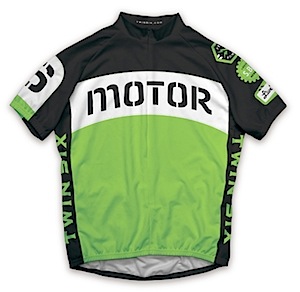
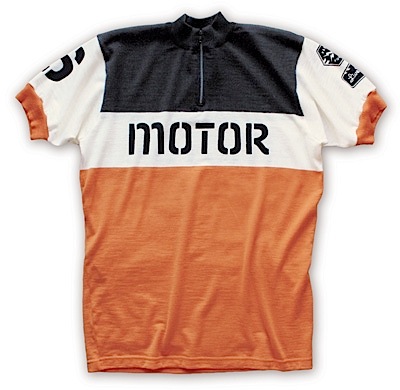
The Wool Motor: OK, I should come clean about this one right away: I already own this jersey, and I love it. It’s ultra-comfortable, the wool is light, and the design is classic and beautiful. Plus, I gotta say I’m a fan of the orange, black and white color scheme. It goes with a lot of my stuff.
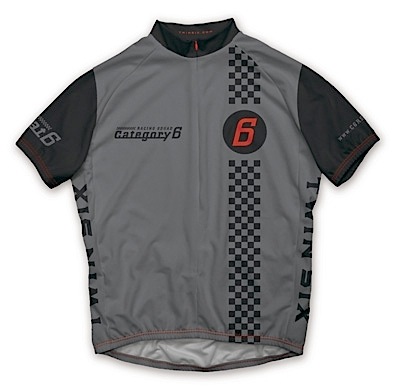
The Cat 6: For one thing, grey and black look very stealth, and the splash of red (along with the much bigger splash of red on the back) gives it just a touch of attitude. For another thing, it’s a classy-looking jersey. For a third thing, it’s a great inside joke for those in the know. For a fourth thing, you can complete the kit with bibs, socks, and a cyclist’s cap.
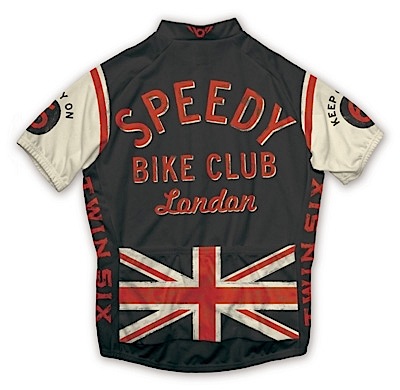
The Speedy London:I like the way this jersey looks from the front, but I love the way it looks from the back. And hey, you may as well get the matching socks.
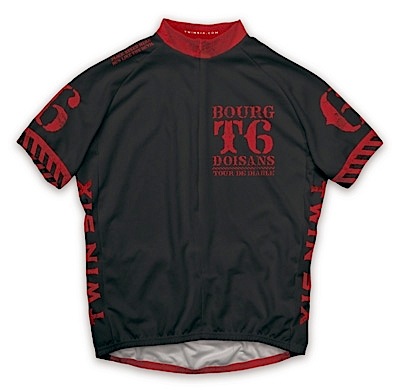
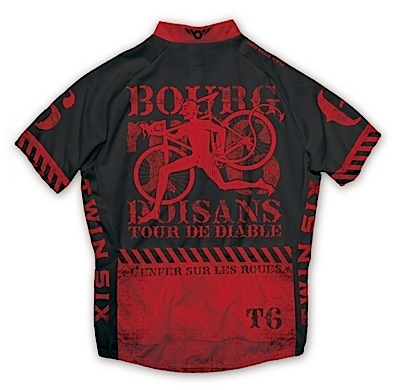
The Cross:This is another one of the jerseys that I have a hard time telling whether I like the front or back better. And honestly, for this one, I think I’m gonna have to show both. So here’s the back:
It’s just a beautiful, distressed-looking jersey that happens to have a little bit of history tied to it. Everyone should have one of these.
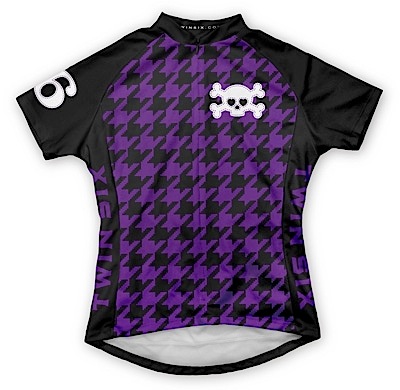
The School Girl: I’m definitely getting The Runner one of these. I just am, that’s all.
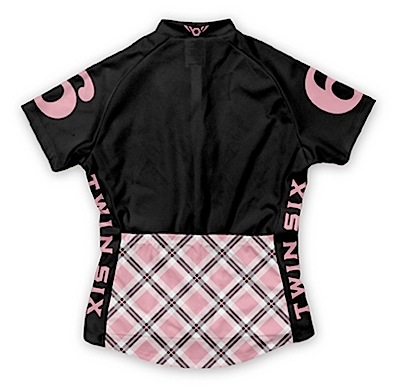
The Betty: Another one for the girls. I’m pretty sure it looks awesome.
Cotton Stuff
Twin Six isn’t just about on-bike clothing. Nosirree. They’ve also got an incredible selection of cotton awesomeness (mens and womens), making it entirely possible to be wearing Twin Six apparel every moment of your waking life.
Which I highly recommend.
Here are a few of the T-shirts I recommend you check out. And by “check out,” I of course mean “purchase.”
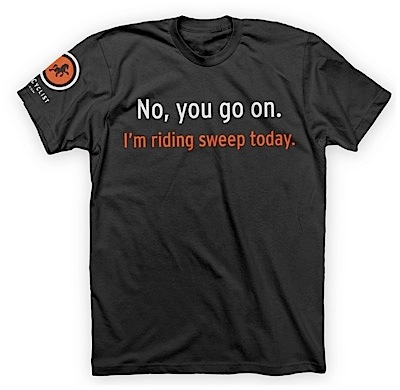
Riding Sweep: My favorite Fat Cyclist jersey ever. It’s funny because it’s true.
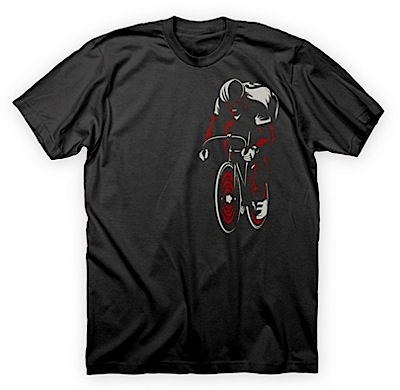
Speed Demon : It’s how we all feel, and what we all wish we looked like. Alas.
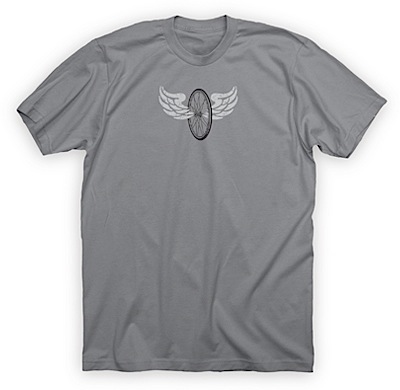
Fly: Tells the world what it feels like to ride better than words ever could.
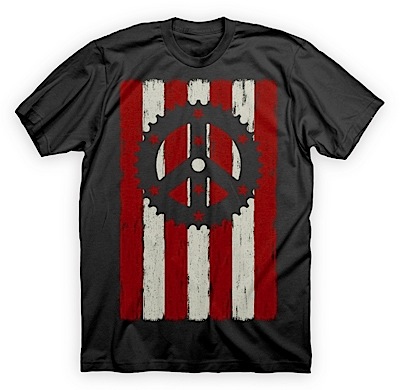
Peace:I don’t think I could say this better than the catalog copy, and besides it’s so darn easy to just copy and paste once in a while: “No matter what issues you fight for, or flag you stand behind, bring a little peace to your part of the world with a two wheeled timeout, every day.”
Dark Stuff
In a poorly-illuminated, out-of-the-way corner of Twin Six sits the “Dark” section, where black is both the new and old black. I’m only telling you about this part of the site because I trust you won’t tell anyone else.
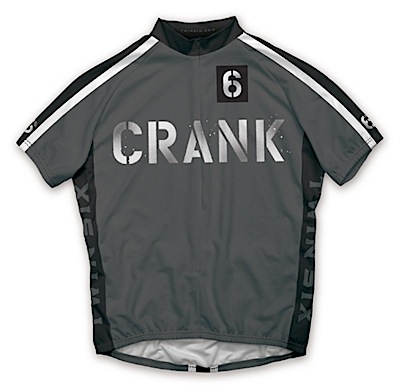
The Crank (Dark) : Is it a description of who you are or what you do? In my case, it’s both.
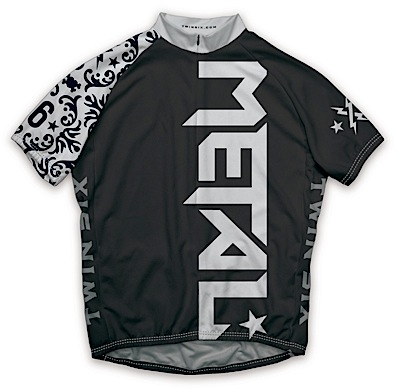
The Metal : Simultaneously understated and overstated. People will be mesmerized when they look at the back of your jersey. Also available in women’s style, as well as long sleeve (both mens and womens) and as a jacket. And arm warmers. And socks. And bibshorts: both men’s and women’s. Clearly, Twin Six is committed to this whole “metal” thing.
The Objective
Twin Six says they’d like to be able to donate $10,000 as a result of today’s event. Personally, I think that’s shooting a little low. I think $15,000 is a more likely number, which means $30,000 worth of sales in a single day.
To do this, it’s going to take more than just those of you who normally visit this site. You’re going to need to tell your cycling friends. And non-cycling friends. So Facebook it. Email it. Tweet it (Use the below button to make the tweeting easy:)
And more than anything else, spend some money at Twin Six. Show ‘em you love their stuff, and appreciate what they’re doing in the fight against cancer.
It’s a little-known fact that on Fridays, nobody reads this blog. Nobody. At all.
For a while, I used to write something on Fridays, thinking that people might read it on Saturday, and then I realized that nobody reads this blog on Saturday, either.
Seriously. You are in fact the first and only person who is or will be reading this blog entry.
Which is lucky for you, because I have some interesting tidbits of information, as well as a considerably more-interesting tidbit of non-information, for you and you alone.
Tidbit the First: Size Doesn’t Matter After All
On Wednesday, I reminded you that if I don’t get down to my racing weight (158 pounds) by June 3, I’m giving away my still-boxed Superfly 100, along with the (still not-used) Bontrager XXX wheels I bought for this bike.
That’s of course an intriguing possibility for those of you who also would ride a bike with a 17.5″ frame, but for those of you who might need a different size, this contest might seem a little less interesting.
Well.
Yesterday I talked with my good friend Travis Ott, and told him about this little problem — i.e., I felt like I was unfairly limiting the people who might want to enter the contest to a certain height.
“Is the bike really still in the box?” Travis asked.
“Yep,” I answered.
“You are a sick puppy,” he replied, having never before witnessed such strange behavior — i.e., buying a dream mountain bike and then letting it set unopened and unused for several months.
“Yep,” I answered, even though Travis had not asked a question.
“OK,” he agreed, “If you lose the contest and have to give up the bike and the winner needs a different size, I’ll trade out for a different size.
So there you go. If what’s been holding you back from this contest is the fact that a 17.5″ Superfly 100 would be too small — or too large — a frame for you, that’s no longer a problem.
Tidbit the Second: You Might Want to Check This Blog Early on Monday
The reason I didn’t post yesterday was because the post I wanted to write started growing and growing and growing. I fell in love with the story I was telling and decided that instead of cutting it short or posting it in two parts, I’d just finish writing it during the weekend and post the whole thing on Monday.
Then, yesterday late afternoon, I got an email that made me — once again — change my plans. Based on the email I received, I have decided to push the post I started yesterday and will finish during the weekend to Tuesday, because I now have a time-sensitive post I need to put up first thing Monday morning.
And by first thing Monday morning, I mean that for real. I’m going to set the auto-post thingy on my blog so that it will publish at 12:01am PT on Monday, at which point I believe it is fair to say that it is truly Monday morning, everywhere in the US.
In case you’re wondering, no, it’s not earth-shattering news about the world of pro (or amateur) cycling. It’s just something really cool and I recommend you read it fairly early in the day on Monday.
Tidbit the Third: Yann and the Awesome Sycip
One thing I have always been irrationally excited about is the amazing fact that when I do bike contests to raise money for the fight against cancer, the winners are (almost) always incredibly excited to have an awesome and beautiful dream bike (and it doesn’t hurt that showing this excitement encourages the companies who have given up their product to support these contests).
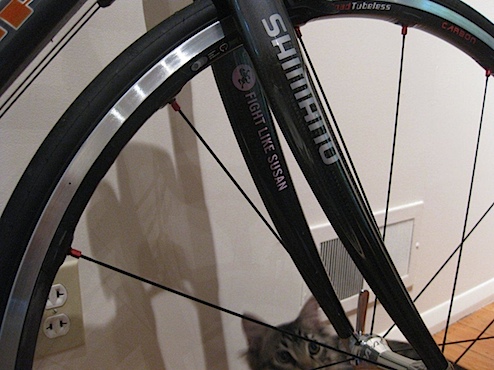
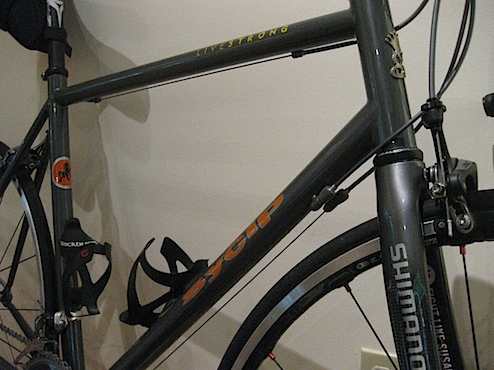
Yann, an outrageously good guy, is the latest to be in love with the bike he won: a hand-made bike from Sycip, outfitted with top-notch components from Shimano.
Here’s Yann with his one-of-a-kind beauty:
And it’s definitely worth checking out some of the detail work Sycip did, like the dropout:
And the fork:
And the headtube and downtube:
Nice. Very nice indeed.
In fact, it kinda makes me get all excited to do another bike contest soon.
PS: No, Monday’s post will not be me launching a new bike contest. I just am getting excited to do one soon, that’s all.
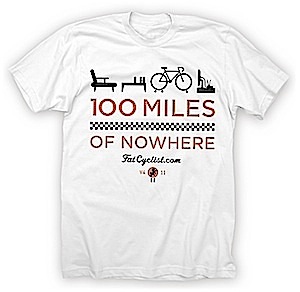
A Note from Fatty About Registering for the 100 Miles of Nowhere, World Bicycle Relief Edition: You have until 6:00pm (ET) today to register for the 100 Miles of Nowhere, the proceeds of which will go to World Bicycle Relief.Check yesterday’s post for details.
Consider this: your registration buys just about half a bike, and that bike changes a life in a big way. And if, by chance, you register forboththe LiveStrong and the WBR versions of the event, well, you get doubleplus good karma. Or your money back.
An Open Appeal to Someone With a Really Expensive Camera
I love super-duper slow-motion videos of everyday stuff. Like seeing someone get slapped in the face:
Or seeing someone get a soccer ball in the face:
Or seeing someone getting a water balloon in the face:
OK, it’s possible, I suppose, that I have chosen three needlessly violent examples here. To level things out a bit, here’s proof that non-evil things are at least moderately awesome in slow motion:
Did you know that spaghetti always breaks into multiple pieces when it snaps? Because I did not know that.
Oh, and water drops and fire and bubbles and other stuff are all fun to watch in slow motion, too.
But there’s something missing from the world of slow motion video. And I’ll bet you can guess what it is, what with the nature of this blog and stuff.
Bikes and Slow-Mo
I don’t know why — I suspect communists, but that may just be because of all the “duck and cover” exercises I did as an elementary school student — but there seems to be a serious lack of super slow-motion video of bikes on the Internet.
And that’s a crying shame.
I think you’ll join with me in wishing you could see, right this second, some or all of the following:
Road sprint: In a bunch sprint at the end of a road stage, sprinters are applying huge forces to their bikes and selves. What do the handlebars look like as the sprinters wrench on them with all their might? How about the frames? How about the sprinters’ legs and arms? I imagine that — even with claims of 70% more rigid frames every single year – that there’d be some pretty impressive wobble in the frames. Oh, and lots of slow motion spit, too.
Carbon MTB flex: As I rattled down Hog Hollow — a rocky doubletrack — on my FattyFly yesterday, I wondered to myself: what was going on with my bike? With every rock I hit, what was going on with the wheel? Were the spokes flexing? How about the rims? How much were the tires compressing? Since my frame and fork (and seatpost and handlebars) are carbon — which is really just a fancy plastic — would slow-mo reveal they ripple like jello as I took hit after hit? I would love to know.
Fatty Flex: Oh, I guess I might as well admit that I’d be interested to see precisely how much my arms (and, alas, stomach) jiggle would be evident as I descended a rocky trail.
MTB Suspension: What does the suspendy part of a suspension fork look like as you fly down a washboard road? How does it look when you land and bottom out after a big drop?
MTB Wheel Taco: I once saw a guy drop down a steep gully, with the intent of riding up the other side. Unfortunately for him, when he reached the uphill part he had too much momentum too far forward and his front wheel crumpled. Unfortunately for those of us watching, it happened too fast for us to see aforementioned crumpling. I would love to see, in super slow-motion, the way the tire blew off the rim and then the whole front wheel just imploded. In fact, I’ll bet the guy who crashed would attempt to replicate the crash if he were told it would be filmed at 4000 frames per second..
Mountain bike crash: I don’t just want to see what happens to a bike when there’s a crash. I want to see it all. What does a roadie look like when he hits the deck? I’m pretty sure there’s a helmet bounce, but what does it look like really? How high do you bounce? How far do you slide? And what does it look like, frame by frame, as your legs, chest and arms get cheese-grated by a gravel road? OK, on second thought, maybe I don’t want to see this one.
Helmet crush: I’ve destroyed three helmets during my cycling career (should I put “career” in quotes there? Probably.), which means helmets have saved me from serious injury three times. That’s pretty impressive. I’d love to see what the helmet looks like as it absorbs the energy that otherwise would have gone to your skull. (Fine, you can use a crash test dummy for this one).
The Problem, and The Solution
The only reason I don’t go out with my high-speed camera and start recording all these things (I’m pretty sure I could get volunteer riders for me to film) is that high-speed video gear is kinda expensive.
Thousands and thousands of dollars worth of expensive, from what I understand.
Plus, those cameras aren’t exactly point and shoot. You’ve actually got to know how to use them. Which would be a problem for me.
So, here’s what I’m thinking. Someone who reads this probably has access to — and maybe even knows how to use — these special high-speed cameras. Or if you don’t have access to the cameras, maybe you know a guy. Who knows a guy. Whatever.
The point is, there are people out there with high-speed cameras, and at least some of you have got to be sick of filming while your friend pops yet another water balloon. Email me. I’ll get my friends together. We’ll make awesome videos.
Cuz really, I just have to know what a fully-rigid carbon MTB frame looks like when it’s bombing down a rocky field.
PS: For those of you wondering whether I’m on track to keeping (or giving away) my still-boxed Superfly 100, I am now posting my weight every day at the bottom of the sidebar on this site. Since I’ve lost less than a pound in the first three days, I’d say I need to step up my efforts somehow. Which means that maybe if you’ve been on the fence about donating, perhaps your chances aren’t so bad after all. And don’t feel bad about betting against me. Hey, if I don’t lose the weight, I’m going to give the bike to somebody. It may as well be you, right?
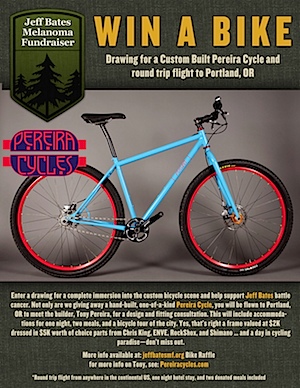
A “Help a Cyclist in His Fight Against Cancer, Win a Trip and an Incredible Bike” Note from Fatty:Jeff Bates has worked for 20+ years in the bicycle industry. He’s fighting melanoma, and needs some support.
Bates’ friends have stepped up in a big way, organizing one of the most awesome bike giveaway contests I’ve ever seen. Specifically, by donating $10, you get a chance at a fully-custom,handbuilt Pereira singlespeed bike, decked out with an incredible set of components: Enve, Chris Ching, Shimano, and Rock Shox.
All told, this bike would retail for $7200 or so.
But that’s not even the whole prize.
Because in addition to getting the bike, the winner will be flown to Portland to be fitted for the bike (and for a bike tour of the city).
I mean, I thought I put on great bike contests, but this one is off the charts.
Saturday, I meant to go on a long ride. You know, something to start reminding myself that I am a cyclist, as opposed to someone who enjoys looking at bikes and reading about cyclists on the Internet.
But when I woke up, I saw there was five inches of new snow on the ground. And I was still achy and sore from the previous day’s effort. So I made an executive decision.
“It’s a rest day,” I decided. And, when asked by others why I wasn’t out riding, I elaborated: “I’m listening to my body.”
I suddenly realized how incredibly smart this extremely valid-sounding reason for not getting out on a ride made me sound. Like I’m supernaturally in-tune with my capabilities and limitations. Like I’m cleverly avoiding an over-use injury, or perhaps am (just barely!) dodging the Chronic Fatigue bullet.
In short, my body told me not to go out on a ride on a day when it — coincidentally — was cold and wet outside, and I heeded my body’s sage advice.
What’s really amazing, though, is that since then I have found my body speaking more clearly and loudly to me since then.
For example, I made Chicken and Tortilla Soup (I’m really close on finishing my own recipe for this and will post it when my confidence is absolute) in the crockpot last Saturday (during the time when I would have otherwise been on a long ride). I felt good about this, because I was cooking something really healthy.
Then, when it was time to serve, it occurred to me: this soup would be so much more delicious if it had a big dollop of sour cream in it. And a handful of cheese. And a fistful (which is like a handful, but more fist-shaped) of crumbled tortilla chips. And half an avocado.
“Wow,” I thought, “That’s a lot of extra fat.”
But you know, I didn’t just want to add all those things. I really really wanted them. Like, my mouth was watering and everything.
And then I realized: my body was trying to tell me that I’ve been starving it of the calories and fat it needs, and that I should listen to my body.
Which I did.
In fact, I’m pleased to say that I had two helpings. And then I made strawberry-and-Oreo milkshakes for the family, because I figured that if my body wanted fat, who am I to deny it?
The following morning, when the alarm woke me, I was groggy and gassy. I staggered to an upright position, but it was clear — from the way I kept nodding off while trying to put on my bike shorts — that I was still sleepy.
“My body’s trying to tell me I need more sleep,” I mumbled. Clearly, I needed to go back to bed. Which I did.
I swear, it’s almost like my body’s been calling me on the phone for months and months, and now that I’ve finally picked up the phone, it’s telling me all sorts of interesting and helpful things.
Unfortunately, my body doesn’t seem to realize that the things it’s been telling me have been causing me to fail utterly in my quest to get to racing shape and weight for this summer.
More to the point, as of this morning, I weight 170.4 pounds. Which is 12 pounds more than what I need to weigh before I can build up my SuperFly 100.
So, I’m afraid I’m going to have to stop listening to my body. I think I’m also going to have to do something a little more extreme than say, “I can’t build up my SuperFly 100 ’til I get to 158 pounds.” Because the fact is, the 100 Miles of Nowhere is coming up fast (i.e., June 4), and I’ve got a 13,000-foot day of climbing ahead of me.
Then, one week later, I’ve got The Rockwell Relay, and I’m not very excited about the prospect of being the slow guy on my team.
So, tomorrow I’m going to announce a new contest. One which, I believe, will get me to my new weight.
And my body will just have to get used to me not listening to it anymore.


 A Note from Fatty About Registering for the 100 Miles of Nowhere, World Bicycle Relief Edition: You have until 6:00pm (ET) today to register for the 100 Miles of Nowhere, the proceeds of which will go to World Bicycle Relief.